













Buddha Preaching

The holy site at Gaya (now Bodhgaya), where Sakyamuni’s Enlightenment took place, was later enclosed by a railing; parts of it from the Sunga
dynasty still exist. The great temple, replacing a structure erected by Asoka,
was admired by the Chinese pilgrim Hsiian-tsang as early as A. D. 635; its
tower rises to nearly 200 feet (fig. 13). The temple has been much restored
over the centuries. An altar-like platform next to it, in the shadow of an old
pipal tree, is said to be the Buddha’s seat; the tree is believed to be the original
Tree of Wisdom, or at least its direct descendant.
From Gaya, the Buddha journeyed to the Deer Park near Varanasi (Benares), the site of the modern Sarnath, where he joined the five hermits
who had shared his previous penances. To these five ascetics, the Buddha
preached his first sermon, the “Sermon of the Turning of the Wheel of the
Law.” This contains the “Four Noble Truths” and the “Noble Eightfold
Path” which are accepted as basic dogma by all Buddhist sects. He defined the
Noble Truths as: Sorrow (birth, age, disease, death, etc.); the Causes of Sorrow (desire leads to rebirth which brings passion, etc.); the Suppression of Sorrow
(the complete suppression of that desire so that no passion remains, etc.); and
the Way to the Suppression of Sorrow (i.e. the Noble Eightfold Path). The
latter consists of Right Views, Right Resolve, Right Speech, Right Conduct,
Right Livelihood, Right Effort, Right Recollection and Right Meditation.
The five ascetics were convinced by the new doctrine, gave up their austerities
and once more became the Buddha’s disciples. On this holy site monasteries,
shrines and stupas were erected; one of the latter still stands.
Painting of the first sermon

Painting of the first sermon
depicted at Wat Chedi Liem in Thailand.
Image source: en.wikipedia.org
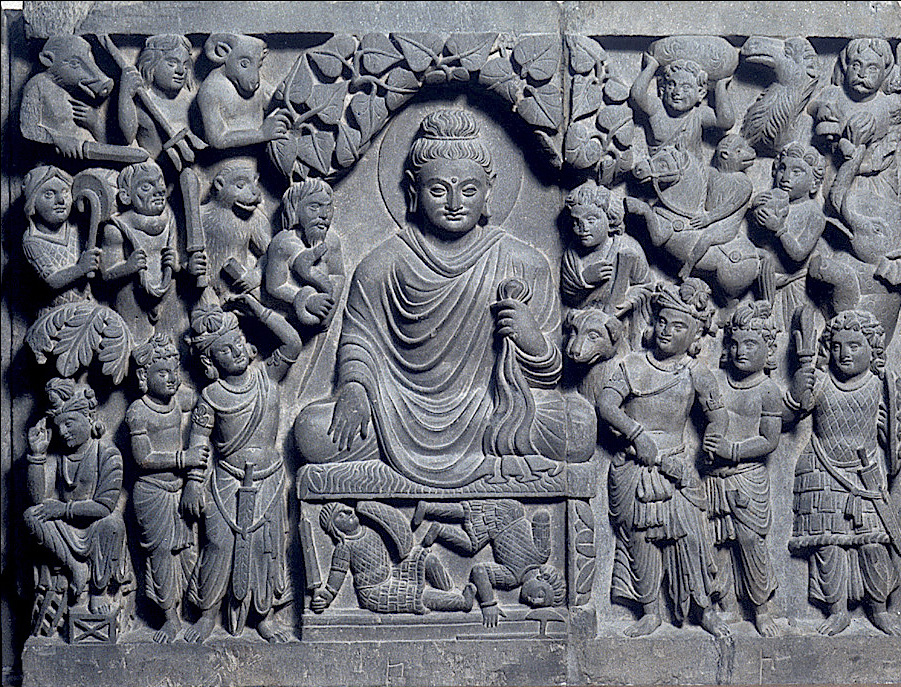
Buddha's First Sermon

Buddha's First Sermon at Sarnath,
Kushan Period, ca. 3rd century Pakistan (ancient region of Gandhara).
Image source: www.arthistoryclub.com
Painting of the first sermon
Painting of the first sermon
depicted at Wat Chedi Liem in Thailand.
Image source: en.wikipedia.org
Buddha's First Sermon

Buddha's First Sermon at Sarnath,
painted clay, Shorchuk, Kirin Cave, probably 8th century AD
Image source: commons.wikimedia.org
Buddha's First Sermon at Sarnath
Buddha's First Sermon at Sarnath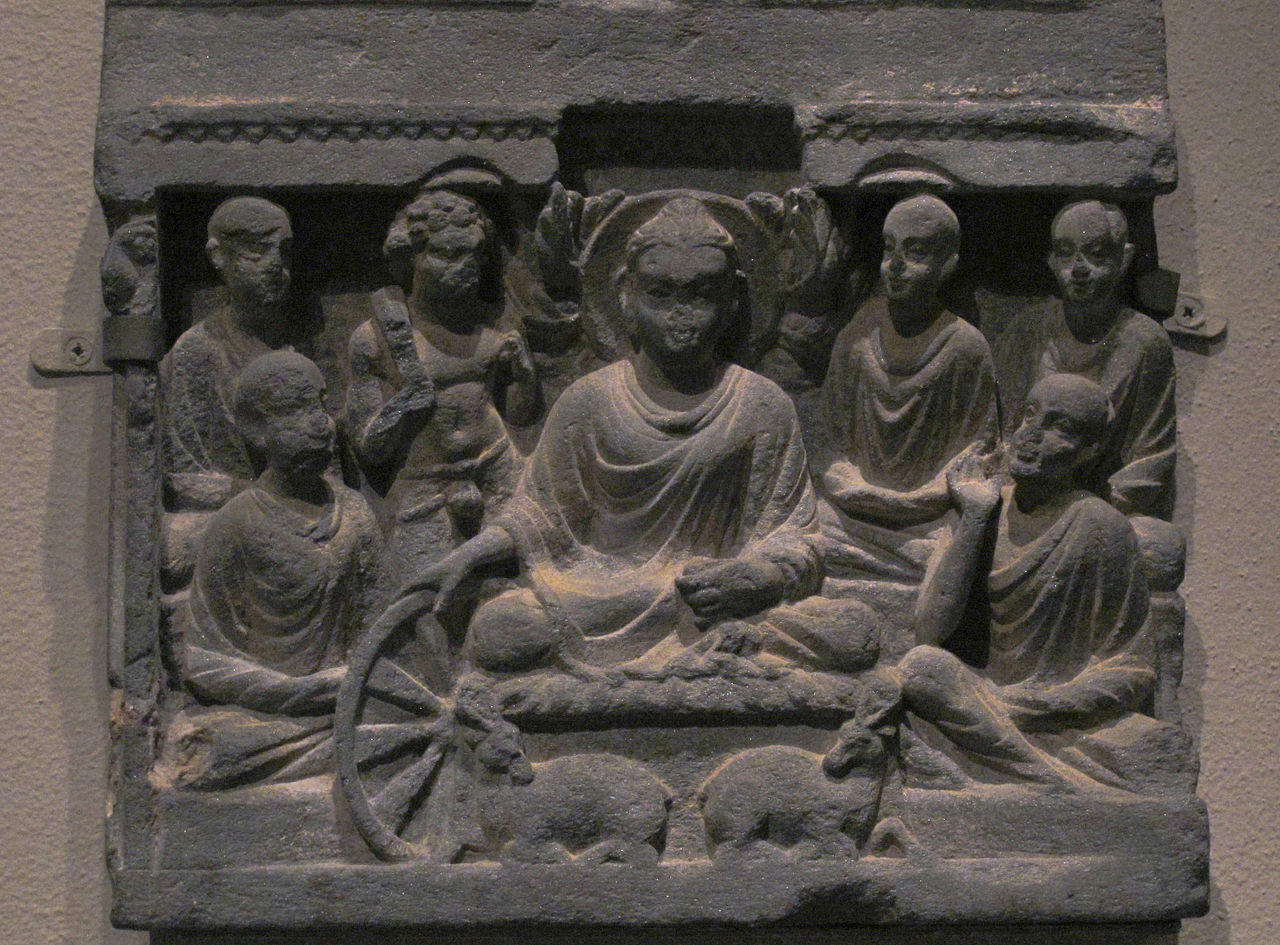
Buddha's First Sermon at Sarnath Pakistan (ancient region of Gandhara), 2nd century. Gray schist, H. 11 1/4 in.; W. 12 3/4 in. Metropolitan Museum of Art.
The Buddha is shown teaching the first sermon to five ascetics who become monks; in this way, he establishes the monastic order. The Buddha reaches down to set in motion the wheel of the law—a well-established symbol of Buddhist teaching, or dharma. To the Buddha's upper right stands the protective deity Vajrapani holding a vajra (thunderbolt).
Image source: commons.wikimedia.org
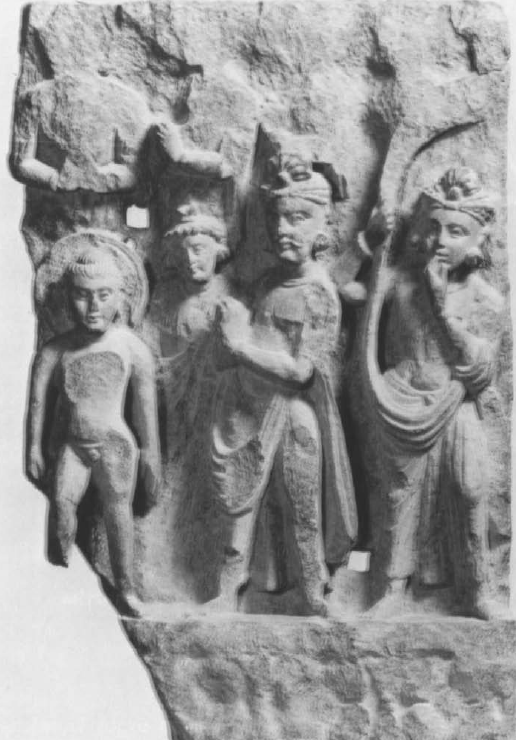
The Buddha’s First Sermon (Scalpture)
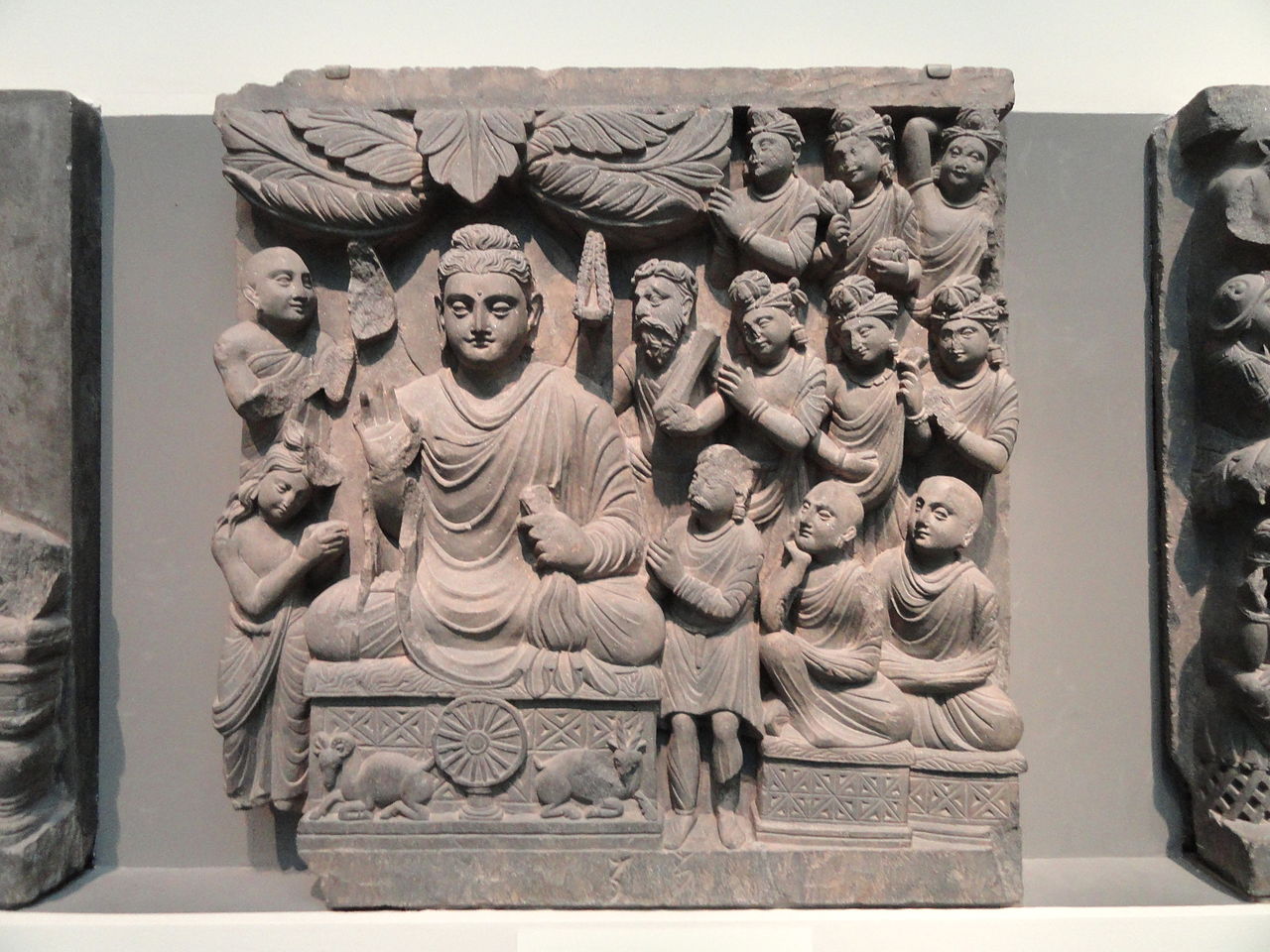
The Buddha’s First Sermon in Sarnath (Scalpture)
Gandhara (Pakistan); Kushan dynasty. Late 2nd to early 3rd century AD
COLLECTION OF FREER GALLERY OF ART, WASHINGTON, D,C.
Image source: commons.wikimedia.org archive.org "The Freer Indian sculptures" Plate 14
The Buddha’s First Sermon and Teaching Buddhas (Scalpture)

The Buddha’s First Sermon and Teaching Buddhas (Scalpture)
Ellora; Chalukya dynasty. seventh century
Gautama as well as the neighbouring Seven Buddhas of the Past are in the
attitude of teaching.
Image source: archive.org "The Freer Indian sculptures" Plate 15
In the Freer relief above (fig. 14) the Buddha is seated on a dais covered with
grass and leaves beneath a tree from which two garlands are hanging. His left
hand once more holds the end of his mantle; the right is raised in a gesture
of assurance, granting the absence of fear (abhaya-mudra). Generally in this
scene — and especially at a more developed stage of Buddhist iconography — the Buddha is shown in the attitude of teaching, of turning the Wheel of the
Law (dharmachakra-mudra).
In front of the Buddha’s seat, we see the Wheel of the Law, indicating the
First Sermon; it is flanked by two reclining deer (antelope and ibex), which
symbolize the Deer Park. This configuration became a standard element of
the First Sermon motif. This configuration became a standard element of
the First Sermon motif. We recognize it in Ellora Cave XII (fig. 15).
At the right of the Freer relief (fig. 14), on two lower seats, two monks with shaved
heads are seated, listening intently; a third is standing on the left. The monks
represent the five ascetics mentioned above; the two missing ones may have
been lost with a part of the relief. Two standing worshippers flank the throne:
on the left, a youthful brahman seems to receive a blessing; on the right, a
typical Kushan in short tunic and trousers, with thick moustache and short
curly hair, probably is an honored donor. Six devas, turbaned and jewelled,
are shown in the background on the right; one of them is offering flowers.
More gods or demi-gods may have been carved on the other side of the
Buddha. The bearded figure holding a thunderbolt (vajra) behind the
Buddha’s left shoulder is once more his guardian Vajrapani.
Scene of the Buddha Preaching

Scene of the Buddha Preaching (Illustration)
Kizil, Cave of the Painters (after Grünwedel)
Scenes of the Buddha Preaching

Scenes of the Buddha Preaching
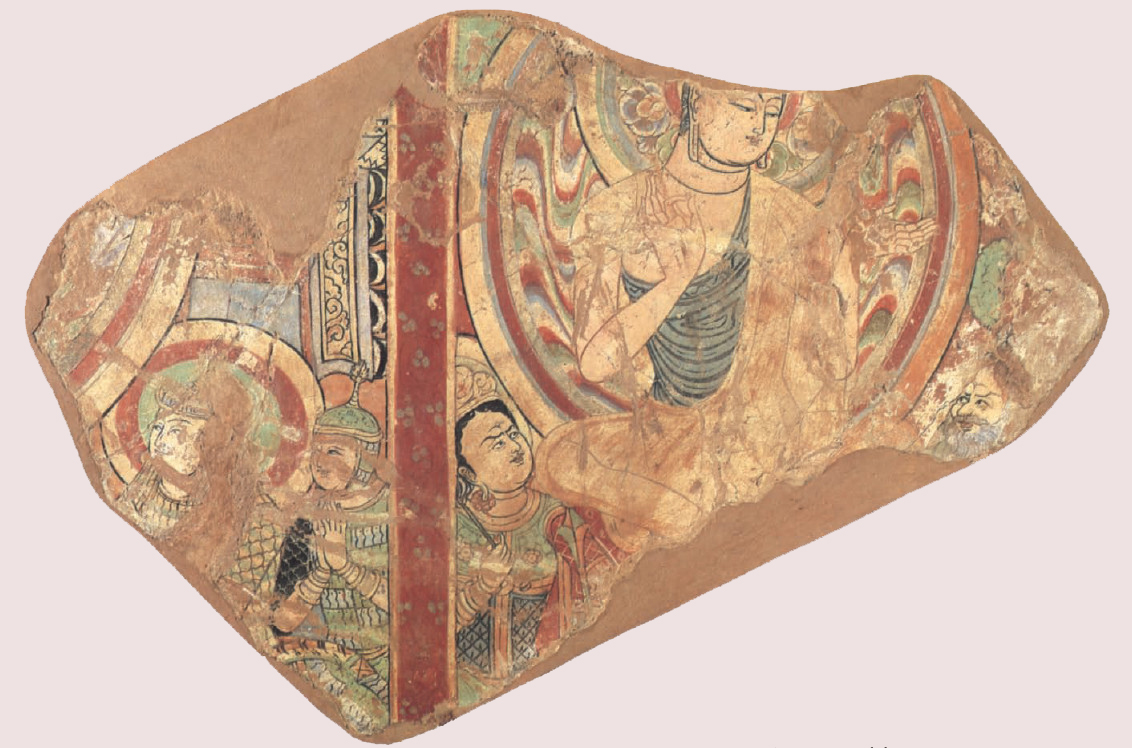
Wall painting, 47x42 cm. Kumtura, Cave at the Bend, 8th century
Museum fur Indische Kunst (MIK III 9024)
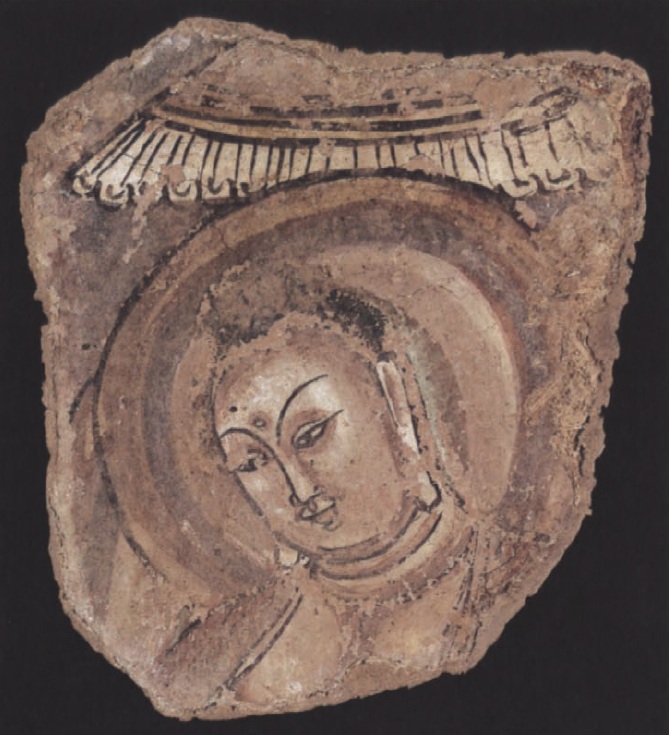
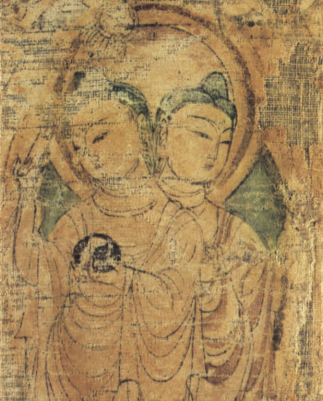
The Buddha is shown with a nimbus and flaming
mandorla, seated crosslegged on a lotus pedestal. He
is debating with a monk who squats to his right, offering what is probably a flower (the object is difficult
to identify). The stubble on the monk's chin, dabbed
on with a brush, is an original touch, making him
more lifelike. The following considerations may help
to explain the unconventional style of the painting.
There are caves in Kumtura with paintings in the
Indo-Iranian style (see No. 18), and others where the
pictures betray a definite East Asian touch. This fact
gives us an idea of the historical influences operating
along the northern Silk Route. It is remarkable that
the two different styles are found in caves of the same
area, without any tendency to merge. We do, however,
possess a few fragments of paintings from Kumtura
that cannot be positively ascribed to one style or the
other: this is one of them. Indo-Iranian elements are
mingled with Buddhist Chinese features; drawing and
coloring techniques cannot be compared with the
works of the main schools. The facial characterization
of the Buddha, the flaming mandorla, and probably
the speckled pattern on the robe are of distincdy
Oriental inspiration, whereas the border, the lotus,
and the portrayal of the monk reflect a different style.
It is interesting to compare this painting with the six
Kumtura murals that follow and to note the disparity
that exists between them.
Scenes of the Buddha Preaching
Scenes of the Buddha Preaching
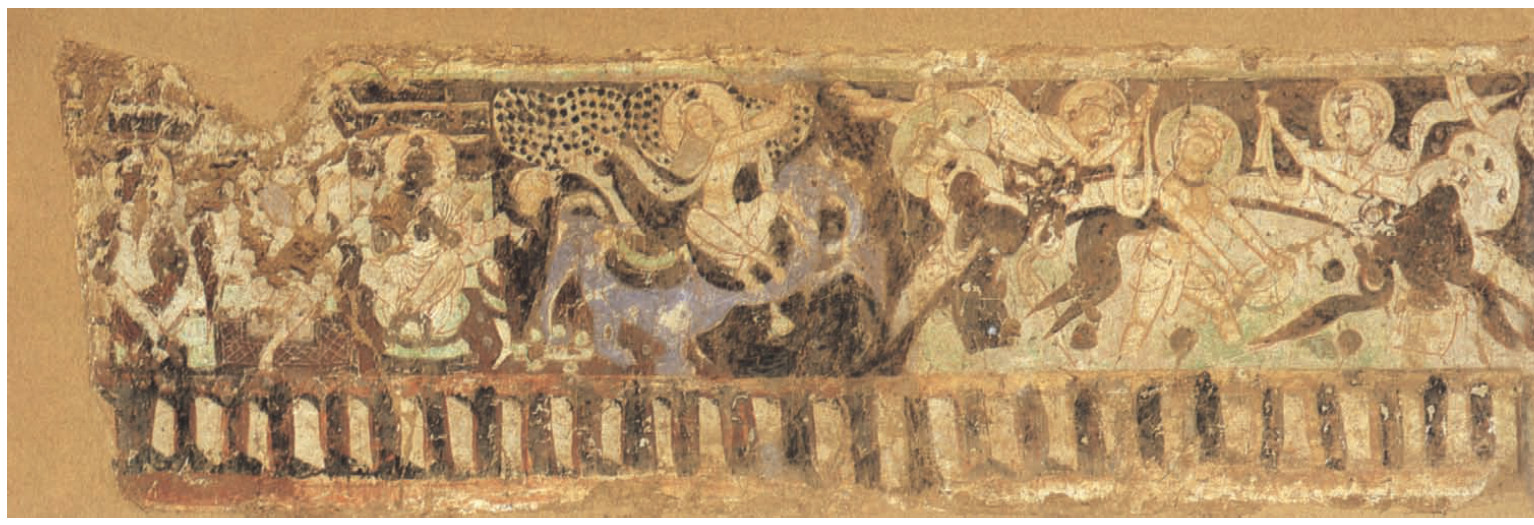
Wall painting, 51x75 cm.Tumshuk, Eastern Area, 7th century
Museum fur Indische Kunst (MIK III 8716)
The main ruins at Tumshuk are situated above the
hamlet of that name on a ridge whose northern end
divides into three spurs. The flat tops of these spurs
and parts of the side of the massif between them are
covered with the ruins of places of worship. Surprisingly enough, although the stone here is a brittle schist
with abundant traces of clay, no works of art in this
material have been found at the site.
While the French expeditions led by Paul Pelliot
investigated the ruins of monasteries and temples
north of the Aksu-Maralbashi road, the fourth German expedition under von Le Coq studied the complexes on the three cliffs to the south.
The area on the middle spur is the smallest and least
interesting. On the eastern spur, however, remains of
wall paintings were discovered, the only examples to
have survived from these two great complexes. Von
Le Coq considered the paintings to be quite different
from those in the Kucha region and earlier in date.
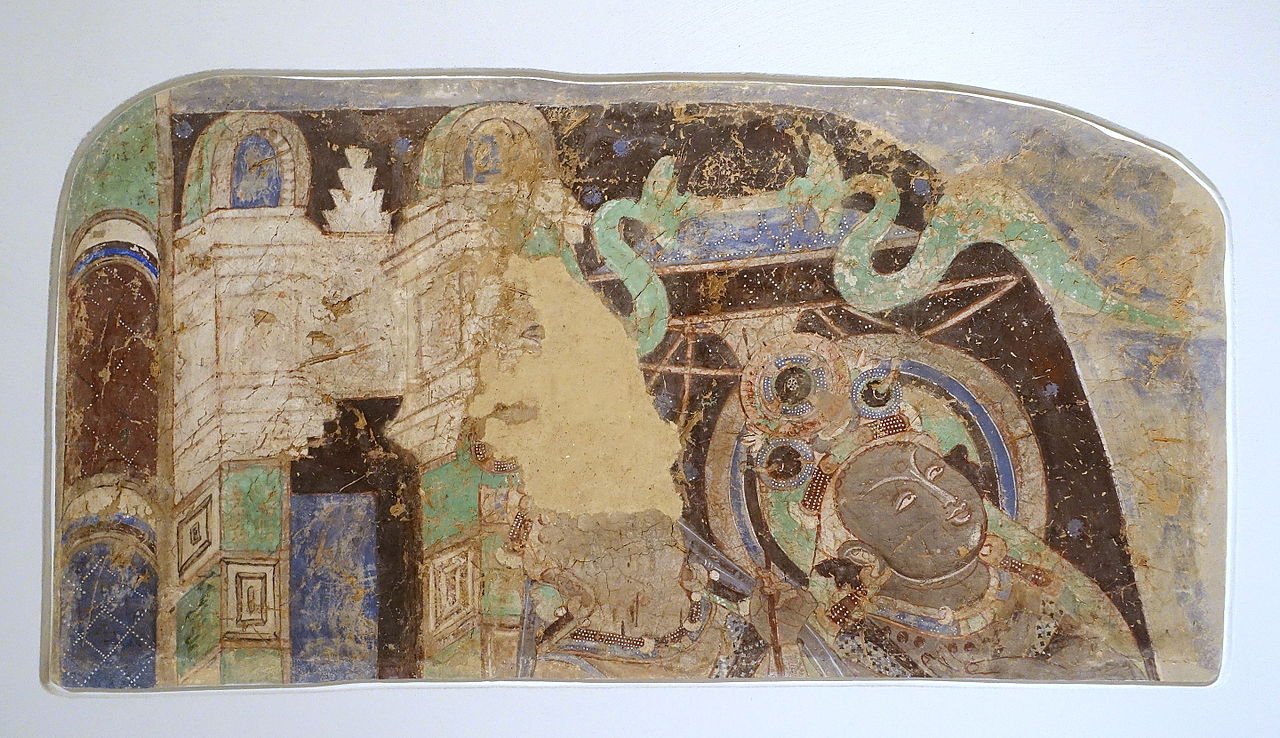
This fragment of wall painting shows two scenes
of the Buddha preaching. On the left the remains of
a Buddha mandorla are visible. In front of it, to all
appearances, stands a knight whose helmet is an un-
usual sort of Spangelhelm. The nimbus round his head sets him off from another, younger man to the right,
with lamellar armor and a conventional helmet.
A broad border separates this scene from a second,
better-preserved one showing a seated Buddha with
both hands raised in the teaching position. Webbing
can be seen between his fingers. His body is surrounded by a circular mandorla, composed of concen-
tric rings of different colors and filled in with a wavy
pattern. The same ornamentation is known to us from
later wall paintings under Chinese influence, for example, a large lunette in the Nirvana Cave in Kumtura
(see No. 64, Fig. l). The design of the floral motifs
around the Buddha's head also suggests a later date
for this painting, as does the separation of the scenes
by an ornamental border. There is a similar example
in the Third Cave from the Front in Kizil, which
Waldschmidt dated after A.D. 650.
The Buddha inclines his head to the right toward
a brahman, whose expressive face with its blue beard
has been preserved. To the left of the Buddha we see
Vajrapani in armor, in his hands the traditional vajra
and a fly whisk. Curiously enough, he is characterized
as a demon by fangs in the corners of his mouth.
Scenes of the Buddha Preaching


Scenes of the Buddha Preachingt
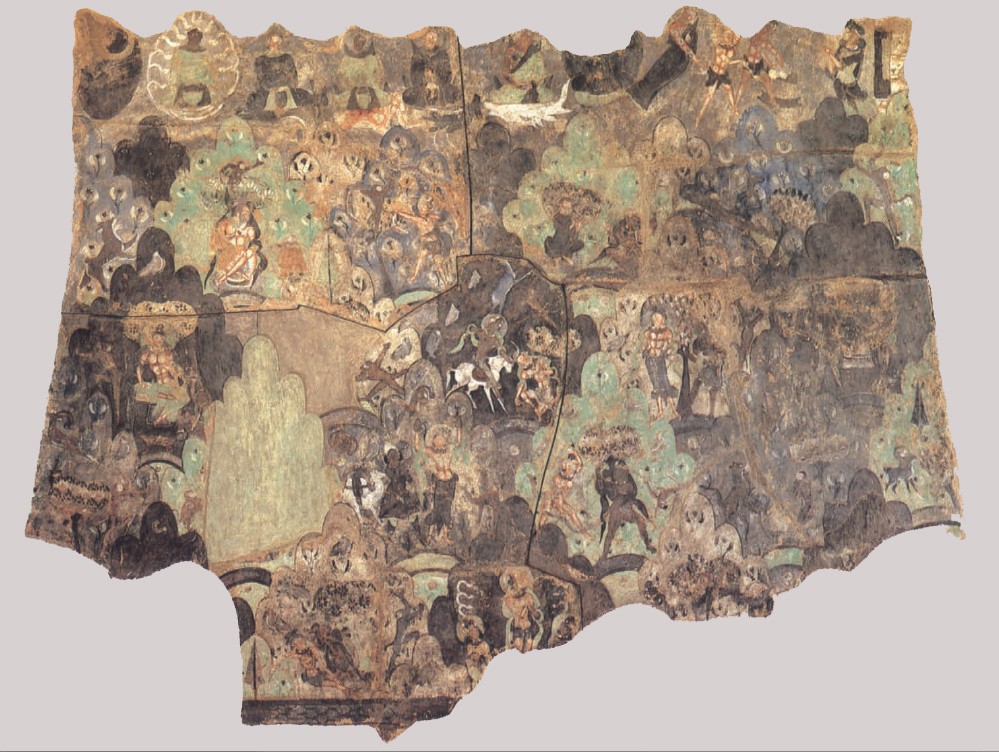
Wall painting, 143x145 cm. Kizil, Gorge Cave, 7th century
Museum fur Indische Kunst (MIK III 8725a)
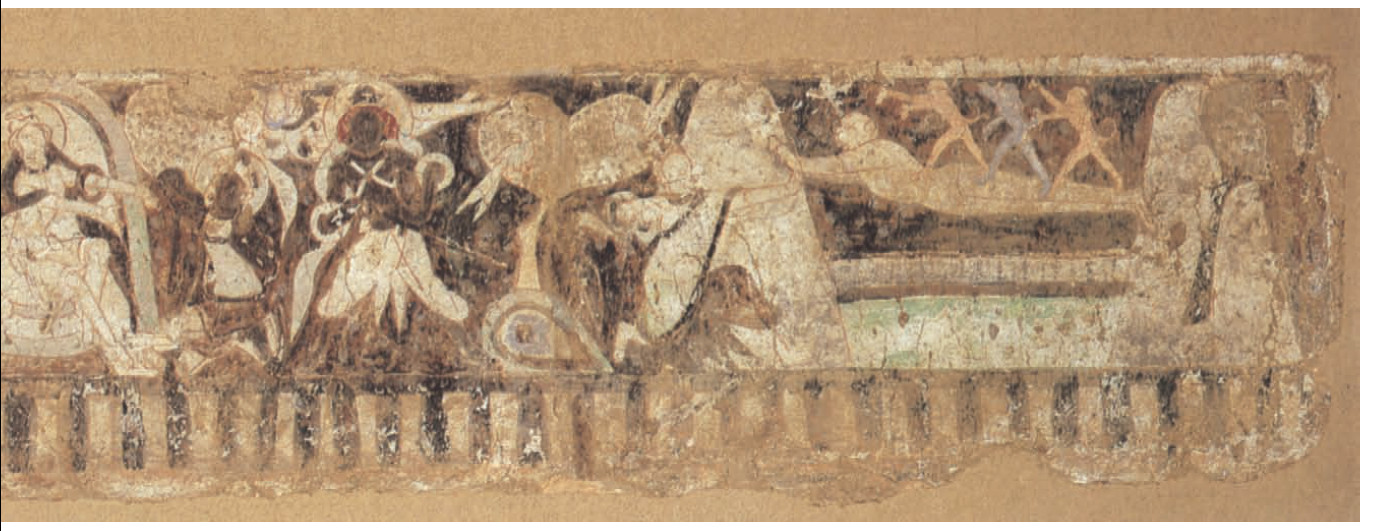
The remains of four square pictures of the Buddha
preaching are contained in these paintings from the
left-hand wall of the cella, which form a series complete
in itself. They are composed on the same lines, with
the Buddha seated in the center and addressing a group
of believers, sometimes to his right, sometimes to his
left. His static form is enlivened only by the varying
position of the hands with broad webbing between
the fingers. The Buddha is bigger than all the other
figures, who surround him on both sides and sometimes encroach over the edges of the picture and the
nimbus.
In the upper register, the left half of the first scene
on the left has been almost totally destroyed. Originally
the Buddha appeared in a nimbus and mandorla,
preaching to his left. Above his nimbus on the left
stood Brahma in a patchwork garment; the god Indra
on the right has been preserved. Three rows of persons
were originally portrayed in the left half. Direcdy at
the Buddha's feet knelt an old ascetic in a patchwork
garment, doubtiess Mahakashyapa; behind him sat
Vajrapani wielding in the left hand a stylized fly whisk,
with the vajra poised on his right knee; the third person was a young brahman. In the second row, adjacent
to the mandorla, there was a young man with his hands
together in an attitude of adoration, thought by
Griinwedel to be the monk Subhuti. Behind and above
him three brahmans could be seen, the one on the top
left holding in his right hand a bowl from which he
strewed flowers. In the midst of these four stood a
dark-skinned lute player.
In the right, remaining half of this scene we can
distinguish the following groups of figures. The first
row from the bottom shows a king and queen looking
up to the Buddha in adoration. Squatting at the
queen's feet a maid supports a tray of flowers. Behind
the king stands a figure holding the royal parasol rather
low so as not to conceal the other attendants behind
him, who carry the rest of the regalia: first, a woman
holding the crown and a man standing behind the
king, bearing the sword; then a flutist and two devaputras. Thus, the king is being invested with his
insignia in the presence of the Buddha.
The story can be identified, as Griinwedel first
pointed out, by reference to the dusky man who kneels
at the Buddha's feet clasping a liquor bottle idhurta).
It is the story of Dhurta the cobbler, who on the
instructions of the Bodhisattva is carried in a drunken
stupor into the king's palace, where he is waited on
as king when he awakes. The cobbler is astonished at
the change in his fortunes; he is then plied anew with
wine, only to wake up again in his own hovel.
The way this scene is put together is very interesting, as the cobbler and the king are, of course,
one and the same person. The contrast between these
two types in a man's life constitutes the theme of the
sermon.
In the upper right-hand scene the Buddha is preaching to his right. Before him kneels a brown-skinned
man, apparendy making an entreaty, and turning his
head toward a royal couple who are seated immediately
next to the Buddha. Griinwedel interprets the scene
thus:
A striped ruff is discernible behind the shoulder of the kneeling figure, which I would explain in the following way. We
always find similar paper ruffs attached to the skull-masks of the Tibetan lamas I am fairly certain that the kneeling man so designated is meant to be an offender under sentence
of death. The two figures behind the king and queen perhaps
relate to the crime the man has committed: an old woman
with a stick is talking to a maid who holds a parasol (the
artist has drawn this very small) over the royal couple.
In the lower register on the left the Buddha faces
to his right; Indra and Brahma are again to be seen
above his nimbus, Sariputra and Maudgalyayana on
either side of his mandorla. The crescent moon in the
tree is meant to suggest night. Two demon princes
with their retinue sit on each side of the Buddha. In
front of him are three bowls on a small trolley. There
should in fact be four, namely those that the guardians
of the four quarters of the universe, the lokapalas
Dhritarashtra, Vaishravana, Virupaksha, and Virudhaka, offered him when the two merchants Trapusa and
Bhallika brought him gifts.
In the last scene on the right, of which only the left
half has come down to us, the seated Buddha was
shown in the company of two naked women (the one
on his right has been preserved) — obviously temple
prostitutes with their companions. A dead woman lay
at his feet. By analogy Griinwedel postulated that the
woman who originally sat on the Buddha's left was
the same person as the dead woman. "She is meant to
be the beautiful Shrimati, Jivaka's sister, with whom
one of the monks fell in love, and who died suddenly.
According to the legend, the Buddha preached a sermon to King Bimbisara over her corpse to the effect
that human beauty is as nothing."













.jpeg)


,_1022a.jpg)


