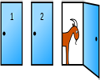

Monty Hall problem.
Suppose you're on a game show, and you're given the choice of three doors.
Behind one door is a car, behind the others, goats.
You pick a door, say #1, and the host, who knows what's behind the doors, opens another door, say #3, which has a goat.
He says to you, "Do you want to pick door #2?"
Is it to your advantage to switch your choice of doors?
The answer is "yes". The chances of winning are doubled by switching.
The odds go up from the original 1/3 to 2/3 if you switch.
This may be the simplest way to explain what is going on here.
You pick a door, say #1, and the host, who knows what's behind the doors, opens another door, say #3, which has a goat.
The probability that the car is behind door #1 is 1/3.
That means the probability that it is behind other two doors (#2 and #3) is 2/3.
The host now opens one of the doors, #2 or #3, which has a goat. Let's suppose he opens door #3.
Notice that the host knows where the car is located. (This is the crucial piece of information and is the key to solve the problem.)
You now have 3 relevant pieces of information:
1. The probability that the car is behind door #1 is 1/3.
2. The probability that the car is behind door #2 or #3 (i.e., not behind door #1) is 2/3.
3. The car is not behind door #3.
With these 3 pieces of information you can conclude that the probability that the car is behind door #2 is 2/3.
Therefore it is to your advantage to switch from the original choice of door #1 to door #2.
The reason is simple. your original guess is right with probability 1/3, whereas one of the other two choices is correct with probability 2/3.