Trickster myth
In mythology, and in the study of folklore and religion, a trickster is a god, goddess, spirit, man, woman, or anthropomorphic animal who exhibits a great degree of intellect or secret knowledge and uses it to play tricks or otherwise disobey normal rules and conventional behaviour. It is suggested by Hansen (2001) that the term "Trickster" was probably first used in this context by Daniel G. Brinton in 1885. (Wikipedia)


Don Juan

#2: Don Juan (Spanish folklore)
Image source: en.wikipedia.org
References: Don Juan
The Trickster of Seville and the Stone Guest

Kokopelli

#3: Kokopelli and Kokopelli Mana as depicted by the Hopi.
Image source: en.wikipedia.org
Reference: Kokopelli

Sun Wukong

#4: Sun Wukong as depicted in a scene in a Beijing opera
Image source: en.wikipedia.org
Reference: Sun Wukong

The trickster figure Reynard the Fox
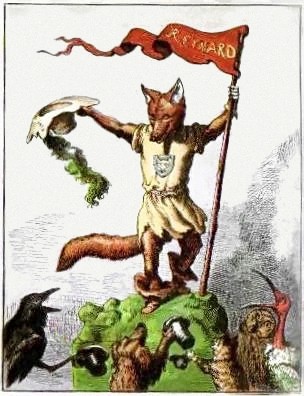
The trickster figure Reynard the Fox
drawn by Ernest Griset, as depicted in an 1869 children's book by Michel Rodange.
Image source: commons.wikimedia.org

Anthropomorphic Coyote trickster

Anthropomorphic Coyote trickster
from North American Indigenous mythology, canoeing up the river. Coyote often has the role of trickster as well as a clown in traditional stories.
Image source: commons.wikimedia.org

Br'er Rabbit and the Tar-Baby

Br'er Rabbit and the Tar-Baby
drawing by E.W. Kemble from The Tar-Baby, by Joel Chandler Harris, 1904. Br'er Rabbit is a trickster character who succeeds through his wits rather than through strength.
Image source: commons.wikimedia.org

Loki cuts the hair of the goddess Sif.

Loki cuts the hair of the goddess Sif.
An illustration by Willy Pogany from the chapter "How Loki wrought mischief on Asgard" in Children of Odin.
Image source: commons.wikimedia.org
