Arhat (Luohan)
In Theravada Buddhism, an Arhat (Sanskrit: अर्हत् arhat; Pali: arahant; "one who is worthy") is a "perfected person" who has attained nirvana. In other Buddhist traditions the term has also been used for people far advanced along the path of Enlightenment, but who may not have reached full Buddhahood.
The understanding of the concept has changed over the centuries, and varies between different schools of buddhism and different regions. A range of views on the attainment of arhats existed in the early Buddhist schools. The Sarvāstivāda, Kāśyapīya, Mahāsāṃghika, Ekavyāvahārika, Lokottaravāda, Bahuśrutīyas, Prajñaptivāda, and Caitika schools all regarded arhats as being imperfect in their attainments compared to buddhas.
Mahāyāna Buddhists are urged to take up the path of a bodhisattva, and to not fall back to the level of arhats and śrāvakas. The arhats, or at least the senior arhats, came to be widely regarded as "moving beyond the state of personal freedom to join the Bodhisattva enterprise in their own way".
In later Mahāyāna Buddhist tradition a group of Eighteen Arhats with names and personalities were regarded as awaiting the return of the Buddha as Maitreya, and other groupings of 6, 8, 16, 100, and 500 also appear in tradition and Buddhist art, especially in East Asia. They can be seen as the Buddhist equivalents of the Christian saints, apostles and early disciples and leaders of the faith. (Wikipedia)
Eighteen Arhats1

Eighteen Arhats by Chen Xuanxing, Inscription by Muan,color on silk, 18 hanging scrolls, Manpuku-ji Temple, Japan
The Eighteen Arhats (Chinese: 十八羅漢/十八阿羅漢; pinyin: Shíbā Luóhàn/Shíbā āLuóhàn; Wade-Giles:Lóhàn) are depicted in Mahayana Buddhism as the original followers of the Buddha who have followed the Eightfold Path and attained the Four Stages of Enlightenment. They have reached the state of Nirvana and are free of worldly cravings. They are charged to protect the Buddhist faith and to await on earth for the coming of Maitreya, a prophesied enlightened Buddha to arrive on earth many millennia after Gautama Buddha's death and nirvana. In China, the eighteen arhats are also a popular subject in Buddhist art, such as the famous Chinese group of glazed pottery luohans from Yixian of about 1000. (Wikipedia)
Image source: commons.wikimedia.org
Eighteen Arhats

Eighteen Arhats by Kawamura Jakushi, Inscription by Yinyuan,color on silk, 18 hanging scrolls, Shomyo ji Temple, Japan
Image source: commons.wikimedia.org
Angry Arhat
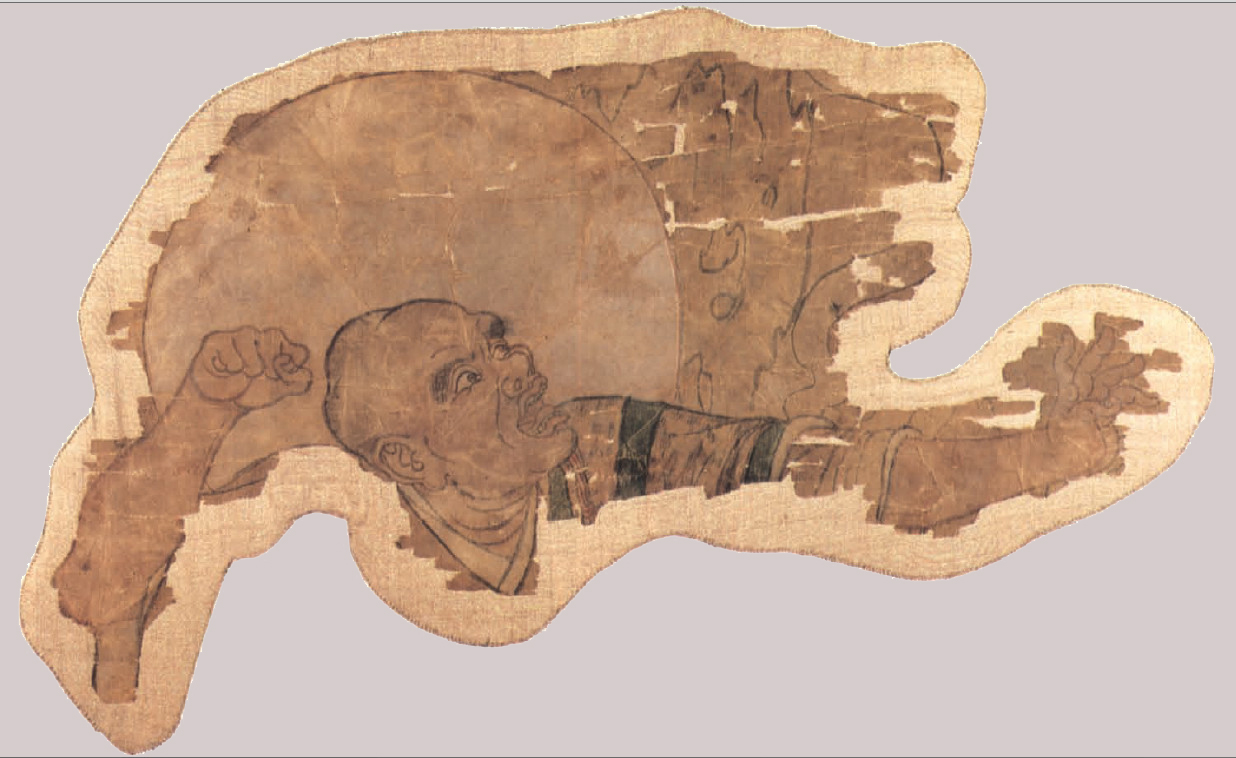
Angry Arhat
Painting on silk, 29.0 x 47.5 cm. Foothills near Turfan, 8th -9th century
Museum fur Indische Kunst (MIK III 7241)
To understand the essence of Buddhism, one must
have a clear picture of the sort of person it aimed to
produce and the kind of perfection its adepts were
supposed to strive after. The ideal man is known as
an arhat (from the Sanskrit root arb, "to deserve, be
worthy"), or one who is worthy. Free from sensual
desires and the longing for existence, he has severed
his worldly connections. In the early days of Buddhism
all Buddhist ascetics were given this title; later only
the wise ones were thus designated.
Among Buddhist works of art many idealized portraits of arhats have been preserved. An arhat is usually
depicted as a venerable old man with a bald head and
an austere expression. In this fragment of a silk painting his look is more one of irritability or anger. He
has turned to face his left; his right arm is raised with
the hand clenched in a fist, while he thrusts out his
left hand and arm in a defensive gesture. His head is
thrown back, with a furious glint in the eyes, and the
mouth is open in a scream. He seems to be trying with
all his might to ward off evil, hostile spirits. Brownish-skinned, he has a muscular physique; his head is shaven
but the hair appears to be growing again. Under the
shaggy brows the whites of the eyes are slighdy tinged
with red. A simple nimbus shows this monk to be a
holy man. The picture, with its gray-green background
enlivened with dabs of color, betrays the hand of a
master of free expression.
Seated Arhat
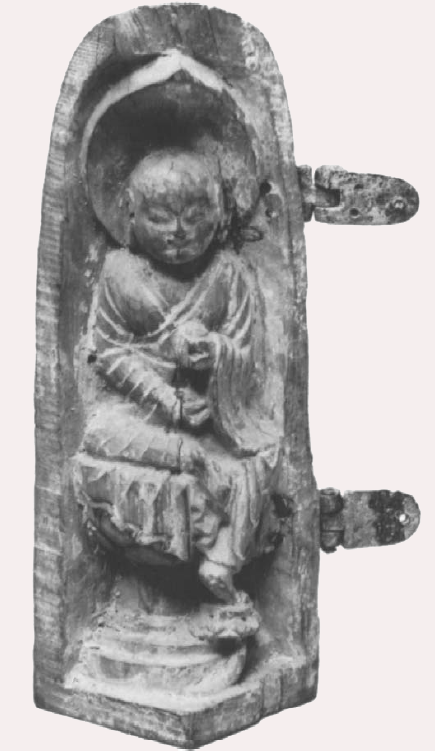
Seated Arhat
Wood, H. 11.2 cm. Khocho, 9th century
Museum fur Indische Kunst (MIK III 6110)
The function of this carving is easily deduced from the
metal fittings on the right: it is part of a portable
triptych. The bald arhat is seated on a lotus pedestal.
He wears a robe that covers both shoulders. His head
is encircled by a nimbus terminating in a point like a
leaf. The face is round, the narrow eyes with their
heavy lids are open. The arhat's right hand rests on his
lap, his left holds a spherical object in front of his
chest. His right leg rests on the seat, while the left foot
hangs down and is supported by a small lotus.
Traces of white paint show that the figure was originally colored. The back of the niche has been left in
its natural state.
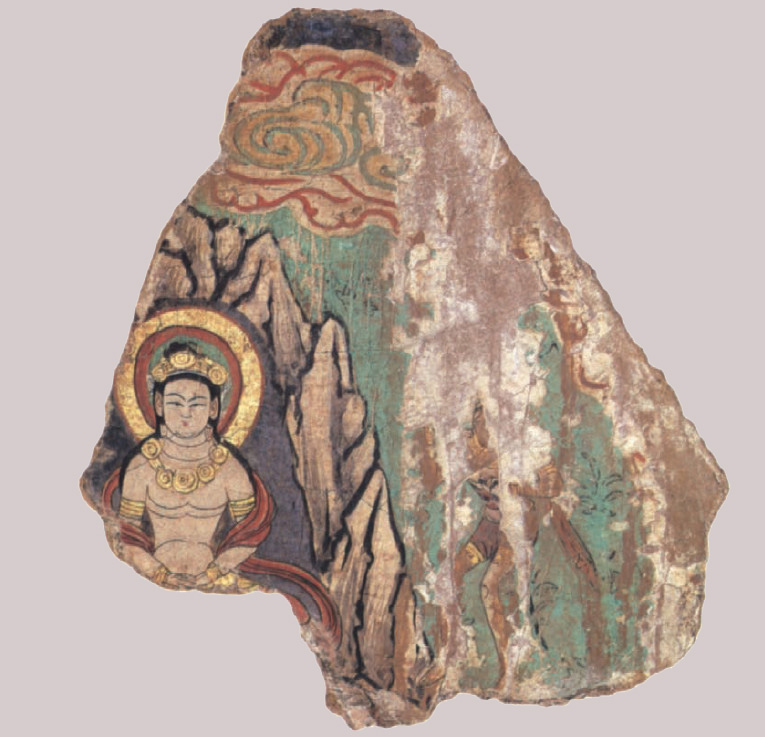
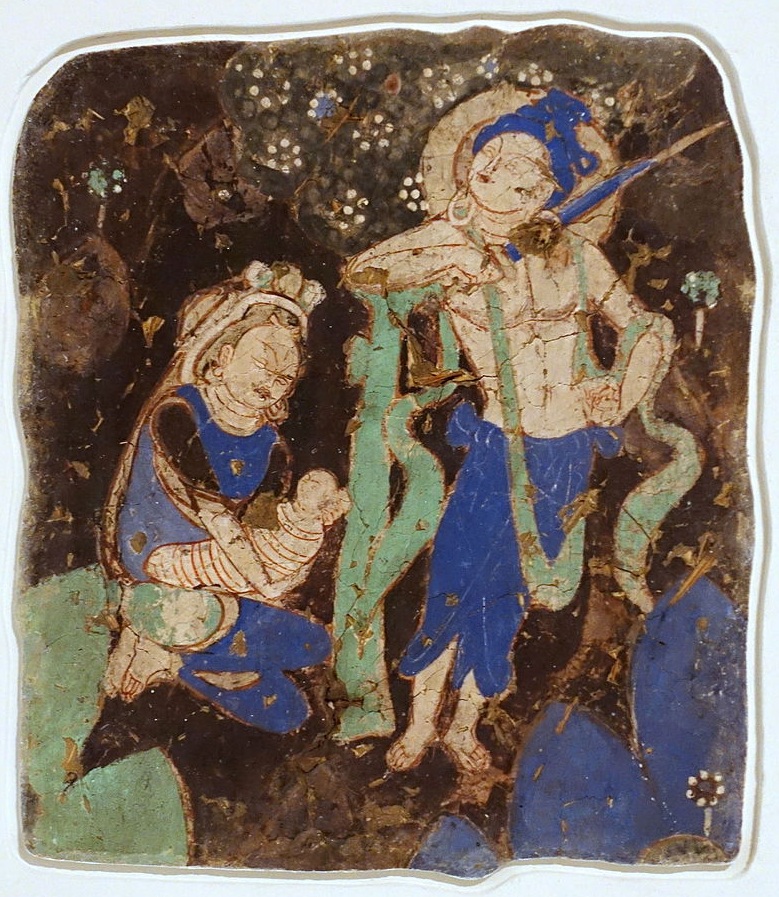
Nanda

The Cowherd Nanda
Wall painting, 60x33 cm. Kizil, Cave of the Statues, ca. 500
Museum fur Indische Kunst (MIK III 8838)
This belongs to a series of wall paintings
of the preaching Buddha that were found in one of
the oldest caves at Kizil, the Cave of the Statues, named
from the quantity of clay figures discovered there.
Buddhist literature contains numerous references
to sermons that the Buddha is said to have preached
during his wanderings. Many of these are quoted at
length, in order to pass on to the faithful the moral
tenets they enjoin. Pictures being more effective than
words, it is not surprising that Buddhist artists should
have taken up the theme and depicted it in so many
variations. Scenes of preaching are particularly common in the cave monasteries of Central Asia, where
one type of composition dominates: the Buddha seated
in the center, his hand raised in the gesture of teaching,
with only the attributes, figures, or animals that surround him varying with the particular sermon represented. This fragment once belonged to such a scene.
Part of the Buddha's mandorla, right arm, and knee
are visible in the upper right corner. At the lower right
we see a brook, a swirl of green with a red blossom
floating on it. Two cattle, one dark in color and the
other white, lie on the ground behind the central figure. This is the cowherd Nanda, who, resting on his
gnarled stick, watches over his animals as he listens
devoutiy to the words of the Buddha. So deep is his
concentration that he is oblivious of the poor frog he
is crushing beneath his stick. The frog, so the legend
goes, would have escaped if it had not meant disturbing Nanda's attention; the frog will be rewarded by
being reborn as a god, while Nanda will enter the
Buddhist order.
Mahakashyapa

Head of Mahakashyapa
Wall painting, 46.5 x 71 cm. Kizil, Cave above the Largest Cave, 7th century
Museum fur Indische Kunst (MIK III 8373a)
High above the Largest Cave and difficult to reach is
a small temple of the usual type, consisting of a cella
with an icon platform and an ambulatory at the back
wall. The paintings in this cave have been destroyed,
all except for two small fragments, of which this is
one. It represents Mahakashyapa, one of the Buddha's
best-known pupils.
His head is inclined before a flowered background;
his hair is cut short and shaved back from his temples
in two wings. The eyes, eyebrows, and nose are
strongly accented. Mahakashyapa's face is framed by
a light blue beard of the same color as his hair. His
earlobes have been distended by the weighty earrings
he once wore; his neck, chin, and mouth are heavily
lined. A fragment of his green patchwork robe is preserved on his shoulder.
This wall painting belongs to a depiction of a Mahaparinirvana scene, as we may conclude from similar,
better-preserved paintings. It is from the Mahaparinirvanasutm, a Sanskrit text found in Central Asia, and
its parallels in Pali, Tibetan, and Chinese, that we learn of the events that took place shortly before and after
the death of the Buddha (Waldschmidt 1948, Bareau
1970).
All these texts give almost the same description re-
garding the preparation of the final resting place of
the Buddha. He asked his favorite disciple, Ananda,
to make a place ready between two shala trees in a
forest near Kushinagara. The Buddha wished to lie on
his right side, his head pointing north. The shala trees
bloomed out of season, strewing his body with flowers
while celestial music sounded. The texts mention several other events of less importance in this connection,
such as the last instructions of the Buddha concerning
his doctrine and his community, and two final conversions. Then, after having pointed out the transience
of the samskaras and having admonished his monks to
improve themselves continually, the Buddha attained
nirvana.
At that time Mahakashyapa was not with the Buddha but on his way from Pava to Kushinagara with a great congregation of monks. He stopped to speak
to a brahman who had come from Kushinagara bringing a mandamka-flower from the celebration held in
honor of the Buddha. From this man he learned that
the Parinirvana had taken place seven days before.
Mahakashyapa went immediately to the cremation
ground, where, finding the body of the Buddha lying
in an oil-filled vessel, he lifted it out, washed and
anointed it, and wrapped it in fresh cloths. Then he
placed the body on the pyre and set it aflame.
Depictions of Mahakashyapa are very often found
in connection with the Parinirvana of the Buddha. To
judge from its expression of deep grief, the present
image was no exception, although it is now impossible
to determine whether Mahakashyapa was shown
kneeling at the head of the Buddha or at his feet during
the cremation.
Hanging Scroll of an Indian arhat

#1: Hanging Scroll of an Indian arhat by Japanese painter Shiba Kokan, Located in National Palace Museum, Taipei.
Image source: en.wikipedia.org
Luohan, hanging scroll

#2: Luohan, hanging scroll, ink and color on silk, 118.1 x 56 cm. Located at the National Palace Museum, Taipei.
Image source: commons.wikimedia.org
Seated luohan

#3: Seated luohan, Liao dynasty (907–1125), ca. 1000 Yixian, Hebei Province, China Earthenware with three-color (sancai) glaze
#3b: Larger image
Image source: commons.wikimedia.org
Image source: www.flickr.com/photos
Seated luohan

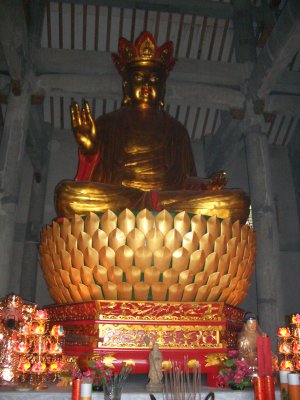
#4: Seated Luohan (Chinese Yuan dynasty 1279-1368 CE) Wood gesso and polychrome
Image source: www.flickr.com
Wooden statue of an arhat

#5: This wooden statue of an arhat is located in the Quan Am Pagoda, Cho Lon, Ho Chi Minh City, Vietnam
Image source: commons.wikimedia.org
Arhat


#6a: The Arhat Panthaka, Japan, Nanbokucho period (1336-1392), 14th century, Hanging scroll, ink and colors on silk
#6b: One of Sixteen Arhats color on silk. 96 cm x 53 cm, hanging scroll Set of 16 hanging scrolls, 11th century Heian period, Tokyo Tokyo National Museum
Image source: commons.wikimedia.org→
#6b: Arhat
Furious Arhat

#7: Furious Arhat (Zorniger Arhat) collected by German expedition to Turkestan in the early 20th century from the foothills near Turfan. Painting on silk, Dating from the 8/9th centuries CE.
Image source: commons.wikimedia.org

Luohan fish

#9: Luohan fish: A flowerhorn (cichlid hybrid) from The 6th "Pramong Nomjai Thaituala" Thailand Tropical Fish Competition 2007. (Won consolidation prize)
Image source: en.wikipedia.org
Reference: en.wikipedia.org: Cichlid
Flowerhorn Cichlid
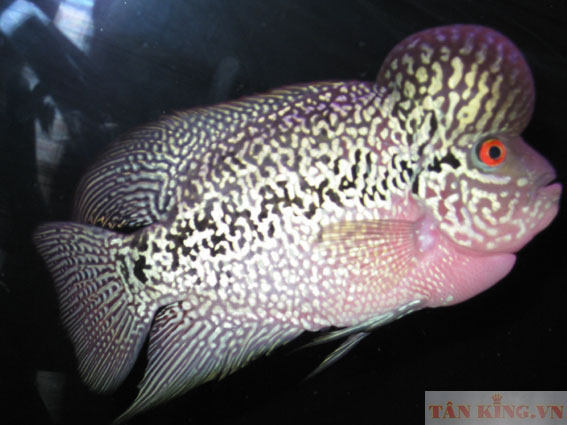
#10: Flowerhorn Cichlid (Tan King strain)
Comment: Arhat incarnate as fish
Image source: en.wikipedia.org
Reference: en.wikipedia.org: Flowerhorn Cichlid
Oranghutan
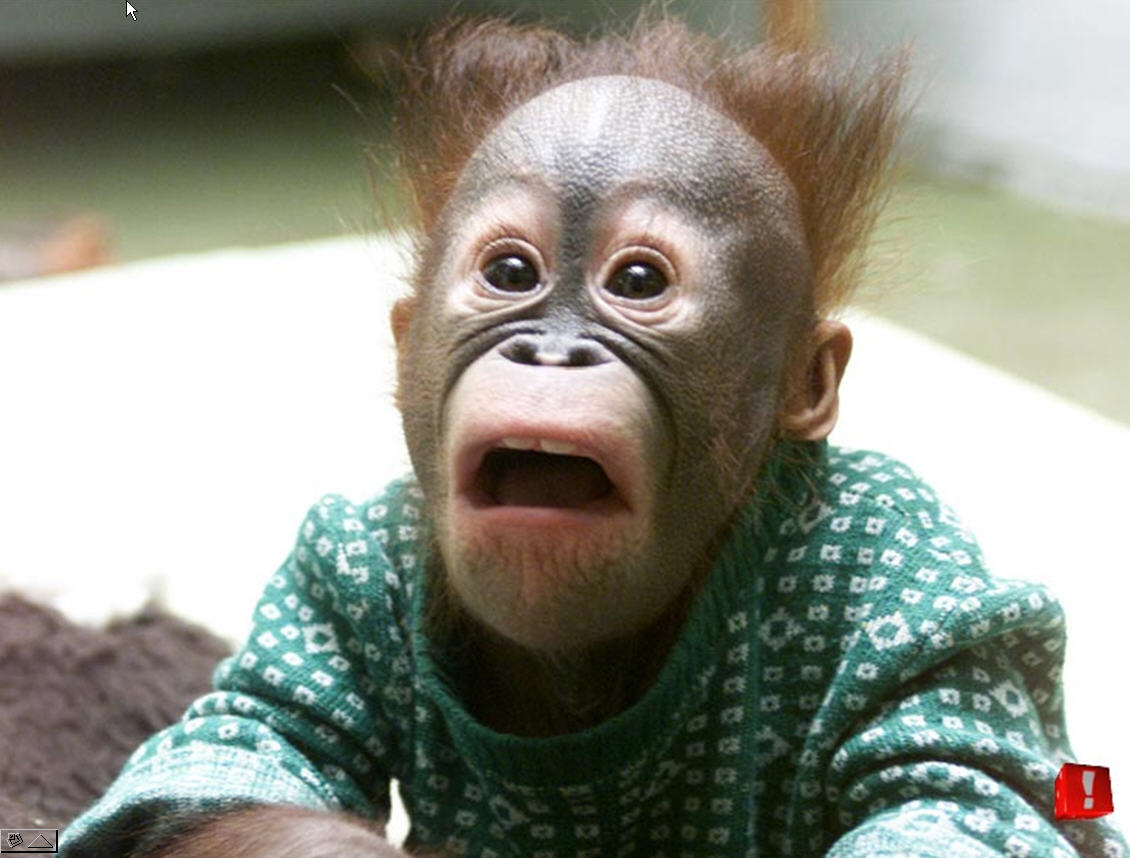
#11: Funny Ape - Oranghutan
Comment: Arhat incarnate as oranghutan
Image source: photobucket.com
/www.google.com
Ven Bakula Rinpoche

#12: Ven Bakula Rinpoche, recognized by the Thirteenth Dalai Lama as a reincarnation of Bakula Arhat
Comment: Bakula Arhat incarnate
Image source: www.lawudo.com
Luohan Laundering

#13: Luohan Laundering, by Lin Tinggui, painted in 1178 during the Song Dynasty: Five Chinese Buddhist luohan (arhats) and one attendant wash clothes in a stream and hang them up to dry.
Image source: commons.wikimedia.org
16 Arhats
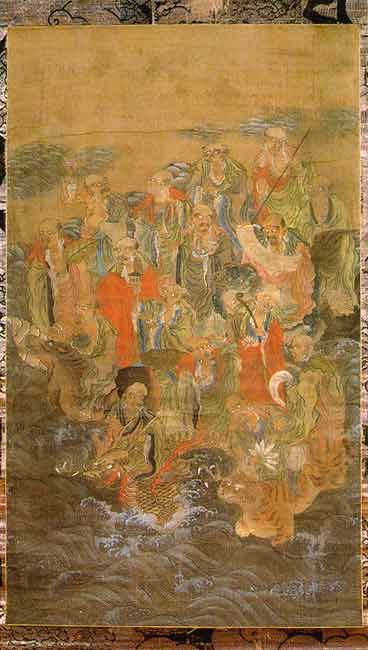
#14: The Sixteen Arhats by Juroku-rakan-zu, (1615 - 1865) Edo Period, Hanging scroll, color on silk.
Image source: commons.wikimedia.org