


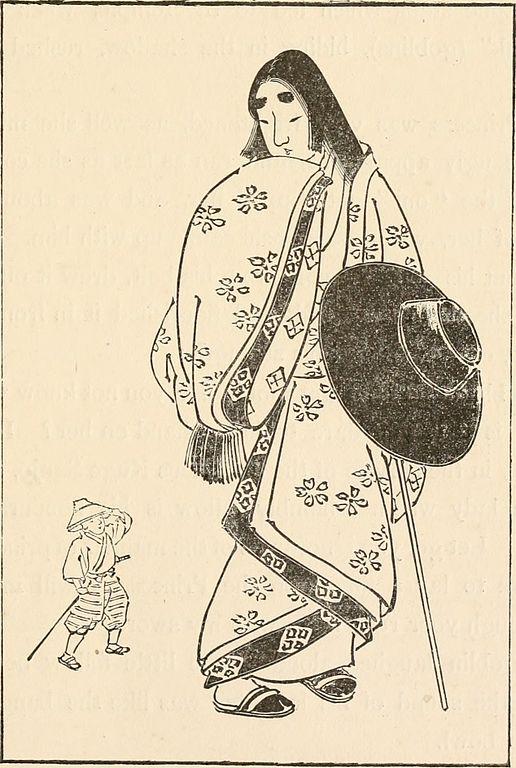


Shuten dōji
しゅてんどうじ 酒呑童子 (sometimes called 酒顛童子, 酒天童子, or 朱点童子)
Shuten dōji (Drunken Child).is a mythical oni leader who lived in Mt. Ooe (大江山) of Tamba Province or Mt. Ooe (大枝) on the boundary between Kyoto and Tamba in Japan.
According to legend, during the reign of Emperor Ichijō (r. 980–1011), people begin to disappear mysteriously from the royal court. Abe no Seimei (921?–1005), an official diviner of the Heian court, discovers that it is the work of the archfiend, Shuten Dōji, the chieftain of the oni. Shuten Dōji and his cohorts abduct and devour young Kyoto maidens.
The warriors Minamoto no Raikō (or Yorimitsu, 948–1021) and Fujiwara no Hōshō (or Yasumasa, 957–1036), as well as Raikō’s shitennō (the four heavenly guardians) are charged by the imperial court to destroy Shuten Dōji and his evil minions. The warriors, with the help of their attending deities, carry out their mission, ultimately slaughtering the oni, rescuing the surviving captives and restoring peace and the security of the country.
VARIOUS VERSIONS OF “SHUTEN DŌJI”
There are two popular versions of Shuten Dōji based on the location of the oni’s fortress: the Ōeyama (Mt. Ōe) version and that of Ibukiyama (Mt. Ibuki) version. It is generally accepted that the Ōeyama version came first.
The Ōeyama ekotoba ((Picture Scroll of Mt. Ōe) made during the fourteenth century, which is kept in Itsuō Museum of Art in Osaka, Japan, depicts the Ōeyama version of the legend.
Another picture scroll, Shuten Dōji emaki (Picture Scrolls of Shuten Dōji), kept in Suntory Museum of Art, in Tokyo, dates to the early sixteenth century, represents the latter, the Ibukiyama version.
The Ibukiyama version includes a section of explanation on Shuten Dōji’s honji, that is, an explanation of their “true nature” or “original form.” Thus, in the Ibukiyama version we are told that Shuten Dōji is dairokuten no maō (the evil king of the Sixth Heaven in darkness) and the archenemy of Buddha. Likewise, the text tells us that Raikō’s honji is Bishamonten (Vaiśravaņa); Emperor Ichijō’s, Miroku (Maitreya); and Seimei’s is Kannon-satta (Kannon Bodhisattva).
Satake Akihiro asserts that the Ibukiyama version formed by incorporating a historical incident, the murder of a bandit named Kashiwabara Yasaburō at Mt. Ibuki in 1201, into the Ōeyama version.
There are a number of copies and versions of the story, but it was the eighteenth-century printed version of the Shuten Dōji story that reached the broadest audience, thanks to a bookseller by the name of Shibukawa Seiemon. For all intents and purposes, the popularity of the Shibukawa edition put an end to creations of further variations. The location of the fortress in the Shibukawa edition is on Mt. Ōe.
Echigo birth legend
Shuten-doji, according to one legend, was born at Ganbara, Echigo, in the Heian era (8th century) when Dengyō Daishi and Kōbō-Daishi were active.
He became a page of the Kokojou temple (国上寺) at Tsubame, Niigata.
He was a “pretty boy” who refused all of the females who loved him, and all of the females who approached him died from being so love-stricken. When he burned the love letters he received from all the females, the smoke that came out enveloped him, turning him into an oni, moving from mountain to mountain centered on Honshu, eventually settled on Mt. Ooe.
One story is that he was the son of a blacksmith in Echigo, that he was in his mother’s womb for 16 months, and that he had teeth and hair when he was born, was immediately able to walk and to talk , and had the wisdom and physical strength of a 16-year-old. He also had a rough temperament and was shunned as an “oni child.”
According to Zentaiheiki, he was abandoned by his mother when he was 6 years of age. He wandered from place to place, and walked the path towards being an oni.
There is also a legend that since he was scorned as an oni child, he was put into custody of a temple, but the chief priest of that temple was a user of unorthodox practices, and the child became an oni through learning those unorthodox practices.
In the town of Wanou (presently, Niigata, Niigata), it is said that when a pregnant woman eats a fish called “tochi,” that child will become a robber if it is a boy, and a prostitute if it is a girl. It is also said that a woman who ate the fish, gave birth to a child after it stayed 16 months in her womb, and that child was Shuten-doji. In Wanou, there are place names like the Doji estate and the Doji field.
Mt. Ibuki birth legend
According to one legend Shuten-doji was born from the dragon-snake Yamata no Orochi and a human girl. He was a page at Mount Hiei from an early age, and underwent training, but he drank sake which was forbidden by Buddhism, and in fact was a big drinker, and was therefore hated by everyone. One day, after a religious festival where he dressed in an oni costume, he was about to take off the costume, but he wasn’t able to since it was stuck to his face, and reluctantly went into some mountain recesses where he started his life as an oni. He then met Ibaraki-dōji, and together aimed for Kyoto.
Yamato province birth legend
He was a page for the Byakugō-ji in the Yamato province (presently, Nara Province), but found a corpse at a nearby mountain, and due to curiosity, brought that meat back to the temple, and made his priest teacher eat it without telling him that it was human meat. Afterwards, the page frequently brought back meat, not only from the flesh of corpses, but also by murdering live humans and returning with their flesh. The priest, who thought that it was suspicious, followed after the page, discovered the truth, harshly criticized the page, and abandoned him in a mountain. The page later became Shuten-doji, and it has been said that the place where he was abandoned was thus called “chigo-saka” (page-hill).
According to another theory, he was a child of the chief priest of Byakugō-ji, but as he matured, he grew fangs and a horn, and later became a child as rough as a beast. The priest was embarrassed by this child, so the child was abandoned, but the child later came to Mt. Ooe, and became Shuten-doji.
SUBORDINATES
Shuten-doji had many subordinates with Ibaraki-doji as his first deputy. and the great four, Kuma-doji, Torakuma-doji, Hoshikuma-doji, and Kanaguma-doji.
Ibaraki-doji ( いばらきどうじ茨 木童子), meaning "thorn tree child" , was was the chief deputy to Shuten dōji and one of the most famous and feared demons to wreck havoc on Japan.
Shuten dōji (しゅてんどうじ 酒呑童子)
TRANSLATION: a nickname meaning “little drunkard”
LEGENDS: There are three monsters who are considered the greatest and most evil yokai in all of Japanese folklore: the ghost of Emperor Sutoku, the nine-tailed kitsune Tamamo no Mae, and the dreaded king of the oni, Shuten dōji.
Shuten dōji was not born an oni. There are many stories about how he came to be, but most of them say that he was originally a human boy who was born over a thousand years ago either in present-day Shiga or Toyama. His mother was a human woman and his father was the great dragon Yamata-no-Orochi. How he changed from boy to demon varies greatly from story to story, but the one popular version goes like this: There was a young boy who was supernaturally strong and abnormally intelligent for his age. Everyone around him constantly called him a demon child due to his incredible strength and wit, and he gradually became terribly anti-social and resentful of others. At age six, even his own mother abandoned him. Orphaned, he became an apprentice priest at Mt. Hiei in Kyoto. Naturally, he was the strongest and smartest of the young acolytes, and he grew resentful of them as well. He slacked off on his studies as a result and got into fights. He also fell into drinking, which was forbidden to monks; however he could out-drink anyone and everyone who was willing to sit down and drink against him. Because of his fondness for alcohol, he became known as Shuten dōji, “the little drunkard.”
One night there was a festival at the temple, and Shuten dōji showed up very drunk. He put on an oni mask and went around playing pranks on his fellow priests, jumping out from the darkness to scare them and such. At the end of the night, he tried to take off his mask but found he couldn’t — to his horror, it had fused to his body! Ashamed, scared, and scolded by his masters for being drunk, he fled into the mountains where he would no longer have to interact with other humans, whom he saw as weak, foolish, and hypocritical. He lived there on the outskirts of Kyoto for many years, stealing food and alcohol from villagers, and drinking vast quantities of alcohol. His banditry eventually attracted groups of thieves and criminals, who stuck with him loyally and became the foundation for his gang.
Living in exile, Shuten dōji grew in power and knowledge. He mastered strange, dark magic, and taught it to his thugs. He met another demon child like him, named Ibaraki dōji, who became his chief servant. Over time, the young man and his gang gradually transformed into oni, and eventually he had a whole clan of oni and yokai thugs who prowled the highways, terrorizing the people of Kyoto in a drunken rage. He and his gang eventually settled on Mount Ōe, where, in a dark castle, he plotted to conquer the capital and rule as emperor.
Shuten dōji and his gang rampaged through Kyoto, capturing noble virgins, drinking their blood and eating their organs raw. Finally, a band of heroes led by the legendary warrior Minamoto no Yorimitsu assaulted Shuten dōji’s palace, and with the help of some magical poison, were able to assault the oni band during a bout of heavy drinking. They cut off the drunken Shuten dōji’s head, but even after cutting it off, the head continued to bite at Minamoto no Yorimitsu.
Because the head belonged to an oni and was unholy, it was buried it outside of the city limits, at a mountain pass called Oinosaka. The cup and bottle of poison that Minamoto no Yorimitsu used are said to be kept at Nariai-ji temple in Kyoto.


Left:
By Katsukawa Shunshō :歌川芳年 (1865), it depicts the appearance of a drinking party. The composition of demons and women who do cloth pulling in front of sake drinks are those taken from the illustration of the literary work in the middle of the Edo period "picture book Taizo"
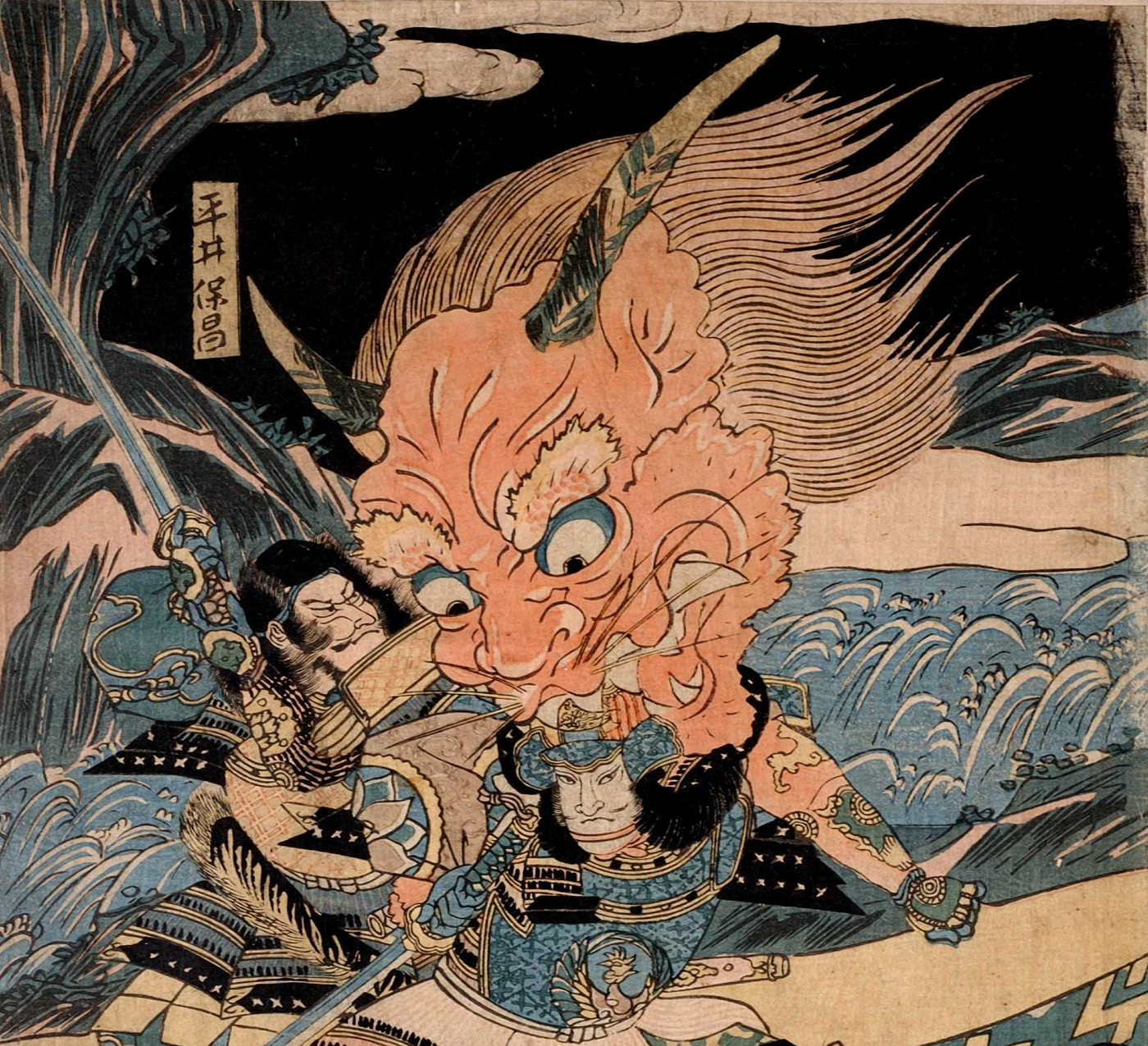
Right: The fight between Minamoto Yorimitsu and the monster Shuten-doji. We see here the severed head of the monster attacking Yorimitsu. Close-up view
by Katsukawa Shuntei (勝川 春亭 1770–1820) 浮世絵
The Emperor Murakami ordered Minamoto Yorimitsu to rid the country of the atrocious monster Shuten -doji who had built a stronghold in the mountains which came to be known as Devil's Mountain. Here, .
5 volumes of scrolls about Oeyama legend, 17th century at Ritsumeikan University Art Research Center


Left: Minamoto no Yorimitsu (Raikō 頼光), Fujiwara no Yasumasa (Hōshō 保昌) and the four heavenly guardians (Sadamitsu, Suetake, Kintoki, Tsuna)
Right: The special sake put Shuten douji into a sound sleep.
The Shuten Dōji Story
According to the oldest extant text titled Ōeyama ekotoba, the story is set in the late tenth or early eleventh century in the Japanese capital of Heian. Abe no Seimei’s divination that the oni living on Mt.Ōe are abducting people sets the plot in motion.. When the emperor commands the famous warriors to assemble their men and conquer the demons, Raikō and Hōshō are at first alarmed by the formidability of their mission, for oni possess supernatural powers and are able to transform into anything, making them difficult to hunt down, much less destroy. Despite their uncertainty, the warriors set out on their quest taking with them several loyal retainers.
The troupe stops to pray for success at four separate shrines. Their faith is rewarded, for while on their way to the oni’s lair on Mt. Ōe, the group encounters four deities disguised as priests. The old priests advise Raikō’s party to disguise themselves as yamabushi (mountain priests), providing the men with the necessary clothing. Thus attired in what one might view as an inversion of their royal livery, the warriors, now joined by the deity-priests, continue on their quest, disguised as yamabushi.
At a river on Mt. Ōe, the group meets an old woman who had been kidnapped by oni. She warns the heroes about the activities of Shuten Dōji and his band of oni. She tells the ersatz monks that Shuten Dōji forces kidnapped maidens into domestic servitude, and at the whim of the oni, they are dismembered, their flesh devoured, and their blood imbibed.
Thus warned, the heroes are prepared to confront the arch demon in his lair. Arriving at the demon’s mountaintop palace, the royal troupe lies to the oni guard, telling him that they are a band of lost yamabushi in need of lodging for the night. Shuten Dōji promptly allows them into his palace and jovially regales the men with stories from his past; he entertains his guests, offering them unknown flesh to eat and a detestable liquid to drink. In turn, one of the deity-priests offers Shuten Dōji his own sake, which causes Shuten Dōji to fall into an inebriated stupor.
After Shuten Dōji retires, a number of oni, disguised as beautiful women, visit Raikō and Hōshō in the palace guest quarters. The oni-women fail, however, to entice the warriors. Raikō gives the oni-women an intense glare, and the demons scurry off.
Soon after, another group of oni disguised as a dengaku (field music) troupe emerge to entertain Raikō and his band. Again, Raikō’s fierce stare wards them off.
Raikō and Hōshō then decide to scout out the palace compound, an impressive structure described as a place where the splendor of heaven and the torment of hell simultaneously exist. In their search, the men discover a cage holding a kidnapped page of the Tendai sect’s head priest. Although protected from death by Buddhist deities, the page remains trapped alongside the other captives.
Raikō’s and Hōshō’s troupe moves quickly to Shuten Dōji’s grand bedchamber. There, they find the entrance to his quarters blocked by a seemingly impenetrable iron door; but as the deity-priests pray and chant mystical incantations, the once impervious door magically melts away. Inside, Shuten Dōji lies in drunken repose, fully reverted to his true monstrous form. He is a giant, over fifty feet tall and with his red body and five-horned head, the epitome of demonic appearance. He has one black leg and one white, a yellow right arm and a blue left. The fifteen-eyed oni sleeps peacefully, oblivious to the fate that awaits him. While the four deity-priests hold each of Shuten Dōji’s colorful limbs, the warriors behead him. Shuten Dōji cries as he is decapitated, “Korera ni hakararete, ima wa kou to miyuru. Teki uteya!” (Deceived by these men, I am now to be done with. Kill these enemies!). As Shuten Dōji’s head hurls through the air, his mouth tries to bite Raikō. Thinking quickly, Raikō dons his helmet, and is thus saved from Shuten Dōji’s final blow. With Shuten Dōji dead, Raikō’s band kills the rest of the oni and frees the surviving captives.
Before parting with the warriors at Mt. Ōe, the four deities reveal their true identities: they are the same deities to whom Raikō and Hōshō prayed at the shrine. The deities also show the heroes their own honji (true nature or original form): Raikō is a reincarnation of Daiitoku (Yamantaka, Great Awe-Inspiring Power) and Abe no Seimei, that of Ryōju bosatsu (Nāgārjuna).
On the troupe’s return to the capital, Shuten Dōji’s head is placed, by imperial command, in Uji no hōzō (Treasure house of Uji). Both Raikō and Hōshō are generously rewarded for their heroic deeds. Fulfilling the otogi zōshi genre’s function of providing moral edification as it entertains, the Shuten Dōji story reveals how, with the help of holy deities, warriors faithful to the emperor can defeat even the most monstrous of villains and reap rich rewards.
Ukiyo-e Art Images of Shuten Doji Story at Ritsumeikan University

Ukiyo-e art, Artist: Toyohara Kunichika, Title: Parody of the Drinking Party at Ôeyama with Flowers of Chivalry. Date:1864


Left: Ukiyo-e art, Artist: Utagawa Kuniyoshi, Title:Raikō beheaded Shuten Doji.
Right: Ukiyo-e art, Artist: 雪☆, Title: Victory at Ōeyama. Date:1818.
The Tale of Shuten Doji
Japan, Edo period
Handscroll; Ink, color, gold and silver on paper.
Dimensions: H x W (overall): 32.5 x 1479.9 cm (12 13/16 x 582 5/8 in)
Creator: Kano Shoun (1637 - 1702)
Source: Freer Gallery of Art and Arthur M. Sackler Gallery
This scroll from a set of three portrays the tale of the killing of Shuten Doji, a giant who lived in a mountain fortress and periodically kidnapped and devoured young noblewomen from Kyoto. Set in the tenth century, the story celebrates the exploits of the warrior known as Raiko. With his band of warriors disguised as Buddhist monks, Raiko locates and enters Shuten Dojis fortress. There they kill the giant after he falls asleep from drinking a wine potion.
This lively tale was often reproduced in paintings and in woodblock-printed books. Painted on silk rather than the usual paper, this set of scrolls is a particularly luxurious example of a work by a professional artist of the Kano school. The participation of an imperial prince and high-ranking imperial courtiers as calligraphers indicates that the commission for this scroll must have come from a person of high rank. These handscrolls enhance the museums holdings of Japanese narrative paintings of the Edo period (1615–1868) and complement other paintings of the same story in folding screen and fan formats.
Image sources:
F1998.303.1 (Scroll 1) #1,2,3
F1998.303.2 (Scroll 2) #4,5,6,7,8
F1998.303.3 (Scroll 3) #9, 10, 11, 12
www.learninglab.si.edu
www.learninglab.si.edu
www.learninglab.si.edu
 2
2 3
3
4
 5
5 6
6
7
 8
8 9
9
10
 11
11 12
12
(1) Six warriors: Minamoto no Yorimitsu (Raikō 源赖光), his lieutenants Fujiwara no Yasumasa (Hōshō 藤原保昌) and the four heavenly guardians (Sadamitsu, Suetake, Kintoki, Tsuna 渡边纲、坂田金时、卜部季武和锥井贞光), are charged by the imperial court to rescue the captives and to destroy Shuten Dōji and his evil gang dwell on Mt. Ōe.
(2) Raikō and his men disguised themselves as yamabushi (mountain monks) and, while on the trail, came upon three old men. They were advised that they must enter the demons dwelling stealthily and were given 3 gifts: a special kind of sake known as jinben kidoku [神便鬼毒] (a divine elixir poisonous to demons), a cord, and a magical helmet.
(3) The group came upon a distraught girl who seemed to be crying while washing out the blood-stained garments of one of Shuten Doji's recent victims. She turned out to be one of the kidnapped noble maidens. She told the disguised warriors that the demons consumed the blood and flesh of the captive maidens as sake and banquet condiments.
(4) The warriors arrived at iron gate, guarded by Shuten Dōji’s doting demons.
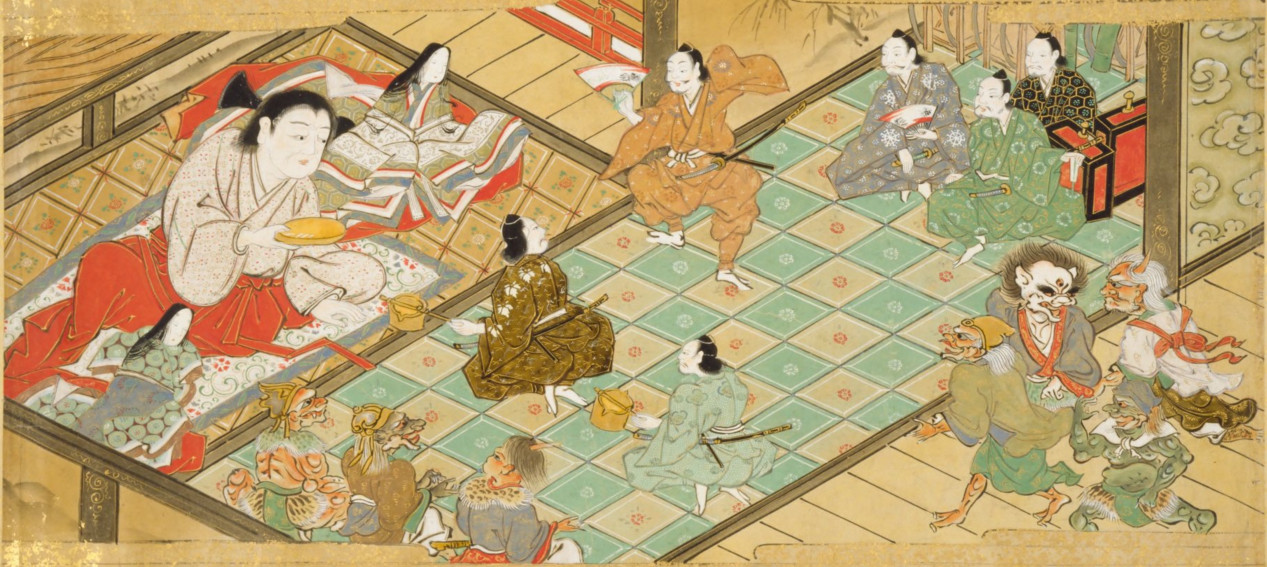
(5) Raikou and his men were guided to Shuten douji's grand mountain palace. Shuten Dōji, towering human form with pale red skin, disheveled short hair and adorned in a checkered kimono with a crimson hakama, appeared and looked down on Raikō and his men.
(6) They are served a feast of human flesh and blood by his beautiful captive maidens.
(7) In return, the men offerred Shuten douji the special sake containing divine elixir.
(8) They also served the special sake to the the demon gang rendering them helplessly drunk.
(9) The special sake put Shuten douji into a sound sleep.
(10) The warriors threw off their disguises, bound Shuten douji with the cord, and struck him with a vengeance and Raikou beheaded him. Yet the demon's decapitated head fiew into the air and landed upon Raikou in an attempt to bite his head off. Raikou was saved by the magic helmet.
(11) The warriors struck the drunken ogres.
(12) In the end, the warriors won and took the trophy head back to the imperial capital.
Shuten Dōji Will Drink Your Blood and Eat Your Flesh
One thousand years ago, the ogre giant Shuten Dōji lounged in his mountain castle, sipping wine and snacking on samurai meat. As he dined with his demonic companions, with a gaggle of captive young noblewomen to serve them, perhaps he wondered how sweet life had turned out for him. A life of debauchery rewarded day after day with earthly pleasures.
Nearby by in Kyoto, the capital of medieval Japan, the emperor grew concerned. Each day, he was forced to stand by and watch, as Shuten Dōji kidnapped one woman after another. The emperor called for the legendary samurai Minaomoto "Raiko" Yorimitsu and his five retainers to conquer the ogre giant. The handsome and morally righteous Riako accepted the challenge, and after a brief stop to pray, he and his band set off toward Shuten Dōji’s castle on Mount Oe.
Disguised as Buddhist monks to avoid suspicion, with armor hidden in their wooden backpacks, the good guys traveled deep into the mountains. Along the way, the disguised samurai met three gods in human form, who shared their strong dislike for the ways of the wicked Shuten Dōji. Raiko is given a magical helmet, as well as a special sleep-inducing sake (rice wine), and the gods guide him to the castle.
When the samurai arrive, they are welcomed and entertained by Shuten Dōji, who is fooled by their monk costumes. After they enter the giant’s home, they watch as horned demons slice off human thigh and shoulder meat before eating it like sushi. Dōji settles down on his favorite decorative rug as the captured noblewomen enter through hand-painted doors to serve the guests wine. It’s then when Raiko gives Shuten Dōji the special sake, and the giant quickly becomes drunk and sleepy.
What Raiko doesn't know, is that whenever someone serves Shuten Dōji wine, the ogre giant transforms into a hairy, red, demon. But Raiko, nevertheless, ambushes and beheads the monster. The hero can’t declare victory, however, because when Raiko least expects it, Shuten Dōji’s head jumps back to life and attempts to kill the samurai. Protected by his magic helmet, Raiko deflects the attacks, conquers the monster and his demon henchmen, and marches victoriously back to Kyoto hauling Shuten Doji’s head in an ox-cart.
Good vanquishes evil once again.
Though fictional, there is at least one truth to this tale. No matter what period you live in, monsters, heroes and captured maidens make for good entertainment.
大江山酒天童子絵巻物
1 2
2 3
3
4
 5
5 6
6
7
 8
8 9
9
10
 11
11 12
12
6
 10
10
Close-up view
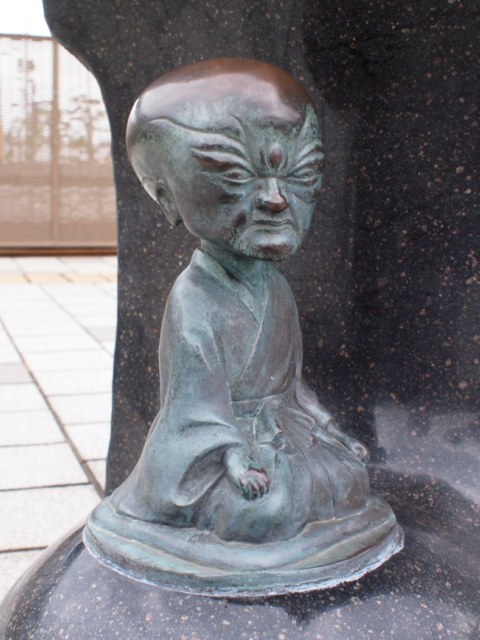
Mr. Shuten Doji

Mr. Shuten Doji (酒呑童子先生)
Sake Child Monster

Sake Child Monster (酒呑童怪)
Ibaraki dōji (いばらきどうじ 茨木童子)
TRANSLATION: a nickname meaning “thorn tree child”
ORIGIN: Ibaraki dōji was one of the most famous and most feared demons to wreck havoc on Japan. She was the chief deputy to Shuten dōji, the greatest oni of all. Not very much is known about Ibaraki dōji’s life; it isn’t even known if Ibaraki dōji was male or female. Most stories and illustrations depict Ibaraki dōji as a kijo, or a female oni; yet there are other stories which refer to Shuten dōji’s deputy as a male. There is also a possibility that not only were the two partners in crime, but also lovers. What is known is that Ibaraki dōji was a wholly terrible and fearsome monster, bent of wreaking as much havoc in the human world as possible.
LEGENDS: Ibaraki dōji’s most famous story takes place at Rashōmon, the southern gate of old Kyotos city walls. Rashōmon was built in 789, but after the Heian period it fell into serious disrepair and became known as an unsavory place. It was overgrown and unkempt. Thieves and bandits hung out near it. It even served as a dumping point for unwanted babies, and a spot to dispose of murder victims. But the scariest part of its haunted reputation was the legend of Rashōmon no oni — the demon of Rashōmon.
After his celebrated victory over Shuten dōji, the hero Minamoto no Yorimitsu returned triumphant to Kyoto. He was celebrating at his home with his deputies — Sakata no Kintoki, Urabe no Suetake, Usui Sadamitsu, and Watanabe no Tsuna — when Fujiwara no Yasumasa, a noble, informed them that an oni was seen haunting Rashōmon gate. Watanabe no Tsuna, having just returned from a great battle with Shuten dōji’s clan, could not believe that there were any oni left, and single-handedly went out to investigate. He mounted his horse and went south.
When Tsuna arrived at the gate, a great howling wind broke out and his horse could travel no further. He dismounted and went on foot. Approaching the gate in the fierce gale, he noticed an enormous hand suddenly reach out of the dark to grab his helmet. Tsuna wasted no time, and swung his great katana around, severing the arm of an enormous demon: it was Ibaraki dōji, coming to avenge the murder of Shuten dōji. The injured demon ran away, leaving her arm behind, and Rashōmon was no longer haunted.
Ibaraki dōji later returned to Rashōmon, looking for her arm. She disguised herself as Watanabe no Tsuna’s wetnurse, and was able to steal back her severed arm and flee. After that, her whereabouts were never known again, though for many years after, occasionally in some town or another, villagers would claim that they had seen Ibaraki dōji coming or going, always in connection with some kind of mischief.
Ibaraki dōji (いばらきどうじ 茨木童子)
Ibaraki dōji (茨木童子 or 茨城童子 "Ibaraki child") is an oni (demon or ogre) featured in tales of the Heian era.
After he became an oni, he met Shuten-doji and became his subordinate, and together they went on a rampage in Kyoto.
The Shuten-doji gang was based on Mt. Ooe (said to be in Tamba province, but there are also theories that it may have been at Mt. Ooe (大枝), at the boundary between Kyoto and Kameoka.
BIRTH
Echigo theory: There is a theory that, just like Shuten-doji, Ibaraki doji was born at Echigo.
As a beautiful boy, he wooed many females and received a mountain load of love letters from girls, and her mother, anxious about his future, sent him to Yahiko-jinja.
However, when, one time, he left the Yahiko-jinja returning to his home, her mother found a "love letter smeared with blood" hidden in his luggage. Upon licking that blood by accidence, his appearance at once turned into that of an oni, and following the beam, broke the gable, and fled.
At that time, Shuten-doji heard about a girl who died from despair from not receiving a reply to her love letter from him, He searched and found that letter. While opening a tsuzura within the letter, a strange smoke started rising, causing him to lost consciousness. Before he knew it, he became an oni, and thus fled the shrine and went on to reach the extremes of evil.
Ibaraki-doji, finding sympathy for each other with Shuten-doji, became his underling, and attacked the surrounding villages together, but when his mother heard that rumor, she stood in front of Ibaraki-doji wearing his clothes he had as a newborn, and perhaps as a result of suddenly recovering his memories of his childhood, he promised not to tread the neighborhood again. He then went to Dogakushi, Shinano and other places, and finally aimed for the capital.
Settsu theory: There are stories that he was born in Amagasaki, Hyogo, and Ibaraki, Osaka, among other places, and documented from various sources like the Settsu Meisho Zue (摂津名所図会), Settsuyou Kendan (摂陽研説), and Setuyou Gundan (摂陽群談).
In the Settsuyou Gundan of 1701, he was born at the village of Tomatsu in Settsu (now Amagasaki, Hyogo), was thrown away at the village of Ibaraki (Ibaraki city). He was picked up by Shuten-doji, given the name Ibaraki, and raised.
In Settsuyou Kendan, Ibaraki-doji was a native of Matsumura, Kawanabe (Tomatsu, or a part of the city of Amagasaki), but was born with fangs and long hair and a glint in his eye, and with the strength that was greater than that of grown-ups. His family was fearful of him, and left him around Ibaraki town, Shimashimo, and he was picked up by Shuten-doji.
According to the legend in Ibaraki city, Ibaraki-doji was born in the town of Mizuo (now Ibaraki city), but after a difficult delivery following a long pregnancy of 18 months, he was borned with grown teeth, and the ability to walk, He suddenly laughed with sharp eyes while looking at his mother, causing his mother to die of shock. The oni-like child was too much for his father, so he was thrown away in front of a kamiyui in Kuzugami forest at the town of Ibaraki, and was then raised by the childless lady of a barbershop. Doji, who excelled at strength and physique at a young age, was also too much for the barbershop, but was taught the job at the barbershop and was able to be settled down. However, one day, Doji injured a customer's face with a razor, and in fright, tried licking his blood-stained fingers to clean it. But he got used to the taste of blood, and from then on intentionally injured customers' faces in order to lick the blood. After getting angry responses at the barber shop, the despondent Doji leaned against a bridge over a brook and dropped his head in shame. When he noticed how his face reflected in the water he became an oni, and did not return to the barbershop. He fled north to a mountain in Tamba, and before long met Shuten-doji and became his servant. That bridge was called "Ibaraki Doji Sugatami-bashi" but no longer exists, and there is a monument at its former site with the inscription.
Ibaraki dōji and Watanabe no Tsuna
Rashōmon Version
When the Mt. Ooe oni extermination ended and everything calmed back down, Minamoto no Yorimitsu and his Four Guardian Kings gathered together having a drinking banquet. They were notified that an oni have appeared in Rashōmon and people are afraid.
1. They all agreed to have a contest of courage. When it became Tsuna’s turn, he went out the door, met an oni, a battle ensued, and he cut off the oni’s arm.
2. Tsuna, who did not think that there was any survivor among the oni, went to Rashōmon to calm thing down, But there he found Ibaraki-doji (or a beautiful girl who was Ibaraki-doji in disguise), and as a result of battle, he cut off the oni’s arm.
Afterwards, Ibaraki-doji changed his appearance, returned and took back the arm.
Ichijou Modorihashi Version
In some versions of the stories, Ibaraki-doji would appear on Ichijou Modorihashi (一条戻橋) as a young, helpless beautiful girl on the road who looked worried. So Watanabe no Tsuna let her ride on his horse, but the girl suddenly transformed into an oni, and grasped Tsuna’s hair, flew in the air, and took him to Mount Atago. Tsuna, not panicked at all, cut off the oni’s arm, averting disaster.
Tsuna showed the oni’s arm to Minamoto no Yorimitsu. Yorimitsu consulted with an onmyoji (there are versions where it was Abe no Seimei), who said that “the oni will surely come for its arm, so confine yourself in your house with all necessary protection for seven days, and don’t let anyone in.” Several days after that, Ibaraki-doji tried to invade Tsuna’s estate using the remaining arm, but due to the power of a Humane King Sutra and a talisman, Ibaraki-doji was not able to enter.
Finally, on the evening of the seventh night, on Settsu, Tsuna’s aunt, Mashiba (there are also versions where it was not his aunt, but his foster mother) came to visitTsuna at his estate. Tsuna told his aunt of the circumstances, and said that he couldn’t let her in. His old aunt grieved and pleaded, “Since your young age, I had raised you with great care, and my reward is this kind of treatment?” and by that, Tsuna disobeyed his instructions, and let his aunt into the house. However, his aunt was, in reality, Ibaraki-doji in disguise. The “aunt” expressed desire to see the arm that Tsuna cut off from the oni, and after the arm was taken out from its sealed box, the “aunt” suddenly transformed back to oni Ibaraki-doji, took the arm, flew up in the air, broke the gable, and disappeared in the distance in the sky.

















.jpg)


