Computer Arts
Computer art is any art in which computers play a role in production or display of the artwork. Such art can be an image, sound, animation, video, CD-ROM, DVD-ROM, videogame, web site, algorithm, performance or gallery installation. Many traditional disciplines are now integrating digital technologies and, as a result, the lines between traditional works of art and new media works created using computers has been blurred. For instance, an artist may combine traditional painting with algorithm art and other digital techniques. As a result, defining computer art by its end product can thus be difficult. Computer art is by its nature evolutionary since changes in technology and software directly affect what is possible. Notable artists in this vein include Manfred Mohr, Ronald Davis, Harold Cohen, Joseph Nechvatal, George Grie, Olga Kisseleva, John Lansdown, and Jean-Pierre Hébert. (Wikipedia)
Digital Art

Digital art is an artistic work or practice that uses digital technology as an essential part of the creative or presentation process. Since the 1970s, various names have been used to describe the process including computer art and multimedia art, and digital art is itself placed under the larger umbrella term new media art.
After some initial resistance, the impact of digital technology has transformed activities such as painting, drawing, sculpture and music/sound art, while new forms, such as net art, digital installation art, and virtual reality, have become recognized artistic practices. More generally the term digital artist is used to describe an artist who makes use of digital technologies in the production of art. In an expanded sense, "digital art" is a term applied to contemporary art that uses the methods of mass production or digital media.
The techniques of digital art are used extensively by the mainstream media in advertisements, and by film-makers to produce visual effects. Desktop publishing has had a huge impact on the publishing world, although that is more related to graphic design. Both digital and traditional artists use many sources of electronic information and programs to create their work. Given the parallels between visual and musical arts, it is possible that general acceptance of the value of digital art will progress in much the same way as the increased acceptance of electronically produced music over the last three decades.
Digital art can be purely computer-generated (such as fractals and algorithmic art) or taken from other sources, such as a scanned photograph or an image drawn using vector graphics software using a mouse or graphics tablet.[8] Though technically the term may be applied to art done using other media or processes and merely scanned in, it is usually reserved for art that has been non-trivially modified by a computing process (such as a computer program, microcontroller or any electronic system capable of interpreting an input to create an output); digitized text data and raw audio and video recordings are not usually considered digital art in themselves, but can be part of the larger project of computer art and information art. Artworks are considered digital painting when created in similar fashion to non-digital paintings but using software on a computer platform and digitally outputting the resulting image as painted on canvas. (Wikipedia)
Computer Generated Fractal Landscape
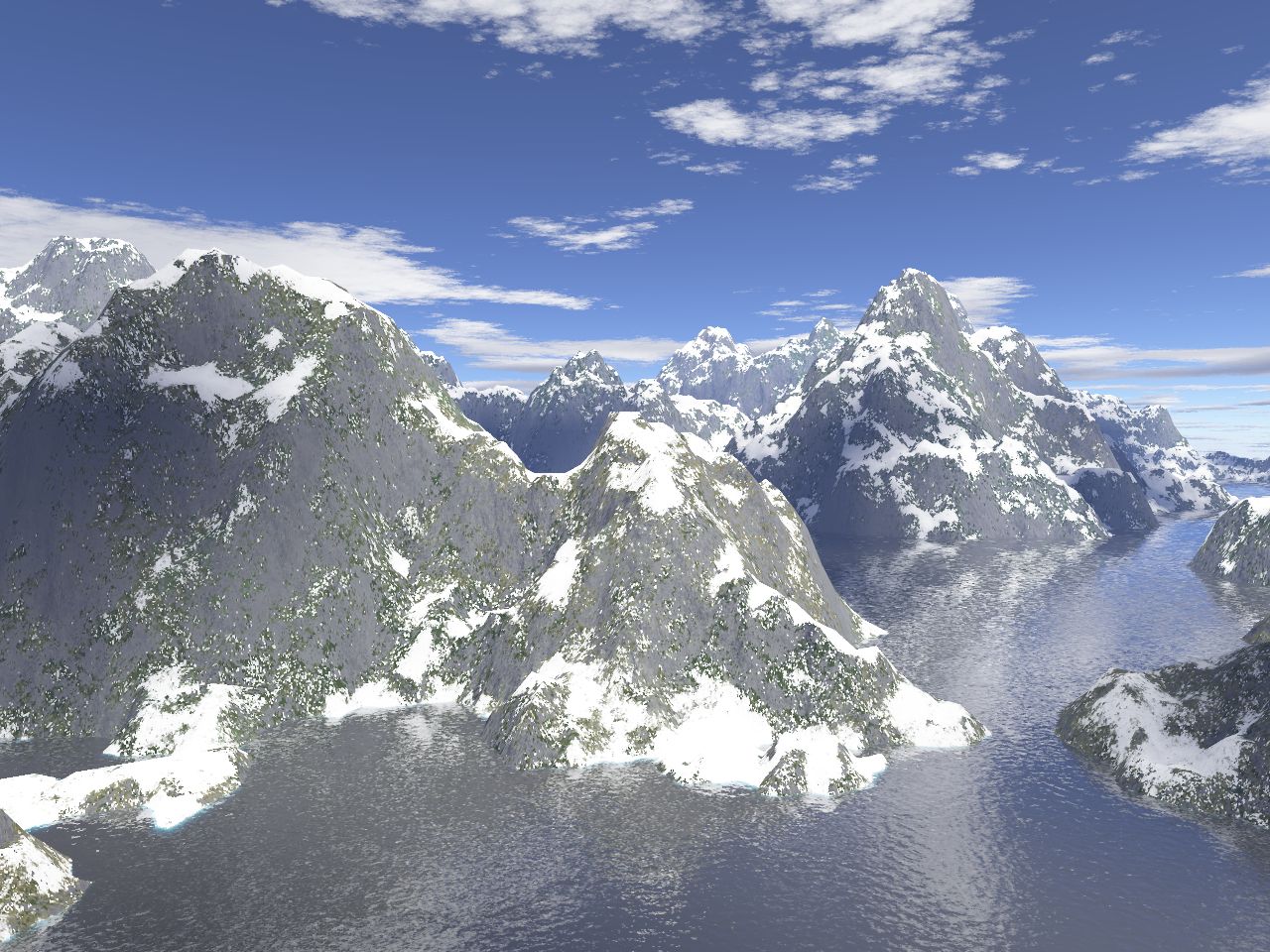
A fractal landscape is a surface generated using a stochastic algorithm designed to produce fractal behaviour that mimics the appearance of natural terrain. In other words, the result of the procedure is not a deterministic fractal surface, but rather a random surface that exhibits fractal behaviour.
Many natural phenomena exhibit some form of statistical self-similarity that can be modeled by fractal surfaces. Moreover, variations in surface texture provide important visual cues to the orientation and slopes of surfaces, and the use of almost self-similar fractal patterns can help create natural looking visual effects. The modeling of the Earth's rough surfaces via fractional Brownian motion was first proposed by Benoît Mandelbrot.
Because the intended result of the process is to produce a landscape, rather than a mathematical function, processes are frequently applied to such landscapes that may affect the stationarity and even the overall fractal behavior of such a surface, in the interests of producing a more convincing landscape.. (Wikipedia)
Water ballerina

Photoshop Tutorial for Beginners: Water Splash
See it at youtube.com




Alebrijes wikilearning

Alebrijes wikilearning
Animation clip about alebrijes and the annual monumental alebrije parade in Mexico City
See it at Youtube.com
Animation of Hokusai’s Painting