Vishnu

Vishnu (/ˈvɪʃnuː/; Sanskrit: विष्णु) is a popular Hindu deity, the Supreme God of Vaishnavism (one of the three principal denominations of Hinduism) and one of the three supreme deities (Trimurti) of Hinduism. He is also known as Narayana and Hari. As one of the five primary forms of God in the Smarta tradition, He is conceived as "the Preserver or the Protector" within the Trimurti, the Hindu Trinity of the divinity.
In Hindu sacred texts, Vishnu is usually described as having dark complexion of water-filled clouds and as having four arms. He is depicted as a blue being, holding a padma (lotus flower) in the lower left hand, the Kaumodaki gada (mace) in the lower right hand, the Panchajanya shankha (conch) in the upper left hand and the discus weapon Sudarshana Chakra in the upper right hand. (Wikipedia)
One of the principal Hindu deities and worshiped as the protector and preserver of worlds and restorer of cosmic order dharma. Vishnu is often conceived as a member of the Trimurti which includes Brahma and Shiva.
Vishnu was first mentioned in the Veda as a minor deity in the Hindu pantheon.
By his worshipers Vishnu is regarded as the supreme God, of whom other gods are secondary manifestations.
He is said to be the cosmic ocean nara and known as Narayana, or "one who moves on the waters" and depicted as resting on Ananta, a many-headed serpent which floats on the cosmic ocean. The river Ganga is said to originate from Vishnu's feet.
Vishnu is usually represented as dark blue in color, dressed in yellow robes, crowned and with four arms.
Bearing in his four hands are four attributes: conch shell ( the sound that comes out from this conch is Om : the primeval sound of universe), discus or chakra that symbolizes the mind and the need of spiritual growth by destroying one's ego and ignorance, a club or mace symbolizes the authority and power from which all mental and physical strength is derived, and lotus that represents the Truth and is the symbol of glorious existence and liberation .
His mount is the eagle Garuda, and his consort is Lakshmi, the goddess of wealth and fortune.
Vishnu is a very popular deity and is also worshipped through his avatars, particularly Rama and Krishna. He manifests himself anytime there is an imbalance between good and evil on the earth to re-establish the peace and harmony. His appearances are innumerable, but in practice 10 are most common.
Vishnu has a "thousands names" which symbolize in fact just as many of his aspects. The repetition of Vishnu's thousand names as acts of devotion is believed to bring great merit.
Maha Visnu and Laksmi on Ananta Sesa with Dasavatara

#1: Maha Visnu and Laksmi on Ananta Sesa with Dasavatara ( Ten incarnations of Visnu )
Image source: www.harekrsna.com
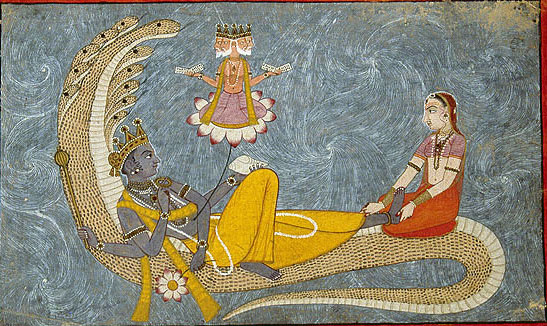

The Hindu God Vishnu with his consort Lakshmi resting on Sheshnag.
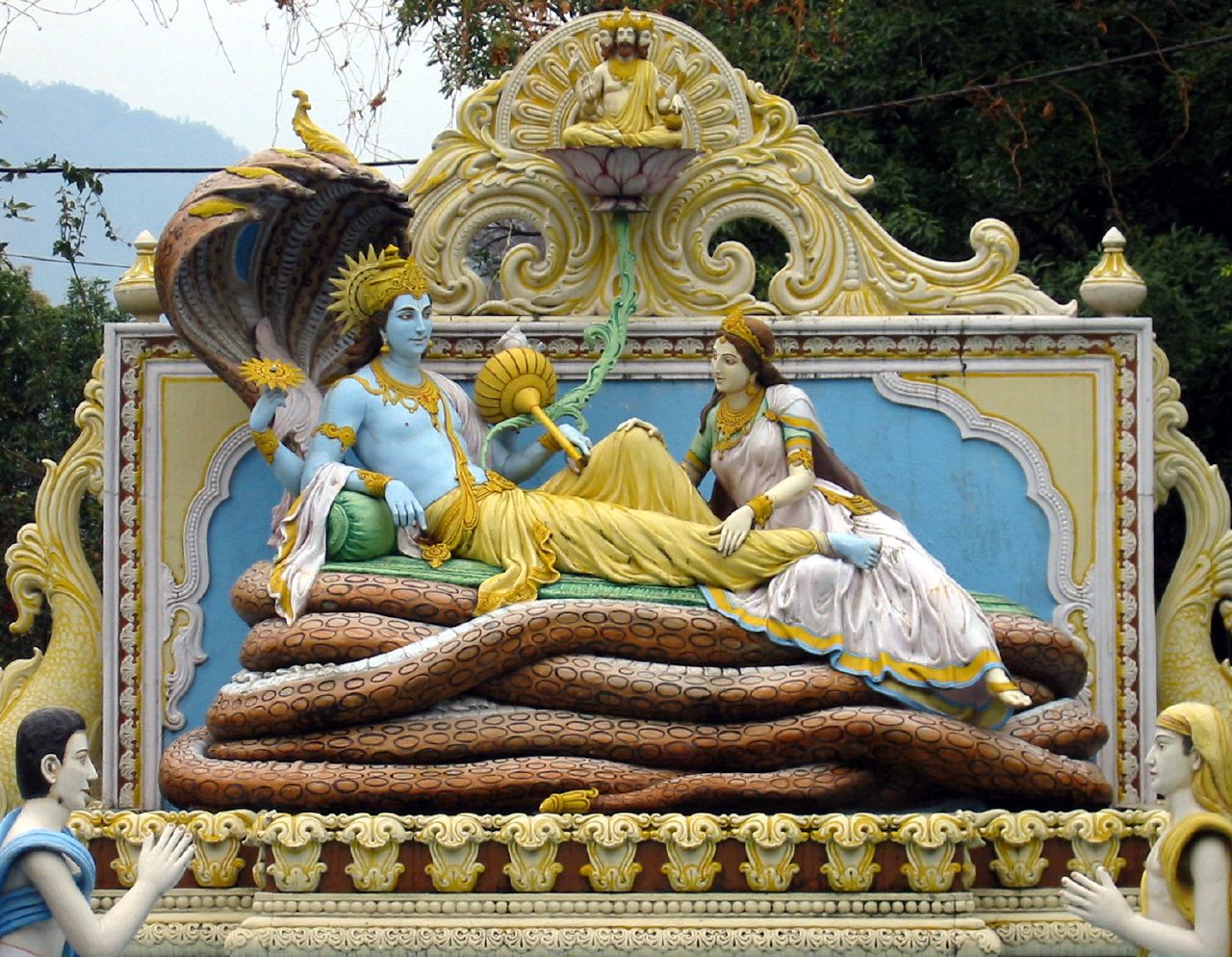
#4: The Hindu God Vishnu with his consort Lakshmi resting on Sheshnag.
Image source: commons.wikimedia.org
Click here for larger imageImage source: media.photobucket.com

Maha Visnu in the cosmic ocean

#6: Maha Visnu in the cosmic ocean
Image source: www.harekrsna.com and satsangh.mantraaonline.com


Painting of Garuda carrying Vishnu and his wife Lakshmi

#11: Painting of Garuda carrying Vishnu and his wife Lakshmi.
Image source: commons.wikimedia.org


Brahma, Vishnu and Shiva seated on lotuses with their consorts

#14: Brahma, Vishnu and Shiva seated on lotuses with their consorts, Saraswati, Lakshmi and Paravati respectively. ca 1770. Guler, India.
Click here to see more Trimurti: the divine Trinity in Hinduism, which includes,Brahma, Vishnu and Shiva.
Image source: commons.wikimedia.org
Downey Laxminarayan Dev

#15: Downey Laxminarayan Dev: Images at Downey Swaminarayan Temple
Image source: commons.wikimedia.org


The God Vishnu with Lakshmi and Sarasvati

#18: The God Vishnu with Lakshmi and Sarasvati 12th century Stone, probably phyllite
Image source: commons.wikimedia.org
Standing Figure of Vishnu, 10th century. Gilt bronze (high copper content) Brooklyn Museum

#19: Standing bronze figure of Vishnu, 10th century
Image source: commons.wikimedia.org


Vishnu seated on coiled serpent throne

#21: Vishnu seated on coiled serpent throne
Image source: www.flickr.com
Stela of a Four-Armed Vishnu

#22: Stela of a Four-Armed Vishnu, Metropolitan Museum of Art -New York
Image source: www.flickr.com
Vishnu and Garuda Changu Narayan

#23: Vishnu and Garuda at Changu Narayan Temple, Nepal
Image source: commons.wikimedia.org

Vishnu at Changu Narayan Temple, Nepal

#24: Vishnu at Changu Narayan Temple, Nepal
Image source: commons.wikimedia.org
