
Image source: Multiple sources
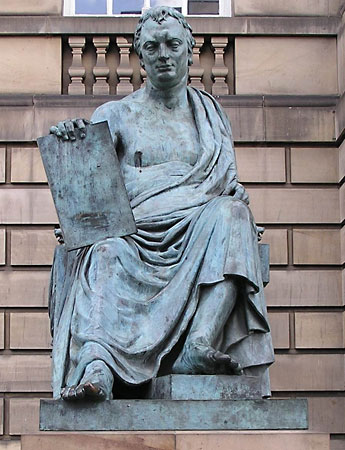
Image source: commons.wikimedia.org

David Hume
David Hume (April 26, 1711 - August 25, 1776) was a Scottish philosopher and historian. Hume was the third, the most radical and, in the eyes of many, the most important of the so-called British Empiricists, after the English John Locke and the Anglo-Irish George Berkeley. Along with Adam Smith and Thomas Reid, he was one of the most important representatives in the Scottish Enlightenment. Hume remains a towering figure in the history of philosophy and is perhaps the most significant English-speaking philosopher of all times.
David Hume’s place in the history of philosophy is strongly associated with his advocacy of skepticism, though his was a “mitigated” form of skepticism, based on an empirical or natural approach and the respect of common sense. It was also Hume’s merit to stretch the line of thought of his predecessors to the breaking point and to offer a more consistent, though in many ways negative, view of things, rejecting what he considered to be false certainties. Immanuel Kant credited Hume with awakening him from his “dogmatic slumber” but opposed the conclusions of his skepticism. Still, the conviction that it is impossible for the human mind to make meaningful statements about that which transcends our senses has become part of Kant’s own system. It has also permanently influenced western thought in a way that is detrimental to religious inquiry of any kind.
By stressing the superiority of the inductive method of empiricism over the deductive method of rationalism, Hume approaches cognition from the outside (experiences coming from the senses) rather than from the inside (the a priori constitution of the mind). This naturally leads to tentative conclusions at best (as Hume himself concedes) and easily to skepticism. Also, the unity of apperception (the oneness of the self) naturally comes to be rejected in favor of a bundle theory of the self, consisting in a mere aggregate of perceptions.
At the age of eighteen, in 1729, Hume made a philosophical discovery that opened up to him "a new scene of thought." He did not recount what this was, but it seems likely to have been his theory of causality—that our beliefs about cause and effect depend on sentiment, custom and habit, and not upon reason or abstract, timeless, general Laws of Nature.
In 1734, he completed A Treatise of Human Nature at the age of 26. Many scholars today consider the Treatise to be Hume's most important work..
(New World Encyclopedia)
'Mitigated' Skepticism
In spite of his reputation as the quintessential skeptic, Hume begins his considerations by refuting several forms of skepticism. Descartes’ methodic doubt is considered absurd, since we all in fact know about our existence. But, more importantly, the certainty Descartes thought to arrive at through his method is challenged as illusory. If humankind were really subjected to the kind of doubt Descartes tries to overcome by his cogito ergo sum, our condition would be incurable. Arriving at certainty though strict reasoning based on an original principle, in Hume’s eyes, is pure fallacy. Still, Hume admits that the Cartesian method is valid to the extent that it chooses to proceed by small, captious steps, with constant reference to experience.
Next, Hume rejects the kind of skepticism that implies the “absolute fallaciousness of [our] mental faculties.” It is clear, he says, that when the testimony of our senses is doubted it is usually the false interpretation of our reasoning that is to be blamed. In particular, in reference to Berkeley, Hume discards as laughable the denial of the reality of the external world.
In reference to Pyrrho of Elis, and ancient Greek philosopher who advocated total suspension of belief, i.e., absolute skepticism, Hume states that moral action and “the occupations of common life” make such doubts “vanish like smoke.” Philosophical doubt is irrelevant to everyday life, which is based on common sense and “nature.”
However, for “more profound research,” notably concerning everything that is beyond the immediate testimony of our senses, philosophical doubt has its place. Hume’s advocacy of mitigated skepticism precisely touches the point that would so strongly influence Immanuel Kant: we cannot possibly apply our mind to those areas of inquiry that our outside or beyond “the narrow capacity of human understanding.” Though Kant would eventually reject Hume’s skeptical conclusions, while accepting his starting point, he would retain much of his skepticism on matters such as God and the eternal life.
(New World Encyclopedia)
Ideas and impressions
Hume believes that all human knowledge comes to us through our senses. Our perceptions, as he called them, can be divided into two categories: ideas and impressions. He defines these terms thus in his An Enquiry Concerning Human Understanding:
By the term impression, then, I mean all our more lively perceptions, when we hear, or see, or feel, or love, or hate, or desire, or will. And impressions are distinguished from ideas, which are the less lively perceptions, of which we are conscious, when we reflect on any of those sensations or movements above mentioned.
He further specifies ideas, saying,
It seems a proposition, which will not admit of much dispute, that all our ideas are nothing but copies of our impressions, or, in other words, that it is impossible for us to think of anything, which we have not antecedently felt, either by our external or internal senses.
This forms an important aspect of Hume's skepticism, for he says that we cannot be certain a thing, such as God, a soul, or a self, exists unless we can point out the impression from which the idea of the thing is derived.
(New World Encyclopedia)
The problem of causation
When one event continually follows after another, most people think that a connection between the two events makes the second event follow from the first. Hume challenged this belief in the first book of his Treatise on Human Nature and later in his Enquiry Concerning Human Understanding. He noted that although we do perceive the one event following the other, we do not perceive any necessary connection between the two. And according to his skeptical epistemology, we can only trust the knowledge that we acquire from our perceptions. Hume asserted that our idea of causation consists of little more than the expectation for certain events to result after other events that precede them:
We have no other notion of cause and effect, but that of certain objects, which have been always conjoined together, and which in all past instances have been found inseparable. We cannot penetrate into the reason of the conjunction. We only observe the thing itself, and always find that from the constant conjunction the objects acquire a union in the imagination. (Hume 1740, 93)
Hume held that one cannot actually say that one event caused another. All one knows for sure is that one event is correlated to another. For this Hume coined the term 'constant conjunction.’ That is, when we see that one event always 'causes' another, what we are really seeing is that one event has always been 'constantly conjoined' to the other. As a consequence, we have no reason to believe that one caused the other, or that they will continue to be 'constantly conjoined' in the future. The reason we do believe in cause and effect is not because cause and effect are the actual way of nature; we believe because of the psychological habits of human nature.
Such a lean conception robs causation of all its force, and some later Humeans like Bertrand Russell have dismissed the notion of causation altogether as something akin to superstition. But this defies common sense, thereby creating the problem of causation: what justifies our belief in a causal connection and what kind of connection can we have knowledge of? Kant would try to solve the problem by stating that the principle of cause and effect is a fundamental law of our mind’s functioning, though we are not entitled to say that it applies to things themselves. Hume held that we have an instinctive belief in causation based on the development of habits in our nervous system, a belief that we cannot eliminate, but which we cannot prove true through any argument, deductive or inductive, just as is the case with regard to our belief in the reality of the external world.
(New World Encyclopedia)
The problem of induction
In Enquiry Concerning Human Understanding (EHU), §4.1.20-27, §4.2.28-33., Hume articulated his view that all human reasoning is of two kinds, Relation of Ideas and Matters of Fact. While the former involves abstract concepts like mathematics where deductive certitude presides, the latter involves empirical experience about which all thought is inductive. Now, since according to Hume we can know nothing about nature prior to its experience, even a rational man with no experience "could not have inferred from the fluidity and transparency of water that it would suffocate him, or from the light and warmth of fire that it would consume him." (EHU, 4.1.6) Thus, all we can say, think, or predict about nature must come from prior experience, which lays the foundation for the necessity of induction.
An inductive inference assumes that the past acts as a reliable guide to the future. For example, if in the past it has rained 60 percent of the time that a given conjunction of atmospheric conditions arose, then in the future it will probably rain 60 percent of the time a similar conjunction arises. But how can we justify such an inference, known as the principle of induction? Hume suggested two possible justifications, but rejected both:
1.The first justification states that, as a matter of logical necessity, the future must resemble the past. But, Hume pointed out, we can conceive of a chaotic, erratic world where the future has nothing to do with the past—or, more tamely, a world just like ours right up until the present, at which point things change completely. So nothing makes the principle of induction logically necessary.
2.The second justification, more modestly, appeals to the past success of induction—it has worked most often in the past, so it will probably continue to work most often in the future. But, as Hume notes, this justification uses circular reasoning in attempting to justify induction by merely reiterating it, bringing us back where we started.
The noted twentieth century theoretician and philosopher Bertrand Russell confirmed and elaborated Hume's analysis of the problem in his work, The Problems of Philosophy, chapter 6.
Despite Hume's critique of induction, he held that it was superior to deduction in its realm of empirical thought. As he states:
…this operation of the mind, by which we infer like effects from like causes, and vice versa, is so essential to the subsistence of all human creatures, it is not probable, that it could be trusted to the fallacious deductions of our reason, which is slow in its operations; appears not, in any degree, during the first years of infancy; and at best is, in every age and period of human life, extremely liable to error and mistake. (EHU, 5.2.22)
(New World Encyclopedia)
Sentiment based ethical theory
Hume's approach is fundamentally an empirical one. Instead of telling us how morality ought to operate, he purports to tell us how we do actually make moral judgments. He comes to the conclusion that most if not all of the behaviors we approve of increase public utility. Does this then mean that we make moral judgments on self-interest alone? Unlike his fellow empiricist Thomas Hobbes, Hume argues that this is not in fact the case. In addition to considerations of self-interest, he asserts, we are swayed by our sympathies for our fellow men.
(New World Encyclopedia)
Free will versus determinism
Just about everyone has noticed the apparent conflict between free will and determinism—if your actions were determined to happen billions of years ago, then how can they be up to you? But Hume noted another conflict, one that turned the problem of free will into a full-fledged dilemma: free will is incompatible with indeterminism. Imagine that your actions are not determined by what events came before. Then your actions are, it seems, completely random. Moreover, and most importantly for Hume, they are not determined by your character—your desires, your preferences, your values, etc. How can we hold someone responsible for an action that did not result from his character? How can we hold someone responsible for an action that randomly occurred? Free will seems to require determinism, because otherwise, the agent and the action wouldn't be connected in the way required of freely chosen actions. So now, nearly everyone believes in free will, free will seems inconsistent with determinism, and free will seems to require determinism. Hume's view is that human behavior, like everything else, is caused, and therefore holding people responsible for their actions should focus on rewarding them or punishing them in such a way that they will try to do what is morally desirable and will try to avoid doing what is morally reprehensible (see also compatibilism). Kant would later attempt to reconcile the determinism of nature and the apparent free choice of our moral actions.
(New World Encyclopedia)