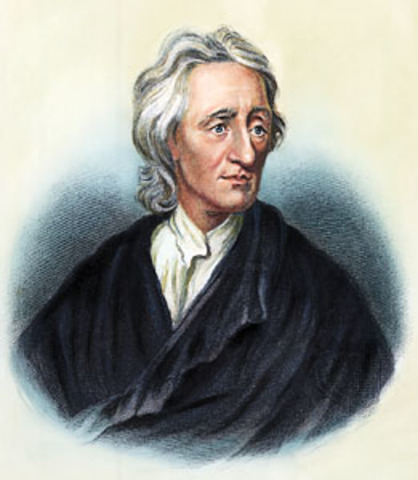
Image source: Multiple sources

Image source: Encyclopædia Britannica
John Locke
John Locke (August 29, 1632 – October 28, 1704) was a seventeenth-century English philosopher and social activist concerned primarily with governance, political theory, epistemology, and religious tolerance. His political writings provide a pivotal philosophical defense for modern democratic institutions. As a philosopher, he was an early proponent of Empiricism. Locke also made contributions in the fields of theology, education, and economics.
Though Thomas Hobbes and especially Francis Bacon had pioneered the empirical method before him, John Locke is considered the first of the three major British Empiricists along with George Berkeley and David Hume. Locke is known for his rejection of the theory of innate ideas in favor of an emphasis on the role of sense perception, and for the expression “tabula rasa” that is associated with this position.
Locke followed the lead of Descartes in moving away from the remnants of medieval scholasticism, but he rejected Descartes’ rationalism in favor of the empirical method. With Locke, the opposition between continental rationalism and British empiricism solidified, both currents of thought seeking to replace medieval consciousness in their own distinct way, based on the autonomy of the human mind. Locke’s epistemology, insisting on the role of experience, stands in direct relationship to his stand against abusive authority in questions of religious freedom and political governance.
Locke’s thought system as a whole is not without inconsistencies. Unlike philosophers like Berkeley, Hume, or Kant, his aim was not to push one precise idea or method to its extreme conclusions. His principal aim was to account for reality by staying as close as possible to common sense, and he was always willing to admit that there were limits and flaws in his tentative explanations. In that sense, it can be said that his empiricism also contained a good dose of healthy pragmatism.
Locke's first major published work was A Letter Concerning Toleration. Religious toleration within Great Britain was a subject of great interest for Locke; he wrote several subsequent essays in its defense prior to his death. Locke's upbringing among non-conformist Protestants made him sensitive to differing theological viewpoints. He recoiled, however, from what he saw as the divisive character of some non-conformist sects. Locke became a strong supporter of the Church of England. By adopting a latitudinarian theological stance, Locke believed, the national church could serve as an instrument for social harmony.
Locke is best known for two works, An Essay Concerning Human Understanding and Two Treatises of Government. The Essay was commenced in 1671, and as Locke himself described, was written in fits and starts over the next 18 years. It was finally published in December 1689. Though the exact dates of the composition of the Two Treatises are a matter of dispute, it is clear that the bulk of the writing took place in the period from 1679-1682. It was therefore much more of a commentary on the exclusion crisis than it was a justification of the Glorious Revolution of 1688, though no one doubts that Locke substantively revised it to serve this latter purpose.
(New World Encyclopedia)
His early works in political philosophy include the Essays on the Law of Nature (1663–1664), and the pro-tolerance An Essay on Toleration (1667). His major and mature works in political philosophy were Two Treatises of Government (written 1680–1683, published in 1689) and the Letter Concerning Toleration (written in 1685, published 1689, with the subsequent letters published in 1690 and 1692). The core of Locke’s classical liberalism is presented in the Second Treatise of Government.
Locke established his reputation as a major figure in philosophy with the publication of his treatise in epistemology, An Essay Concerning Human Understanding (1689). His most important later work was The Reasonableness of Christianity (1695).
(The Encyclopedia of Libertarianism Copy)
An Essay Concerning Human Understanding
Locke’s Essay is that of inquiring into “original, certainty, and extent of human knowledge, together with the grounds and degrees of belief, opinion, and assent”. He hoped to discover where our ideas and our knowledge come from, where we are capable of knowledge about, how certain our knowledge actually is, and when we may be justified in holding opinions based on our ideas. The value of such an understanding, Locke asserted, is that one would thus know the powers and the limits of human understanding, so that “the busy mind of man” would then restrict itself to considering only those questions with which it was actually capable of dealing and would “sit down in a quite ignorance of those things” which were beyond the reach of its capacities.
Summary:
At birth the mind is a blank tablet; no one is born with innate ideas.
All of our ideas come from experience, either from sensation or by reflection.
All simple ideas come from experience; and the mind, by combining simple ideas, forms new complex ideas.
The qualities of objects are either primary or secondary:
Primary qualities – solidity, extension, figure, mobility, and number – are inseparable from object.
Secondary qualities – such as colors and odors – are in the observer.
The substance of objects is something – we know not what – which we have to assume as the support of an object’s qualities.
Abstract general ideas:
All things that exist, Locke asserted, are particulars, but by abstracting from our ideas of things, by separating from them particular details or features, we finally form a general idea. In this way we arrive at the abstract ideas that we reason about.
Berkeley and Hume both challenged Locke on this point and insisted that we do not, in fact, possess any abstract general ideas. Hence, they insisted that an empirical account of our ideas of so called general terms must be developed from the particular ideas that we have.
One of the general terms that Locke claimed gained from the abstracting process is that of “substance”. … Locke’s analysis distinguished between what he called “the nominal essence” and “the real essence” of a substance. The nominal essence is that abstract general idea of a substance formed by abstracting the basic group of features that constantly occur together. The real essence, in contrast, is the nature of the object which accounts for its having the properties that it does. The nominal essence describes what properties a substance has, whereas the real essence explains why it has these properties. Unfortunately, Locke pointed out, we can never know the real essence of anything, since our information, which we abstract from, deals only with the qualities that we experience, and never with the ultimate causes which account for the occurrence of these properties. Thus, our knowledge of things is sure to be sharply curtailed because of the fact that we will never discover the reason why things have the characteristics that they do.
On Knowledge
The fourth book of the Essay deals with knowledge in general, with the scope of knowledge, and with the question as to how certain we can be of such knowledge. Our knowledge deals only with ideas, since these are only items that the mind is directly acquainted with. What constitutes knowledge, according to Locke, is the perception of the agreement or disagreement of two ideas. Ideas may agree or disagree in four ways. They may possibly be identical or diverse. They may possibly be identical or diverse. They may be related in some respect. They may agree in coexisting in some subject or substance. And, fourthly, they may agree or disagree in having a real existence outside the mind. All of our knowledge, Locke insisted, falls under these headings. We know either that some ideas are the same or different, or that they are related, or that they always coexist, or that they really exist independently of our minds.
If these are the kinds of items that we can know about, how can we gain such knowledge? One source of our knowledge is intuition, the direct and immediate perception of the agreement or disagreement of any two ideas. The mind “see” that black is not white and that a circle is not a triangle. Also, this kind of knowledge is the clearest and most certain that human frailty is capable of”. …. All certain knowledge depends upon intuition as its source and guarantee.
We acquire knowledge not only by directly inspecting ideas, but also through demonstrations. According to Locke, when we know by demonstration, we do not see immediately that two ideas agree or disagree, but we see mediately, by means of connecting two ideas with others until we are able to connect them with each other. This process is actually a series of intuitions, and each step in a demonstration is therefore certain. …. Intuition and demonstration are the only two sources of certain knowledge.
…….. ……. ………
Abstract general ideas
Since all things that exist are particulars, it might be thought reasonable that words, which ought to conform to things, would stand for particular things. But the facts are quite different: most words in all languages are general terms. There are reasons for this; indeed it was inevitable— for three reasons:
First, it is impossible for every particular thing to have a name all of its own.
Secondly, even if this were possible, it would be useless, because it would get in the way of language’s main purpose.
Thirdly, even if this were feasible (which I don’t think it is), a separate name for every particular thing wouldn’t be of much use for increasing our knowledge. Although knowledge is ultimately based on particular things, it broadens itself to take general views of things; and for this it needs to group them into sorts, under general names.
Now we must consider how general words come to be made. For since all things that exist are only particulars, how do we come by general terms? Where do we find those ‘general natures’ they are supposed to stand for? Words become general by being made the signs of general ideas; and ideas become general by separating from them the circumstances of time and place and any other ideas that may tie them down to this or that particular existence. By means of such abstraction they are fitted to represent more than one individual. Every individual that conforms to that abstract idea is of that sort (as we call it).
To understand this more clearly, let us trace our notions and names from their beginning in infancy, and see how they develop from there. ………. infants notice that many other things in the world resemble—in shape and in other ways—their father and mother and other people they have been used to; and they form an idea that applies equally to all those many particular people, associating this idea with the name ‘man’. That is how they come to have a general name and a general idea. In doing this, they don’t make anything new, but only leave out of the complex ideas they had of Nurse and Mamma, Peter and James, Mary and Jane, whatever is unique to each, and retain only what is common to them all.
8. In the same way that they come by the general name ‘man’ and the general idea of man, they easily advance to names and notions that are even more general. They notice that various things that differ from their idea of man, and so can’t be brought under the name ‘man’, nevertheless share certain qualities with man. By uniting just those qualities into one idea, leaving all other qualities out, they come to have another yet more general idea, which they associate with a new word that applies to more things than ‘man’ does. This new idea is made not by adding anything but only, as before, by leaving out the shape and some other properties signified by the name ‘man’, and retaining only a body, with life, sense, and spontaneous motion. Those are the properties signified by the name ‘animal’.
It is obvious that this is how men first came to form general ideas and to associate general names with them. To see that it is right, you have only to consider what goes on in your mind, or in the minds of others, when you or they think and gain knowledge. Someone who thinks that general natures or notions are anything but such abstract and partial ideas, drawn from more complex ideas and originally taken from particular existing things, will be at a loss to say what they are. Reflect on your own mind and then answer this: How does your idea of man differ from your idea of Peter and Paul (or your idea of horse differ from your idea of Bucephalus) except by leaving out whatever is unique
to each individual and retaining only what is present in all the complex ideas of particular men (or particular horses)? Again, by starting with the complex ideas signified by the names ‘man’ and ‘horse’, omitting whatever features they don’t share and retaining only those that are common to both, we can form a complex idea to which we give the name ‘animal’. Leave sense and spontaneous motion out of the idea of animal, and what remains are the simpler ideas of body, life, and nourishment; they constitute a more general idea that we associate with the term ‘living’. In the same way the mind proceeds to ‘body’, ‘substance’, and at last to universal terms that stand for any of our ideas whatsoever—I mean terms such as ‘being’ and ‘thing’. To conclude, this whole mystery of genera and species, which they make such a fuss about in the schools and which are rightly disregarded everywhere else, is simply a matter of more or less comprehensive abstract ideas, with names
tied to them. There are no exceptions to this: every more general term stands for such an idea, and the idea is merely a part of any of the ideas associated with less general terms contained under the more general one—so that, for instance, the idea of ‘animal’ is a part of the ideas of ‘man’ and of ‘tiger’.
An Essay Concerning Human Understanding
An Essay Concerning Human Understanding is Locke's most famous work. In it, Locke critiques the philosophy of innate ideas and builds a theory of the mind and knowledge that gives priority to the senses and experience. He describes the mind at birth as a blank slate (tabula rasa), filled later through experience. The essay was one of the principal sources of empiricism in modern philosophy, and influenced philosophers such as David Hume and Immanuel Kant.
Ideas
Locke's main thesis is that the mind of a newborn is a blank slate and that all ideas are developed from experience. Book I of the Essay is devoted to an attack on the doctrine of innate ideas. Locke allowed that some ideas are in the mind from an early age, but argued that such ideas are furnished by the senses starting at birth: for instance, differences between colors or tastes. If we have a universal understanding of a concept like sweetness, it is not because this is an innate idea, but because we are all exposed to sweet tastes at an early age.
Book II of the Essay sets out Locke's theory of ideas, including his distinction between passively acquired simple ideas, such as "red," "sweet," "round," etc., and actively built complex ideas, such as numbers, causes and effects, abstract ideas, ideas of substances, identity, and diversity. Locke also distinguishes between the truly existing primary qualities of bodies, like shape, motion and the arrangement of minute particles, and the “secondary qualities” that are "powers to produce various sensations in us" (Essay, II. viii.10) such as "red" and "sweet." These “secondary qualities,” Locke claims, are dependent on the “primary qualities.” This part of Locke’s thought would be sharply and famously criticized by Berkeley, who argued that there was no basis for a distinction between primary and secondary qualities and for asserting that primary qualities were any more “real” than the secondary ones. The weak point in Locke’s thought is that, in his own words, the substrate of those primary qualities, substance, is a “I know not what.” In other words, Locke is convinced that there must be something (substance) that is the foundation of objective existence and carries the primary qualities, but he is unable to further define it based on his empirical method.
Along these lines, Locke also argued that people have no innate principles. Locke contended that innate principles would rely upon innate ideas, which do not exist. For instance, we cannot have an innate sense that God should be worshipped, when we cannot even agree on a conception of God or whether God exists at all (Essay, I.iii). Here, the close relationship between Locke’s epistemology and his moral and social views becomes evident. One of Locke's fundamental arguments against innate ideas is the very fact that there are no truths to which all people attest. He takes the time to argue against a number of propositions that rationalists offer as universally accepted truths, for instance the principle of identity, pointing out that at the very least children and idiots are often unaware of these propositions.
Whereas Book I is intended to reject the doctrine of innate ideas proposed by Descartes and the rationalists, Book II explains that every idea is derived from experience either by sensation–direct sensory information–or reflection–mental construction.
In chapter 27 of Book II, Locke discusses personal identity, and the idea of a person. What he says here has shaped our thoughts and provoked debate ever since. Book III is concerned with language, and Book IV with knowledge, including intuition, mathematics, moral philosophy, natural philosophy ("science"), faith, and opinion.
Language
The close of Book II suggests that Locke discovered a close relationship between words and ideas that prompted him to include a book on language before moving on to discuss knowledge. Book III addresses definitions, names, and the imperfections and abuses of verbal communication. To most scholars, this content is less coherent and important than the surrounding material (Encyclopedia of Philosophy, 496).
Knowledge
Book IV is devoted to a discussion of knowledge, including intuition, mathematics, moral philosophy, natural philosophy ("science"), faith and opinion.
Reaction, response, and influence
Just as it was critical of Cartesian rationalism, Locke's empiricist viewpoint was in turn sharply criticized by rationalists, namely in the person of Gottfried Leibniz. In 1704, Leibniz wrote a rationalist response to Locke's work in the form of a chapter-by-chapter rebuttal, the Nouveaux essais sur l'entendement humain ("New Essays on Human Understanding"). At the same time, Locke's work provided crucial groundwork for the work of future empiricists like David Hume.
An Essay Concerning Human Understanding
The long gestation of his most important philosophical work, An Essay Concerning Human Understanding (1689), began at a meeting with friends in his rooms, probably in February 1671. The group had gathered to consider questions of morality and revealed religion (knowledge of God derived through revelation). Locke pointed out that, before they could make progress, they would need to consider the prior question of what the human mind is (and is not) capable of comprehending. It was agreed that Locke should prepare a paper on the topic for their next meeting, and it was this paper that became the first draft of his great work.
Theory of ideas
Locke begins the Essay by repudiating the view that certain kinds of knowledge—knowledge of the existence of God, of certain moral truths, or of the laws of logic or mathematics—are innate, imprinted on the human mind at its creation. (The doctrine of innate ideas, which was widely held to justify religious and moral claims, had its origins in the philosophy of Plato, who was still a powerful force in 17th-century English philosophy.) Locke argues to the contrary that an idea cannot be said to be “in the mind” until one is conscious of it. But human infants have no conception of God or of moral, logical, or mathematical truths, and to suppose that they do, despite obvious evidence to the contrary, is merely an unwarranted assumption to save a position. Furthermore, travelers to distant lands have reported encounters with people who have no conception of God and who think it morally justified to eat their enemies. Such diversity of religious and moral opinion cannot not be explained by the doctrine of innate ideas but can be explained, Locke held, on his own account of the origins of ideas.
In Book II he turns to that positive account. He begins by claiming that the sources of all knowledge are, first, sense experience (the red colour of a rose, the ringing sound of a bell, the taste of salt, and so on) and, second, “reflection” (one’s awareness that one is thinking, that one is happy or sad, that one is having a certain sensation, and so on). These are not themselves, however, instances of knowledge in the strict sense, but they provide the mind with the materials of knowledge. Locke calls the materials so provided “ideas.” Ideas are objects “before the mind,” not in the sense that they are physical objects but in the sense that they represent physical objects to consciousness.
All ideas are either simple or complex. All simple ideas are derived from sense experience, and all complex ideas are derived from the combination (“compounding”) of simple and complex ideas by the mind. Whereas complex ideas can be analyzed, or broken down, into the simple or complex ideas of which they are composed, simple ideas cannot be. The complex idea of a snowball, for example, can be analyzed into the simple ideas of whiteness, roundness, and solidity (among possibly others), but none of the latter ideas can be analyzed into anything simpler. In Locke’s view, therefore, a major function of philosophical inquiry is the analysis of the meanings of terms through the identification of the ideas that give rise to them. The project of analyzing supposedly complex ideas (or concepts) subsequently became an important theme in philosophy, especially within the analytic tradition, which began at the turn of the 20th century and became dominant at Cambridge, Oxford, and many other universities, especially in the English-speaking world.
Primary and secondary qualities
In the course of his account, Locke raises a host of related issues, many of which have since been the source of much debate. One of them is his illuminating distinction between the “primary” and “secondary” qualities of physical objects. Primary qualities include size, shape, weight, and solidity, among others, and secondary qualities include colour, taste, and smell. Ideas of primary qualities resemble the qualities as they are in the object—as one’s idea of the roundness of a snowball resembles the roundness of the snowball itself. However, ideas of secondary qualities do not resemble any property in the object; they are instead a product of the power that the object has to cause certain kinds of ideas in the mind of the perceiver. Thus, the whiteness of the snowball is merely an idea produced in the mind by the interaction between light, the primary qualities of the snowball, and the perceiver’s sense organs.
Personal identity
Locke discussed another problem that had not before received sustained attention: that of personal identity. Assuming one is the same person as the person who existed last week or the person who was born many years ago, what fact makes this so? Locke was careful to distinguish the notion of sameness of person from the related notions of sameness of body and sameness of man, or human being. Sameness of body requires identity of matter, and sameness of human being depends on continuity of life (as would the sameness of a certain oak tree from acorn to sapling to maturity); but sameness of person requires something else. Locke’s proposal was that personal identity consists of continuity of consciousness. One is the same person as the person who existed last week or many years ago if one has memories of the earlier person’s conscious experiences. Locke’s account of personal identity became a standard (and highly contested) position in subsequent discussions.
Association of ideas
A further influential section of Book II is Locke’s treatment of the association of ideas. Ideas, Locke observes, can become linked in the mind in such a way that having one idea immediately leads one to form another idea, even though the two ideas are not necessarily connected with each other. Instead, they are linked through their having been experienced together on numerous occasions in the past. The psychological tendency to associate ideas through experience, Locke says, has important implications for the education of children. In order to learn to adopt good habits and to avoid bad ones, children must be made to associate rewards with good behaviour and punishments with bad behaviour. Investigations into the associations that people make between ideas can reveal much about how human beings think. Through his influence on researchers such as the English physician David Hartley (1705–57), Locke contributed significantly to the development of the theory of associationism, or associationist psychology, in the 18th century. Association has remained a central topic of inquiry in psychology ever since.
Language
Having shown to his satisfaction that no idea requires for its explanation the hypothesis of innate ideas, Locke proceeds in Book III to examine the role of language in human mental life. His discussion is the first sustained philosophical inquiry in modern times into the notion of linguistic meaning. As elsewhere, he begins with rather simple and obvious claims but quickly proceeds to complex and contentious ones. Words, Locke says, stand for ideas in the mind of the person who uses them. It is by the use of words that people convey their necessarily private thoughts to each other. In addition, Locke insists, nothing exists except particulars, or individual things. There are, for example, many triangular things and many red things, but there is no general quality or property, over and above these things, that may be called “triangle” (“triangularity”) or “red” (“redness”). Nevertheless, a large number of words are general in their application, applying to many particular things at once. Thus, words must be labels for both ideas of particular things (particular ideas) and ideas of general things (general ideas). The problem is, if everything that exists is a particular, where do general ideas come from?
Locke’s answer is that ideas become general through the process of abstraction. The general idea of a triangle, for example, is the result of abstracting from the properties of specific triangles only the residue of qualities that all triangles have in common—that is, having three straight sides. Although there are enormous problems with this account, alternatives to it are also fraught with difficulties.
Knowledge
In Book IV of the Essay, Locke reaches the putative heart of his inquiry, the nature and extent of human knowledge. His precise definition of knowledge entails that very few things actually count as such for him. In general, he excludes knowledge claims in which there is no evident connection or exclusion between the ideas of which the claim is composed. Thus, it is possible to know that white is not black whenever one has the ideas of white and black together (as when one looks at a printed page), and it is possible to know that the three angles of a triangle equal two right angles if one knows the relevant Euclidean proof. But it is not possible to know that the next stone one drops will fall downward or that the next glass of water one drinks will quench one’s thirst, even though psychologically one has every expectation, through the association of ideas, that it will. These are cases only of probability, not knowledge—as indeed is virtually the whole of scientific knowledge, excluding mathematics. Not that such probable claims are unimportant: humans would be incapable of dealing with the world except on the assumption that such claims are true. But for Locke they fall short of genuine knowledge.
There are, however, some very important things that can be known. For example, Locke agreed with Descartes that each person can know immediately and without appeal to any further evidence that he exists at the time that he considers it. One can also know immediately that the colour of the print on a page is different from the colour of the page itself—i.e., that black is not white—and that two is greater than one. It can also be proved from self-evident truths by valid argument (by an argument whose conclusion cannot be false if its premises are true) that a first cause, or God, must exist. Various moral claims also can be demonstrated—e.g., that parents have a duty to care for their children and that one should honour one’s contracts. People often make mistakes or poor judgments in their dealings with the world or each other because they are unclear about the concepts they use or because they fail to analyze the relevant ideas. Another great cause of confusion, however, is the human propensity to succumb to what Locke calls “Enthusiasm,” the adoption on logically inadequate grounds of claims that one is already disposed to accept.
One major problem that the Essay appeared to raise is that if ideas are indeed the immediate objects of experience, how is it possible to know that there is anything beyond them—e.g., ordinary physical objects? Locke’s answer to this problem, insofar as he recognized it as a problem, appears to have been that, because perception is a natural process and thus ordained by God, it cannot be generally misleading about the ontology of the universe. In the more skeptical age of the 18th century, this argument became less and less convincing. This issue dominated epistemology in the 18th century.
The Essay’s influence was enormous, perhaps as great as that of any other philosophical work apart from those of Plato and Aristotle. Its importance in the English-speaking world of the 18th century can scarcely be overstated. Along with the works of Descartes, it constitutes the foundation of modern Western philosophy.
Two Treatises of Government
Published as one book, the two treatises are unequal in size and in influence. In the First Treatise Locke attacks Sir Robert Filmer who had defended a peculiar theory of the Divine Right of Kings. Rather strangely, Filmer derived the absolute right of kings from the royal authority endowed by God to Adam. In a point-by-point biblical refutation, complete with Hebrew quotations, Locke easily ridicules Filmer’s position and his conclusion that the British king of his time had received a special privilege to rule over other men because he descended from Adam. Locke’s refutation is humorous and entertaining, but in the process he makes important statements on marriage and family life. His main point is to stress the limitations of paternal authority. Essentially, men and women are born equal and free and the parental function is to care for children while they are still immature. While recognizing the need for marriage and the family, Locke thus introduces a rather minimalist view of these institutions, coupled with a stress on individual freedom and responsibility.
The Second Treatise, or True End of Civil Government, is one of Locke’s two most influential works. It purports to justify the Glorious Revolution by developing a theory of legitimate government and arguing that the people may remove a regime that violates that theory; Locke leaves it to his readers to understand that James II of England had done so. He is therefore best known as the popularizer of natural rights and the right of revolution.
Locke posits a state of nature as the proper starting point for examining politics, which is consistent with his view that our origin in a common ancestor, Adam, is of little significance. Individuals have rights, but also duties, which are defined in terms of protecting their own rights and respecting those of others. Through the law of nature, which Locke describes as "reason," we are able to understand why we must respect the natural rights of others (including the right to property for which one has labored). In practice, the law of nature can be ignored—and thus, government is necessary. However, unlike Hobbes, Locke does not see the natural condition as a permanent state of war of all against all, but rather a situation where the Golden Rule of reciprocity is generally followed. Civil government can be created only by the consent of the governed, leading to a commonwealth of laws. As law is sometimes incapable of providing for the safety and increase of society, man may acquiesce in being done certain extralegal benefits (prerogative). All government is therefore a fiduciary trust: when that trust is betrayed, government dissolves. A government betrays its trust when the laws are violated or when the trust of prerogative is abused. Once government is dissolved, the people are free to erect a new one and to oppose those who claim authority under the old one, that is, to revolt.
Property
Locke proposed a labor theory of property that built on the idea of natural law (see Thomas Aquinas). By mixing an object with his labor, man then owns that object. However, labor also set the bounds of private property because, under the labor idea, a person could only own that which could be enjoyed and used. By these bounds, the economy should run efficiently because property will not be wasted, spoiled, or hoarded. Scholars believe that Karl Marx later adapted Locke's theory on property in his philosophies.
Influence
Generally, Locke exercised a profound influence on subsequent philosophy and politics. He influenced the continental Enlightenment, notably in France, through thinkers like Montesqieu and Voltaire. Upon his return from exile in London, the latter popularized Locke’s ideas on freedom and independence of mind mixed with moderate skepticism in matters of theoretical inquiry. Compared to the French philosophes, however, Locke was remarkably moderate, and there was no anti-religious element in his thought.
Most importantly perhaps, Locke's notions of a "government with the consent of the governed" and people's natural rights—life, liberty, health and property—had an enormous influence on the development of political philosophy. Locke’s ideas on liberty and the social contract influenced the written works of Thomas Jefferson, James Madison, and other Founding Fathers of the United States. His ideas helped form the basis for the concepts used in American law and government, allowing the colonists to justify revolution. In particular, the Declaration of Independence drew upon many eighteenth century political ideas derived from the works of Locke.
Appraisals of Locke have therefore been tied to appraisals of the United States and of liberalism in general. Detractors note that he was a major investor in the English slave-trade, as well as his participation in drafting the Fundamental Constitution of the Carolinas while Shaftesbury's secretary, which established a feudal aristocracy and gave a master absolute power over his slaves. Most scholars reject these criticisms, however, questioning the extent of his impact upon the Fundamental Constititution and his detractors' interpretations of his work in general.
Locke's epistemology and philosophy of mind also had a great deal of significant influence well into the Enlightenment period and beyond.
Locke's epitaph
(Translated from Latin)
"Stop Traveller! Near this place lieth John Locke. If you ask what kind of a man he was, he answers that he lived content with his own small fortune. Bred a scholar, he made his learning subservient only to the cause of truth. This thou will learn from his writings, which will show thee everything else concerning him, with greater truth, than the suspected praises of an epitaph. His virtues, indeed, if he had any, were too little for him to propose as matter of praise to himself, or as an example to thee. Let his vices be buried together. As to an example of manners, if you seek that, you have it in the Gospels; of vices, to wish you have one nowhere; if mortality, certainly, (and may it profit thee), thou hast one here and everywhere."
Two Treatises of Government
When Shaftesbury failed to reconcile the interests of the king and Parliament, he was dismissed; in 1681 he was arrested, tried, and finally acquitted of treason by a London jury. A year later he fled to Holland, where in 1683 he died. None of Shaftesbury’s known friends was now safe in England. Locke himself, who was being closely watched, crossed to Holland in September 1683.
Out of this context emerged Locke’s major work in political philosophy, Two Treatises of Government (1689). Although scholars disagree over the exact date of its composition, it is certain that it was substantially composed before Locke fled to Holland. In this respect the Two Treatises was a response to the political situation as it existed in England at the time of the exclusion controversy, though its message was of much more lasting significance. In the preface to the work, composed at a later date, Locke makes clear that the arguments of the two treatises are continuous and that the whole constitutes a justification of the Glorious Revolution, which brought the Protestant William III and Mary II to the throne following the flight of James II to France.
The first treatise
The first treatise was aimed squarely at the work of another 17th-century political theorist, Sir Robert Filmer, whose Patriarcha (1680, though probably written in the 1630s) defended the theory of divine right of kings: the authority of every king is divinely sanctioned by his descent from Adam—according to the Bible, the first king and the father of humanity. Locke claims that Filmer’s doctrine defies “common sense.” The right to rule by descent from Adam’s first grant could not be supported by any historical record or any other evidence, and any contract that God and Adam entered into would not be binding on remote descendants thousands of years later, even if a line of descent could be identified. His refutation was widely accepted as decisive, and in any event the theory of the divine right of kings ceased to be taken seriously in England after 1688.
The second treatise
Locke’s importance as a political philosopher lies in the argument of the second treatise. He begins by defining political power as a
right of making Laws with Penalties of Death, and consequently all less Penalties, for the Regulating and Preserving of Property, and of employing the force of the Community, in the Execution of such Laws and in defence of the Common-wealth from Foreign Injury, and all this only for the Publick Good.
Much of the remainder of the Treatise is a commentary on this paragraph.
The state of nature and the social contract
Locke’s definition of political power has an immediate moral dimension. It is a “right” of making laws and enforcing them for “the public good.” Power for Locke never simply means “capacity” but always “morally sanctioned capacity.” Morality pervades the whole arrangement of society, and it is this fact, tautologically, that makes society legitimate.
Locke’s account of political society is based on a hypothetical consideration of the human condition before the beginning of communal life. In this “state of nature,” humans are entirely free. But this freedom is not a state of complete license, because it is set within the bounds of the law of nature. It is a state of equality, which is itself a central element of Locke’s account. In marked contrast to Filmer’s world, there is no natural hierarchy among humans. Each person is naturally free and equal under the law of nature, subject only to the will of “the infinitely wise Maker.” Each person, moreover, is required to enforce as well as to obey this law. It is this duty that gives to humans the right to punish offenders. But in such a state of nature, it is obvious that placing the right to punish in each person’s hands may lead to injustice and violence. This can be remedied if humans enter into a contract with each other to recognize by common consent a civil government with the power to enforce the law of nature among the citizens of that state. Although any contract is legitimate as long as it does not infringe upon the law of nature, it often happens that a contract can be enforced only if there is some higher human authority to require compliance with it. It is a primary function of society to set up the framework in which legitimate contracts, freely entered into, may be enforced, a state of affairs much more difficult to guarantee in the state of nature and outside civil society.
Property
Before discussing the creation of political society in greater detail, Locke provides a lengthy account of his notion of property, which is of central importance to his political theory. Each person, according to Locke, has property in his own person—that is, each person literally owns his own body. Other people may not use a person’s body for any purpose without his permission. But one can acquire property beyond one’s own body through labour. By mixing one’s labour with objects in the world, one acquires a right to the fruits of that work. If one’s labour turns a barren field into crops or a pile of wood into a house, then the valuable product of that labour, the crops or the house, becomes one’s property. Locke’s view was a forerunner of the labour theory of value, which was expounded in different forms by the 19th-century economists David Ricardo and Karl Marx (see also classical economics).
Clearly, each person is entitled to as much of the product of his labour as he needs to survive. But, according to Locke, in the state of nature one is not entitled to hoard surplus produce—one must share it with those less fortunate. God has “given the World to Men in common…to make use of to the best advantage of Life, and convenience.” The introduction of money, while radically changing the economic base of society, was itself a contingent development, for money has no intrinsic value but depends for its utility only on convention.
Locke’s account of property and how it comes to be owned faces difficult problems. For example, it is far from clear how much labour is required to turn any given unowned object into a piece of private property. In the case of a piece of land, for example, is it sufficient merely to put a fence around it? Or must it be plowed as well? There is, nevertheless, something intuitively powerful in the notion that it is activity, or work, that grants one a property right in something.
Organization of government
Locke returns to political society in Chapter VIII of the second treatise. In the community created by the social contract, the will of the majority should prevail, subject to the law of nature. The legislative body is central, but it cannot create laws that violate the law of nature, because the enforcement of the natural law regarding life, liberty, and property is the rationale of the whole system. Laws must apply equitably to all citizens and not favour particular sectional interests, and there should be a division of legislative, executive, and judicial powers. The legislature may, with the agreement of the majority, impose such taxes as are required to fulfill the ends of the state—including, of course, its defense. If the executive power fails to provide the conditions under which the people can enjoy their rights under natural law, then the people are entitled to remove him, by force if necessary. Thus, revolution, in extremis, is permissible—as Locke obviously thought it was in 1688.
The significance of Locke’s vision of political society can scarcely be exaggerated. His integration of individualism within the framework of the law of nature and his account of the origins and limits of legitimate government authority inspired the U.S. Declaration of Independence (1776) and the broad outlines of the system of government adopted in the U.S. Constitution. George Washington, the first president of the United States, once described Locke as “the greatest man who had ever lived.” In France too, Lockean principles found clear expression in the Declaration of the Rights of Man and of the Citizen and other justifications of the French Revolution of 1789.