Benedict de Spinoza, Hebrew forename Baruch, Latin forename Benedictus, Portuguese Bento de Espinosa (1632-1677), Dutch Jewish philosopher, one of the foremost exponents of 17th-century Rationalism and one of the early and seminal figures of the Enlightenment.
Spinoza’s Works
During his lifetime, Spinoza published just two works: Principles of Cartesian Philosophy and Metaphysical Thoughts (1663) and the TheologicalPolitical Treatise (1670).
His other texts, The Treatise on the Emendation of the Intellect, the Short Treatise on God, Man, and his Wellbeing, the Hebrew Grammar and the unfinished Political Treatise were published, along with The Ethics, by Spinoza’s followers after his death.
Spinoza: Rationalist, Empiricist, Atheist, Radical?
Philosophers of the seventeenth and eighteenth centuries are divided into categories. Are they rationalists or empiricists about knowledge? Are they materialists or idealists about reality? Typically, Spinoza is cast as a rationalist and a materialist: someone who believes that reason is the main ingredient of our knowledge of a world that is exclusively material.
These distinctions are not very helpful. Spinoza is called a rationalist because of the centrality of rational knowledge to his system. But if we call him a rationalist, we lose sight of the enormous emphasis he places on the experience and capabilities of the body. While Spinoza believes that the truth is known through reason, he also believes that rational knowledge could not be attained without experience and experiments. It is one of the aims of this book to persuade you that Spinoza is just as much an empiricist as he is a rationalist.
Another label frequently applied to Spinoza is ‘atheist’. This may surprise you when you start to read the Ethics, since its first part is dedicated to proving the existence and nature of God. Spinoza is indeed an ‘atheist’ insofar as he denies the existence of the God of theism – an anthropomorphic, intentional God to be feared, worshipped and obeyed. Spinoza’s dismissal of the theistic idea of
God as illusory led him to be castigated as one who denies God altogether. However, it is clear that Spinoza believes very strongly in God in a different sense: a God that is identical with nature. This has led him to be labelled a pantheist (someone who believes God is everywhere) and a panentheist (someone who believes God is in every being).
Categorising Spinoza along these lines is useful only to the extent that it reminds us of the uniqueness of his system. Spinoza is interested in the same questions that other philosophers of his era were writing about, but he approaches them in a very different way. Spinoza is radical in his metaphysics, epistemology and ethics. The word ‘radical’ refers both to Spinoza’s distinctness from the philosophical mainstream and to his subversion of it. Spinoza actively undermined establishment views about philosophy, religion and politics, because he believed that his society had got all three badly wrong. Spinoza’s philosophical radicalism therefore runs parallel to his religious and political radicalism, for which he would be punished with exile, censorship and vilification.
Spinoza has an assured place in the intellectual history of the Western world. Because his philosophical system was completely severed from any specific religious or historical perspective, and because he was strongly opposed to any form of supernaturalism, he was almost universally misunderstood (and denounced) as an atheist for nearly a century after his death. The tone was set by the French philosopher Pierre Bayle, whose Dictionnaire historique et critique (1697; “Historical and Critical Dictionary”) asserted that Spinoza was the first philosopher to make atheism into a philosophical system. A much more discerning assessment, however, was given in the late 18th century by the German poet Novalis, who said that Spinoza was a “God-intoxicated man.” The intensely religious—yet entirely rational and undogmatic—character of Spinoza’s thought has been appreciated and admired by philosophers as well as poets ever since.
Political Thought
Fundamental to Spinoza's political thought (presented in the Theological-Political Treatise and the later Political Treatise) is his notion of each thing's conatus - or striving to persevere. Even though he sees contemplation of God as the highest good, Spinoza recognizes that it is rarely possible for humans to engage in such contemplation. He considers a sort of state of nature, wherein each individual independently so strives. Given that we are mere modes in a vast causal web, however, we find it reasonable to forfeit a certain degree of our freedom to enter into a society for the sake of security. Spinoza, then, accepted a form of social contract theory.
The society itself constitutes an entity for Spinoza, and so has its own striving for perseverance. In light of this, Spinoza holds that the society has the right to a good deal of control over the lives of its constituents (though not over their thoughts, religious beliefs, and expressions thereof, for reasons similar to those later espoused by John Stuart Mill). While the state should be free from interference by clergy, it does have a right to regulate public religious matters. There should be a single religion that the state regulates, so as to preclude the possibility of sectarianism.
While Spinoza held that the best form of government (with respect to the interest of its citizens) is a representative democracy, he believed that not all nations were prepared for such a government. In light of this, the unfinished Political Treatise set out to show the directions in which existing governments should develop. Oligarchies, for instance, should have a sufficiently large class of rulers to ensure stability and prevent any one ruler from attaining too much power. Monarchies, however, should establish some body of representatives who would propose options for the ruler - where the ruler was not allowed to act in any way beyond the proposed options.
CONTENTS Introduction …… page viii Chronology…… xxxv Further reading …… xxxviii Note on the text and translation …… xlii
THEOLOGICAL-POLITICALTREATISE …… 1
Preface …… 3
1 On prophecy ……13
2 On the prophets …… 27
3 On the vocation of the Hebrews, and whether the prophetic gift was peculiar to them …… 43
4 On the divine law ….. 57
5 On the reason why ceremonies were instituted, and on belief in the historical narratives, i.e. for what reason and for whom such belief is necessary …… 68
6 On miracles …… 81
7 On the interpretation of Scripture ……97
8 In which it is shown that the Pentateuch and the books of Joshua, Judges, Ruth, Samuel and Kings were not written by the persons after whom they are named. The question is then asked whether they were written by several authors or by one, and who they were …… 118
9 Further queries about the same books, namely, whether Ezra made a definitive version of them, and whether the marginal notes found in the Hebrew MSS are variant readings …… 130
10 Where the remaining books of the Old Testament are examined in the same manner as the earlier ones …… 144
11 Where it is asked whether the Apostles wrote their Epistles as apostles and prophets or as teachers, and the role of an Apostle is explained ….. 155
12 On the true original text of the divine law, and why Holy Scripture is so called, and why it is called the word of God, and a demonstration that, in so far as it contains the word of God, it has come down to us uncorrupted ….. 163
13 Where it is shown that the teachings of Scripture are very simple, and aim only to promote obedience, and tell us nothing about the divine nature beyond what men may emulate by a certain manner of life …… 172
14 What faith is, who the faithful are, the foundations of faith defined, and faith definitively distinguished from philosophy ….. 178
15 Where it is shown that theology is not subordinate to reason nor reason to theology, and why it is we are persuaded of the authority of Holy Scripture …… 186
16 On the foundations of the state, on the natural and civil right of each person, and on the authority of sovereign powers …… 195
17 Where it is shown that no one can transfer all things to the sovereign power, and that it is not necessary to do so; on the character of the Hebrew state in the time of Moses, and in the period after his death before the appointment of the kings; on its excellence, and on the reasons why this divine state could perish, and why it could scarcely exist without sedition …… 208
18 Some political principles are inferred from the Hebrew state and its history …..230
19 Where is shown that authority in sacred matters belongs wholly to the sovereign powers and that the external cult of religion must be consistent with the stability of the state if we wish to obey God rightly …… 238
20 Where it is shown that in a free state everyone is allowed to think what they wish and to say what they think …… 250
Annotations:Spinoza’ssupplementarynotestotheTheological-Political Treatise …… 260 Index …… 276
Theological-Political Treatise
The reason for the delayed publication of the Ethics was the reputation Spinoza had acquired as a result of the Theological-Political Treatise. This work is a religious and political critique directly responsive to the Dutch Republic in the 1660s. It combines a critical study of the Bible with a critique of religious authority and a defence of liberal democracy, tolerance and freedom of expression. To say that the Theological-Political Treatise is radical is an understatement. Spinoza set out to demolish the whole system of established beliefs about political and religious authority, provoking condemnation and violent opposition. ……..
To understand why Spinoza caused such outrage, read the following passage from his Preface to the Theological-Political Treatise:
I have often wondered that men who make a boast of professing the Christian religion, which is a religion of love, joy, peace, temperance and honest dealing with all men, should quarrel so fi ercely and display the bitterest hatred towards one another day by day . . .. I am quite certain that it stems from a widespread popular attitude of mind which looks on the ministries of the Church as dignities, its offices as posts of emolument and its pastors as eminent personages. For as soon as the Church’s true function began to be thus distorted, every worthless fellow felt an intense desire to enter holy orders . . .. Little wonder then, . . . that faith has become identical with credulity and biased dogma. But what dogma! Degrading rational man to beast, completely inhibiting man’s free judgment and his capacity to distinguish true from false, and apparently devised with the set purpose of utterly extinguishing the light of reason. Piety and religion . . . take the form of ridiculous mysteries, and men who utterly despise reason, who reject and turn away from the intellect as naturally corrupt – these are the men (and this is of all things the most iniquitous) who are believed to possess the divine light!(TPT Pref., CW 390–1)
Spinoza’s criticism is breathtaking, even today. He accuses the Church of appointing self-aggrandising, anti-intellectual fools to positions of authority and of guiding people through lies and deceit. Religious dogma prevents people from using their reason, while Faith is nothing more than superstition that inhibits enlightenment. Organised religion is anti-rational and leads to hatred, violence and
war.
Spinoza wants to diagnose why people irrationally follow such systems. Why, he wonders, are people distracted from Christianity’s message of joy and love towards hatred and resentment? Why do they put up with a government that leads them into endless wars? And why do the majority long for less freedom and tolerance by fighting for the return of a monarch? Spinoza’s answer is that both Church and State encourage the masses to remain irrational and powerless, thus ensuring the continuance of their own power. The result is a society of people discouraged from using their reason, who not only tolerate their own enslavement but actively fight for it.
Enlightenment involves enabling people to make use of their own reason. But Spinoza recognises that increased rationality depends on a change in political and social conditions. A liberal democracy, freedom of expression and the rejection of superstition are necessary conditions for the free use of reason. Spinoza argues that the Bible is not the word of God revealing metaphysical truths, but a human text, subject to critical interpretation like any other work of literature. A miracle is not a divine intervention, but a natural event whose causes are unknown to us. Theology is therefore distinct from philosophy and the sciences, and total freedom of expression should be allowed in the latter. The civil state can flourish and fulfil its purpose – greater freedom – only if people are free to exercise their reason.
The Theological-Political Treatise was published anonymously, but Spinoza quickly became known as its author. The result was explosive: he was charged with atheism, sacrilege and denial of the soul, and was attacked by all sides of the religious and philosophical spectrum. Spinoza became known throughout Europe as the dangerous and subversive author of a book that was universally banned.
This led to the widespread vilification of Spinoza’s thought, but also to underground currents of interest from free-thinkers all over Europe. ‘Spinozist’ became a term of derision and shorthand for a variety of anti-establishment positions; it was used as an insult and threat to anyone propounding ideas even slightly related to Spinoza’s. Throughout the eighteenth and nineteenth centuries, the accusation of ‘Spinozism’ led philosophers to be dismissed from their posts and their books to be banned. So feared was this accusation that it became commonplace for philosophers to publish denunciations of Spinoza – in most cases, without ever having read his work! It was not until the 1780s that it became acceptable to read his works, and even then, it was not without a frisson of danger.
The public outcry against the Theological-Political Treatise made it impossible for Spinoza to publish his major work, the Ethics, during his lifetime. When it was published after his death in 1677, it too was banned.
Tractatus Theologico-Politicus (TTP)
The publication of the Tractatus Theologico-Politicus in 1670 made Spinoza notorious. Although his name did not appear on the work, he was quickly known as its author. The Tractatus was one of the few books to be officially banned in the Netherlands during this period, though it could be bought easily. It was soon the topic of heated discussion throughout Europe.
The Tractatus combines biblical criticism, political philosophy, and philosophy of religion with germs of Spinoza’s developing metaphysics.The early chapters can be seen as the culmination of Spinoza’s long-standing skepticism regarding the Bible. The themes that the Bible is not historically accurate, that it is full of inconsistencies, and that some of its content can be explained through scientific study of the language, history, and beliefs of past times probably date from the period before Spinoza’s excommunication. The first seven chapters in particular contain many borrowings from La Peyrère’s Prae-Adamitae and from Book III of Leviathan (1651), by the English philosopher (and atheist) Thomas Hobbes.
Spinoza denies that the Jewish prophets possessed any knowledge beyond that of ordinary mortals, and he denies that the history of the Jews is any more extraordinary than that of other peoples. He contended that much of the content of the Bible was determined by the peculiarities of Hebrew history from the time of the Exodus onward. The particular rituals it describes were relevant to the circumstances in which the ancient Hebrews found themselves but no longer made sense in a modern age; hence, the ceremonial law of the ancient Hebrews could be disregarded. Although most of the discussion concerns Judaism and the Hebrew Bible (Old Testament), Spinoza also briefly indicates that Christian ceremonial law is also historically determined and therefore not binding on the modern believer. He cites in support of his conclusion the fact that Dutch Christians in Japan were willing to set aside all of their religious paraphernalia and practice during their trading visits in the country.
A more radical side of Spinoza’s view emerges in his discussion of divine law and scripture. According to Spinoza, divine law is necessary and eternal; it cannot be changed by any human or divine action. Hence, miracles, which by definition are violations of divinely created laws of nature, are impossible. Alleged miracles must have a rational, scientific explanation, and anyone who believes in the reality of miracles is thus simply ignorant. Scientific developments will explain all alleged miracles once all of the laws of nature have been discovered.
Spinoza then turns his attention to the study of the Bible, arguing that it should be studied in almost the same way in which nature should be studied. Scripture should be examined in terms of linguistic development and historical context. Using his naturalistic approach to language, he argued that the scriptures were simply a collection of Hebrew writings by different persons from different times and places. Indeed, the examination of conflicting passages reveals that there must have been many authors, not just Moses and the prophets. Deuteronomy, for example, must have had more than one author, since the alleged author, Moses, describes his own death. While the scriptures may provide an interesting picture of ancient Hebrew life and times, they contain no superhuman dimension.
Spinoza derides those who reinterpret scripture in order to see a rational message in it—as Moses Maimonides did—as well as those who accept its unreasonableness on faith. Instead, one should dispense with the view that the scriptures are a divine document and simply accept them as a historical one.
This line of thought leads Spinoza to assert that the message of the scriptures is to be found not in any collection of ancient parchments but rather in the spirit that pervades them. He reduces this message to a simple set of propositions that any rational person could determine for himself: that God exists, that God causes everything, and that a person should treat others as he would wish others to treat him.
Spinoza’s scientific approach to the scriptures has implications for his view of the origins of political societies in human history. According to Spinoza, they develop not from supernatural forces but in response to human needs and human values. Spinoza accepted Hobbes’s view of the justification of political authority: people cede their own power to a sovereign in order to preserve themselves from the violence and chaos that must attend a state of nature. In a society so constituted, religion can play a significant role in promoting people’s obedience to the sovereign. Spinoza proposes wide toleration of different religions as long as they help to make the people obedient and as long as they are subordinate to the state.
Spinoza insists that the obligation to obey the sovereign is absolute; the people have no right of rebellion in any circumstances, no matter how badly the sovereign may rule. In this respect his view is more authoritarian than that of Hobbes, who believed that the people would be justified in rebelling against the sovereign if they were in fear of their lives or if they felt that their condition had become no better than it would be in a state of nature.
At the end of the Tractatus, Spinoza argues for complete freedom of thought and of speech, claiming that no one can be forced to have one thought rather than another and that people should be allowed to develop their thoughts by themselves. People should be allowed to say and publish whatever they wish, so long as it does not interfere with the state. Spinoza ended the work with a declaration that this is what he thinks and, if the state thinks otherwise, he would be glad to change his text—which of course he never did.
Theological-Political Treatise
The ostensive aim of the Theological-Political Treatise (TTP), widely vilified in its time, is to show that the freedom to philosophize can not only be granted without injury to piety and the peace of the Commonwealth, but that the peace of the Commonwealth and Piety are endangered by the suppression of this freedom. But Spinoza’s ultimate intention is reveal the truth about Scripture and religion, and thereby to undercut the political power exercised in modern states by religious authorities. He also defends, at least as a political ideal, the tolerant, secular, and democratic polity.
Read the entire section at The Stanford Encyclopedia of Philosophy
Social Contract in the TTP
A good deal of scholarly attention has been placed on Spinoza's account of the social contract in the TTP. Spinoza introduces the contract in Chapter 16 (On the foundations of the state, on the natural and civil right of each person, and on the authority of sovereign powers …… ), when considering how people escape the pre-civil condition. Here he claims that “[men] had to make a firm decision, and reach agreement, to decide everything by the sole dictate of reason” (Chapter 16, 198), which requires, as he later makes clear, that each transfers one's right to determine how to live and defend himself to the sovereign (Chapter 16, 199–200); cf. EIVP37S2). He also cites the establishment of the Hebrew state, with Moses as the absolute sovereign, as an historical example of a social contract (Chapter 19, 240). The social contract seems to confer nearly boundless authority on the sovereign. So long as we are rational, “we are obliged to carry out absolutely all commands of the sovereign power, however absurd they may be” (Chapter 16, 200). Read the entire section at The Stanford Encyclopedia of Philosophy
The Tractatus Politicus (TP)
One might wonder why Spinoza, having published the Tractatus Theologico-Politicus (TTP) in 1670, spent the last years of his life working on a second political treatise that covers some of the same ground as the first. It is tempting to suppose that he must have come to reject many of his earlier views. However, with the possible exception of his view of the social contract, there is little evidence that Spinoza came to reject any of the central claims of his earlier treatise. Rather, the TP is distinguished from the earlier treatise chiefly by its aims and rhetorical style. Whereas the TTP was an occasional piece, written for an audience of liberal Christian theologians to address the problems posed by officious Calvinist theocrats, the TP is concerned with the general organization of the state and was written for philosophers. In the later treatise, Spinoza abandons what has been described as the “theological idiom of popular persuasion” in favor of the dispassionate style of a political scientist (Feuer 1987. Balibar 1998).
The TP is a fitting sequel to the Ethics (Matheron 1969). Whereas the Ethics reveals the path to individual freedom, the TP reveals the extent to which individual freedom depends on civil institutions. We should not be surprised to find Spinoza to be civic-minded. From his earliest writings, he claims that he is concerned not just to perfect his own nature but also “to form a society of the kind that is desirable, so that as many as possible may attain [a flourishing life] as easily and surely as possible” (TdIE, §14). The TP may be seen as Spinoza's attempt to articulate some of the conditions for the possibility of such a society.
The work can be divided into three sections. In the first section (roughly through Chapter 4), Spinoza discusses the metaphysical basis of the state and the natural limits of state power. In the second section (Chapter 5), Spinoza lays out the general aims of the state. And in the third section (Chapter 6 to the end), Spinoza gives specific recommendations for how various regime forms—monarchy, aristocracy, and democracy—are to be constituted so as to satisfy the aims of the state as set out in section two. (Source: The Stanford Encyclopedia of Philosophy Spinoza's Political Philosophy, #The Tractatus Politicus)
Metaphysical Background: Social Contract in the TP
In the early chapters of the TP, Spinoza puts forth his naturalistic program, beginning with the premise that the state, like everything else, is a natural thing (res naturalis), governed by the laws of nature (see Bartuschat 1984, 30). It is in this light that we can appreciate Spinoza's claim that “one should not look for the causes and natural foundations of the state in the teachings of reason” (Chapter 1/7). It has seemed to some (e.g., Wernham 1958, 265n) that this statement indicates a sharp break with the contractarian conception of the state formation advanced in the TTP. This view is supported by the fact that virtually no mention of a social contract is made in the later chapters of the TP (Wernham 1958, 25; Matheron 1990). …. At the very least, this passage illustrates a break with the ultra-rational conception of the social contract that appears to lie behind some of the claims of the TTP
However, Spinoza's account of the state as the spontaneous product of natural passions is perfectly consistent with the psychological interpretation of the contract (§3.6, above). Indeed, he seems to support such a view in his work when he claims that individuals are under the right of the commonwealth (3/5), regardless of whether they obey its laws from fear or love of civic order (2/10; 3/8). They stand under the right or power [sub potestate] of the sovereign, because they are held (psychologically) in its sway.
But what exactly does it mean to deduce the foundations of the state from the nature of men? In the TP Spinoza tells us that men, who are individually weak and effectively powerless compared to the cumulative powers of others (2/15; Cf. EIVP5dem.), come together as a result of “some common emotion...a common hope, or common fear, or desire to avenge some common injury” (6/1; see Matheron 1969 and 1990). The state is thus an unintended, but salutary, outcome of the natural interplay of human passions. (In this sense, the civil condition is a natural condition). Because, on this view, stable patterns of behavior emerge from blind interplay of the passions, thereby overcoming coordination problems, some have regarded Spinoza's account as “evolutionary,” anticipating the theory of unintended consequences found in Mandeville, Smith, and Hayek (Den Uyl 1985 and 1983). However, Spinoza says precious little about the process of civil formation itself in the TP, making such an interpretation deeply underdetermined, at best. While one can, like Den Uyl (ibid.) or Matheron (1969, 1990), construct a genetic story on the basis of Spinozistic psychology, the account that Spinoza himself offers is quite meager.
General Aim of the State
Having established in the preceding chapters that anything that can be done is done by right, Spinoza turns directly the question of how the sovereign should exercise its power in Chapter Five, noting that there is an important distinction between doing something by right and doing it in the best way (5/1). Here his concern is just to delineate the general aim of the state on the basis of which he can give more fine-grained recommendations relative to regime forms (see 4.3). The fundamental aim of the state, according to Spinoza, is “peace and security of life” [pax vitaeque securitas] (5/2). To grasp what Spinoza means here we must try to understand what he means by peace. Spinoza rejects Hobbes' definition of peace as the “absence of war” (De Cive 1, 12), calling it instead “a virtue which comes from strength of mind” (5/4), or a “union or harmony of minds” (6/4). It is one thing for a state to persist or to avoid the ravages of war, it is quite another for the state to flourish. Spinoza makes this point by way of an organic metaphor:
So when we say that the best state is one where men pass their lives in harmony, I am speaking of human life, which is characterized not just by the circulation of the blood and other features common to animals, but especially by reason, the true virtue and life of the mind. (5/5)
But if the aim of the state is peace and peace consists in the “harmony of minds” or the rational activity one might wonder how it is that the state could hope to achieve its end in light of Spinoza's skepticism concerning human rationality (1/5; 2/5; 6/1). How is it that the state can promote the civic virtue or “strength of mind” [fortitudo] on which peace depends (5/2, 5/3)? This is perhaps the central normative question of the TP (see Steinberg 2009). Spinoza addresses this question by way of offering institutional recommendations for each regime type.
Constitutionalism and Model Regimes: Monarchy, Aristocracy, and Democracy
The bulk of the Ethics is written as a geometric proof in the style of Euclid’s Elements. ......
In the Ethics, you will encounter the following elements:
● Definitions which set out the meanings of key terms.
● Axioms which set out basic, self-evident truths.
● Propositions – the points that Spinoza argues for – and their demonstrations.
● Corollaries, which are propositions that follow directly from the propositions they are appended to.
● Lemma: propositions specifically related to physical bodies (these appear only in Part II).
● Postulates: assumptions about the human body that are drawn from (and apparently, justified by) common experience.
● Scholia: explanatory remarks on the propositions. In the scholia, Spinoza comments on his demonstrations, gives examples, raises and replies to objections and makes piquant observations about people’s beliefs and practices. The scholia are some of the most interesting and enjoyable passages of the Ethics. (EDINBURGH PHILOSOPHICAL GUIDES / Beth Lord)
PART I. CONCERNING GOD.
DEFINITIONS.
I. By that which is self—caused, I mean that of which the essence involves existence, or that of which the nature is only conceivable as existent.
II. A thing is called finite after its kind, when it can be limited by another thing of the same nature; for instance, a body is called finite because we always conceive another greater body. So, also, a thought is limited by another thought, but a body is not limited by thought, nor a thought by body.
III. By substance, I mean that which is in itself, and is conceived through itself: in other words, that of which a conception can be formed independently of any other conception.
IV. By attribute, I mean that which the intellect perceives as constituting the essence of substance.
V. By mode, I mean the modifications of substance, or that which exists in, and is conceived through, something other than itself.
VI. By God, I mean a being absolutely infinite—that is, a substance consisting in infinite attributes, of which each expresses eternal and infinite essentiality.
Explanation—I say absolutely infinite, not infinite after its kind: for, of a thing infinite only after its kind, infinite attributes may be denied; but that which is absolutely infinite, contains in its essence whatever expresses reality, and involves no negation.
VII. That thing is called free, which exists solely by the necessity of its own nature, and of which the action is determined by itself alone. On the other hand, that thing is necessary, or rather constrained, which is determined by something external to itself to a fixed and definite method of existence or action.
VIII. By eternity, I mean existence itself, in so far as it is conceived necessarily to follow solely from the definition of that which is eternal.
Explanation—Existence of this kind is conceived as an eternal truth, like the essence of a thing, and, therefore, cannot be explained by means of continuance or time, though continuance may be conceived without a beginning or end.
AXIOMS.
I. Everything which exists, exists either in itself or in something else.
II. That which cannot be conceived through anything else must be conceived through itself.
III. From a given definite cause an effect necessarily follows; and, on the other hand, if no definite cause be granted, it is impossible that an effect can follow.
IV. The knowledge of an effect depends on and involves the knowledge of a cause.
V. Things which have nothing in common cannot be understood, the one by means of the other; the conception of one does not involve the conception of the other.
VI. A true idea must correspond with its ideate or object.
VII. If a thing can be conceived as non—existing, its essence does not involve existence.
Propositions
Prop. I. Substance is by nature prior to its modifications.
Prop. II. Two substances, whose attributes are different, have nothing in common.
Prop. III. Things which have nothing in common cannot be one the cause of the other.
Prop. IV. Two or more distinct things are distinguished one from the other, either by the difference of the attributes of the substances, or by the difference of their modifications.
Prop. V. There cannot exist in the universe two or more substances having the same nature or attribute.
Prop. VI. One substance cannot be produced by another substance.
Prop. VII. Existence belongs to the nature of substances.
Prop. VIII. Every substance is necessarily infinite.
Prop. IX. The more reality or being a thing has, the greater the number of its attributes (Def. iv.).
Prop. X. Each particular attribute of the one substance must be conceived through itself.
Prop. XI. God, or substance, consisting of infinite attributes, of which each expresses eternal and infinite essentiality, necessarily exists.
Prop. XII. No attribute of substance can be conceived from which it would follow that substance can be divided.
Prop. XIII. Substance absolutely infinite is indivisible.
Prop. XIV. Besides God no substance can be granted or conceived.
Prop. XV. Whatsoever is, is in God, and without God nothing can be, or be conceived.
Prop. XVI. From the necessity of the divine nature must follow an infinite number of things in infinite ways-that is, all things which can fall within the sphere of infinite intellect.
Prop. XVII. God acts solely by the laws of his own nature, and is not constrained by anyone.
Prop. XVIII. God is the indwelling and not the transient cause of all things.
Prop. XIX. God, and all the attributes of God, are eternal.
Prop. XX. The existence of God and his essence are one and the same.
Prop. XXI. All things which follow from the absolute nature of any attribute of God must always exist and be infinite, or, in other words, are eternal and infinite through the said attribute.
Prop. XXII. Whatsoever follows from any attribute of God, in so far as it is modified by a modification, which exists necessarily and as infinite, through the said attribute, must also exist necessarily and as infinite.
Prop. XXIII. Every mode, which exists both necessarily and as infinite, must necessarily follow either from the absolute nature of some attribute of God, or from an attribute modified by a modification which exists necessarily, and as infinite.
Prop. XXIV. The essence of things produced by God does not involve existence.
Prop. XXV. God is the efficient cause not only of the existence of things, but also of their essence.
Prop. XXVI. A thing which is conditioned to act in a particular manner, has necessarily been thus conditioned by God ; and that which has not been conditioned by God cannot condition itself to act.
Prop. XXVII. A thing, which has been conditioned by God to act in a particular way, cannot render itself unconditioned.
Prop. XXVIII. Every individual thing, or everything which is finite and has a conditioned existence, cannot exist or be conditioned to act, unless it be conditioned for existence and action by a cause other than itself, which also is finite, and has a conditioned existence ; and likewise this cause cannot in its turn exist, or be conditioned to act, unless it be conditioned for existence and action by another cause, which also is finite, and has a conditioned existence, and so on to infinity.
Prop. XXIX. Nothing in the universe is contingent, but all things are conditioned to exist and operate in a particular manner by the necessity of the divine nature.
Prop. XXX. Intellect, in function (actu) finite, or in function infinite, must comprehend the attributes of God and the modifications of God, and nothing else.
Prop. XXXI. The intellect in function, whether finite or infinite, as will, desire, love, &c., should be referred to passive nature and not to active nature.
Prop. XXXII. Will cannot be called a free cause, but only a necessary cause.
Prop. XXXIII. Things could not have been brought into being by God in any manner or in any order different from that which has in fact obtained.
Prop. XXXIV. God's power is identical with his essence.
Prop. XXXV. Whatsoever we conceive to be in the power of God, necessarily exists.
Prop. XXXVI. There is no cause from whose nature some effect does not follow.
Part I: Being, Substance, God, Nature
Part I is concerned with ontology - the theory of being. ……
Spinoza believes that we need to start with being because being is not a conceptual abstraction; it is the concrete ground of all of reality. Only once we understand what being is will we have the right basis for understanding objects, people, ideas and the universe.
Spinoza’s basic idea is that being is one, that being is equivalent to God and that all the individual beings we experience are ‘modes’ of being and thus ‘modes’ of God. This is what Spinoza tries to convince you of in Part I.
Spinoza’s seventeenth-century readership would have held a certain common-sense view of the world, a combination of the Aristotelian principles that had been the basis of science and metaphysics for hundreds of years, and the philosophy of minds and bodies that had recently been proposed by
Descartes. This is the view Spinoza hoped to convince them was misguided.
Aristotelian principles, the most basic of which is the idea that the universe is made up of substances and their attributes. For Aristotle, substances are the basic, independently existing ‘things’ of the universe, and attributes are their changeable properties. Whereas attributes depend on substances for their existence, substances do not logically depend on anything beyond themselves. The existence of a substance, such as a human body, does not logically require the existence of anything else to be what it is. By contrast, the property ‘weight’ cannot exist unless it is the weight of some body.
Descartes heavily revised this Aristotelian picture in his 1644 work Principles of Philosophy and in his earlier Meditations on First Philosophy. The ideas in these texts shook up the Aristotelian world-view which had held sway for centuries.
Descartes agreed with Aristotle that the universe is made up of innumerable substances with changeable properties. But he believed that underlying those changeable properties, every substance has one fundamental property that is essential to it. Substances which are bodies have the property of extension. ‘Extension’ is a term philosophers use to refer to the way things take up space, or their physicality (imagine a point ‘extending’ itself in space to become a line, then a two-dimensional figure, then a three-dimensional figure). Although the particular extent of a body is subject to change, the property of extension as such is not removable or changeable. Descartes also believed there were non-physical substances, minds, which have the essential property of thinking. Just as extension is essential to what it is to be a body, thinking is essential to what it is to be a mind.
These essential properties, extension and thinking, Descartes called ‘principal attributes’, whereas he called changeable properties ‘modes’ of those attributes. Substances, for Descartes, are either ‘extended substances’ (bodies) or ‘thinking substances’ (minds), and these two kinds of substance are fundamentally different. Descartes posited, and attempted to demonstrate, a necessarily existing infinite thinking substance, God, who creates and sustains the existence of all these substances.
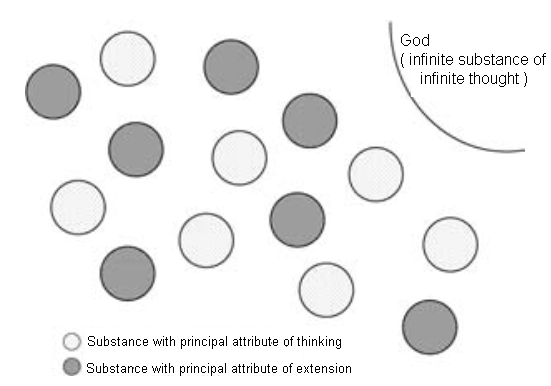
A seventeenth-century Cartesian, then, believed that the world is made up of an enormous number of substances, some of them minds and others bodies, whose existence is made possible by a necessarily existing God. Figure 1 represents this common-sense view of multiple substances with their principal attributes.
Spinoza’s objective in Part I is to convince readers that their common-sense, Aristotelian–Cartesian view of a world of multiple, individual substances is wrong. He does this by letting readers discover that if they start with good definitions of terms like substance, attribute and God, they will not arrive at the conception of reality described by Descartes or Aristotle. They will, instead, work through Spinoza’s propositions and arguments to arrive at the true conception of reality: a single substance equivalent to God.
Definitions
Spinoza begins Part I with definitions. If we are going to make use of terms like substance and attribute in order to understand reality truly, we need to start with a clear understanding of those terms.
……….. ……… ……….
From D1, D3 and D5, we understand what a substance is, in its most basic definition. A substance is, simply, that which is prior to, and independent of, its modes. At its most basic, a substance is pure, indeterminate being. This pure, indeterminate being is and is conceived. The very first principles of reality are that there is being and there is conceiving of being. A substance depends on itself alone for its being, strongly suggesting that it is ‘cause of itself’, the eternal activity of causing its existence. If that suggestion turns out to be right, then being as such is the power of making itself actual.
We now need to look at Spinoza’s definition of attribute in D4. This is a difficult concept to grasp. The definition of attribute as ‘what the intellect perceives of a substance, as constituting its essence’ can be misleading. Spinoza does not mean that each person’s intellect perceives a substance in a different way. Nor does he mean that attributes are subjective illusions or ‘mere appearances’. But he does mean that attributes are the different ways in which a substance can be perceived. The intellect can truly perceive a substance, but not as pure, indeterminate being. The intellect always perceives a substance as one of its attributes. An attribute is the substance itself, as perceived in a certain way.
To clarify this, adopt the position of the seventeenth-century common-sense reader. You believe that the world is full of substances, as defined in D3, and that those substances can be perceived by the intellect. But what we perceive is not substance as such. That is, in our sensory experience and thinking we never perceive pure, bare ‘being’. Rather, we perceive being as one of two kinds: either physical bodies or minds. We perceive substances as extended things and as thinking things. Descartes understands extension and thinking to be fundamental properties of substances. But Spinoza disagrees. For him, extension and thinking are not properties of a substance, but rather two different ‘ways’ that a substance can be perceived. Extension and thinking are two expressions of the essence of substance
(as Spinoza puts it at P10S). Attributes are the ways in which the essence of a substance is expressed and perceived. It is incoherent to think of a substance without an attribute, because the intellect necessarily perceives substance as one or more of its attributes.
Spinoza will demonstrate later in the text that extension and thinking are two of the attributes of substance. At that point it will also become clear why Descartes, along with the common-sense reader, is wrong to think of attributes as properties. Attributes are not properties of a substance and they are not separable from a substance. Attributes constitute what the substance exists as.
These four definitions are what we need most for what is coming next. …….. If you have some sense of what Spinoza means by cause of itself, substance, attributes and modes, you now have the basic building blocks of Spinoza’s ontology.
Axioms
The seven axioms that follow the definitions are Spinoza’s basic logical principles. He takes them to be self-evident, eternal truths.
For example, ‘whatever is, is either in itself or in another’ (A1): anything that has being is either an ontologically independent substance or an ontologically dependent mode. Spinoza thinks that this, and all the other axioms, are basic, uncontroversial statements of logical relation.
Propositions
Each proposition, along with its demonstration, is an argument for a specific point, with the propositions building and combining to form argumentative arcs. (The whole book can be seen as one big arc, encompassing numerous smaller arcs.)
The proof of Spinoza’s Propositions 1-4
PI. Substance is by nature prior to its modifications.
D3: By substance, I mean that which is in itself, and is conceived through itself: in other words, that of which a conception can be formed independently of any other conception.
D5: By mode, I mean the modifications of substance, or that which exists in, and is conceived through, something other than itself.
Spinoza’s Argument: Since the modes depend on substance for their being (D5) and substance depends only on itself (D3), Spinoza argues that Substance must therefore be logically and ontologically prior to its modes (P I).
P2: Two substances, whose attributes are different, have nothing in common.
Proof.—Also evident from D3. For each must exist in itself, and be conceived through itself; in other words, the conception of one does not imply the conception of the other.
D3: By substance, I mean that which is in itself, and is conceived through itself: in other words, that of which a conception can be formed independently of any other conception.
D4: By attribute, I mean that which the intellect perceives as constituting the essence of substance.
Spinoza’s Argument: According to D3, each substance must exist in itself, and be conceived through itself; in other words, the conception of one does not imply the conception of the other.
This tells us that two substances having different attributes have nothing in common with one another (P2).
P3: Things which have nothing in common cannot be one the cause of the other.
A3: From a given definite cause an effect necessarily follows; and, on the other hand, if no definite cause be granted, it is impossible that an effect can follow.
A4: The knowledge of an effect depends on and involves the knowledge of a cause.
According to Prop 2, two substances, whose attributes are different, have nothing in common -- they are two separate beings that are perceived in two separate ways. Each substance exists independently and is conceived independently, so the being of one does not ‘involve’ the being of the other, and the concept of one does not ‘involve’ the concept of the other. They are ontologically and epistemologically distinct. Since their being is not ‘involved’ (i.e. one is not bound up in the other) and their concepts are not involved (the concept of one is not bound up in the concept of the other), these two substances cannot be causally related in the sense described in A3 and A4 as well as in P3.
P4: Two or more distinct things are distinguished one from the other, either by the difference of the attributes of the substances, or by the difference of their modifications.
Proof: Everything which exists, exists either in itself or in something else (A1),—that is (by D3 and D5.), nothing is granted in addition to the understanding, except substance and its modifications. Nothing is, therefore, given besides the understanding, by which several things may be distinguished one from the other, except the substances, or, in other words (see A4) their attributes and modifications. Q.E.D.
A1: Everything which exists, exists either in itself or in something else.
D3: By substance, I mean that which is in itself, and is conceived through itself: in other words, that of which a conception can be formed independently of any other conception.
D4: By attribute, I mean that which the intellect perceives as constituting the essence of substance.
D5: By mode, I mean the modifications of substance, or that which exists in, and is conceived through, something other than itself.
Spinoza’s Argument:
In P4 we learn that there are two ways of distinguishing substances from one another: either they are distinguished by existing as different attributes or they are distinguished by having different affections (modes). This is because reality consists of nothing but substances (as their attributes) and the modes of substances, so there is no other way to distinguish them.
The proof and Significance of Spinoza’s Proposition 5
P5: There cannot exist in the universe two or more substances having the same nature or attribute.
Proof.—If several distinct substances be granted, they must be distinguished one from the other, either by the difference of their attributes, or by the difference of their modifications (P4). If only by the difference of their attributes, it will be granted that there cannot be more than one with an identical attribute. If by the difference of their modifications—as substance is naturally prior to its modifications (P1),—it follows that setting the modifications aside, and considering substance in itself, that is truly, (D3 and D6) there cannot be conceived one substance different from another,—that is (by 4) there cannot be granted several substances, but one substance only. Q.E.D
Up to now, Spinoza’s definitions and propositions have not broken with the Cartesian position. The seventeenth-century commonsense reader can accept Spinoza’s definitions and axioms, and P1–4, without challenging his own world-view. With P5, however, things change, for this is where Spinoza makes his first major break from the common-sense view. He argues that in nature there cannot be two or more substances of the same attribute. This is significant because if Spinoza is right, there cannot be multiple thinking substances (human minds) or multiple extended substances (bodies), as Descartes believed. Because it is so important, we shall look at P5 in some detail.
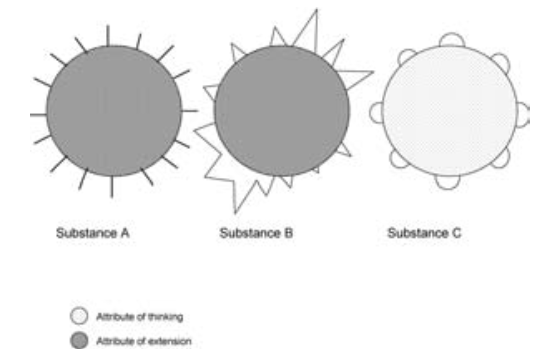
Spinoza’s question in P5 is this: can there be more than one substance of the same attribute? Descartes thought that there could be multiple substances of the same attribute, as we can see in Figure 1. To test Descartes’ position, let us examine three substances, depicted in Figure 2. Substances A and B share the same attribute, but differ in their modes (represented by the differently shaped ‘surface manifestations’ of the substances). Substances B and C have different attributes, and also differ in their modes.
Now, look at the demonstration for P5. If there were two or more distinct substances, they would have to be distinguished from one another either by a difference in their attributes or by a difference in their modes; that was demonstrated in P4. Let’s take each of these options in turn.
First, assume that two substances are distinguished from one another by a difference in their attributes, as substances B and C are in the Figure. In this case, the two substances have different attributes and can be distinguished. But if different attributes are the only way to distinguish substances from one another, then two substances with the same attribute (A and B) cannot be distinguished. They are both pure, indeterminate being, perceived as extension. There is no other way of distinguishing A from B, so they must be the same substance. Therefore, there is only one substance of the same attribute.
Next, consider whether A and B could be distinguished from one another by the difference in their modes. In this case, Spinoza says, we are merely talking about a difference of mode, and not about a difference of substance. The fact that the modes are different does not mean that the substances are distinct. This is because substance is prior to its modes (P1), and substance is understood through itself, not through its modes (D3). In order to compare the substances as such, we must ‘put the modes to one side’ and consider the substances in themselves. When we ignore the surface manifestations and consider the substances in themselves, substances A and B cannot be distinguished from one another, so they must be the same substance. Therefore, there is only one substance of the same attribute.
This is more easily understood if we remember that attributes are what the substance exists as. Two substances sharing the same attribute exist as, and are perceived as, the same thing. The attributes cannot be taken away to reveal two different substances underneath, for a substance without its attributes is just pure, indeterminate being. An attribute is the most basic determination of being. Two substances with the same basic determination cannot be distinguished; therefore they are the same thing. There cannot be multiple substances sharing the same attribute.
Problems with P5
A problem with Spinoza’s demonstration has probably already occurred to you. Spinoza argues that two substances having the same attribute are, in fact, only one substance. But couldn’t there be two substances with the same attribute that are numerically distinct, i.e. standing side by side in space, as A and B are in the figure?
The answer is no, for the simple reason that substances are not in space. For Spinoza, space is not a container for substances, but a mode of substance. If space were a container for substances, its existence would be independent of substances. That would mean space was itself a substance that other substances were dependent on, which would contradict D3. Spinoza understands space to be among the modes that we must ‘put to one side’ in P5. Substances are prior to space and thus cannot be considered as having positions in space. For this reason, there could not be two ‘duplicate’ substances with the same attribute sitting side by side. If you can imagine two substances as having the same attribute, you are really thinking of one substance.
Here is another problem that might have occurred to you. Doesn’t Spinoza jump illegitimately from the conclusion ‘two substances with the same attribute cannot be distinguished from one another’ to the claim that ‘two substances with the same attribute cannot be distinct’?
For Spinoza, these two statements are the same. It is not merely the case that we human beings cannot distinguish one substance from another. It is logically impossible to do so. There simply are no grounds for the distinctness of substances other than their having distinct attributes. If two substances share an attribute, they are not distinct.
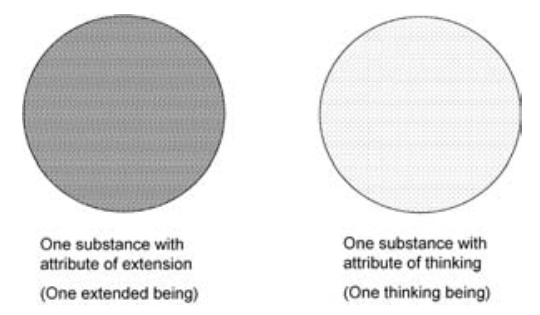
If we accept P5 – and Spinoza thinks we must accept it – then our world-view necessarily changes. No longer do we believe in the world of Figure 1. Our world now looks more like Figure 3.
With P5, Spinoza has shown that there cannot be multiple substances sharing the attribute ‘thinking’ or multiple substances sharing the attribute ‘extension’. Since there cannot be two or more substances of the same attribute, there can be only one thinking substance and one extended substance. That leaves open the possibility that there are multiple substances, since there can be as many substances as there are different attributes. The purpose of the next set of propositions, 6–14, is to show that there is only one substance with all the attributes, and that is God.
The period of the Ethics
Spinoza begins by stating a set of definitions of eight terms: self-caused, finite of its own kind, substance, attribute, mode, God, freedom, and eternity.
These definitions are followed by a series of axioms, one of which supposedly guarantees that the results of Spinoza’s logical demonstrations will be true about reality.
Spinoza quickly establishes that substance must be existent, self-caused, and unlimited.
From this he proves that there cannot be two substances with the same attribute, since each would limit the other. This leads to the monumental conclusion of Proposition 11: “God, or substance consisting of infinite attributes, each of which expresses eternal and infinite essence, necessarily exists.”
From the definition of God as a substance with infinite attributes and other propositions about substance, it follows that “there can be, or be conceived, no other substance but God” (Proposition 14) and that “whatever is, is in God, and nothing can be or be conceived without God". (Proposition 15) This constitutes the core of Spinoza’s pantheism: God is everywhere, and everything that exists is a modification of God.
God is known by human beings through only two of his attributes—thought and extension (the quality of having spatial dimensions)—though the number of God’s attributes is infinite.
Later in Part I, Spinoza established that everything that occurs necessarily follows from the nature of God and that there can be no contingencies in nature.
Part I concludes with an appended polemic about the misreading of the world by religious and superstitious people who think that God can change the course of events and that the course of events sometimes reflects a divine judgment of human behaviour.
Part II explores the two attributes through which human beings understand the world, thought and extension. The latter form of understanding is developed in natural science, the former in logic and psychology. For Spinoza, there is no problem, as there is for Descartes, of explaining the interaction between mind and body. The two are not distinct entities causally interacting with each other but merely different aspects of the same events. Spinoza accepted the mechanistic physics of Descartes as the right way of understanding the world in terms of extension. Individual physical or mental entities are “modes” of substance: physical entities are modes of substance understood in terms of the attribute of extension; mental entities are modes of substance understood in terms of the attribute of thought. Because God is the only substance, all physical and mental entities are modes of God. Whereas the modes are natura naturata (“nature-created”) and transitory, God, or substance, is natura naturans (“nature-creating”) and eternal.
Physical modes that are biological have a feature beyond simple extension, namely, conatus (Latin: “exertion” or “effort”), a desire and drive for self-preservation. Unconsciously, biological modes are also driven by emotions of fear and pleasure to act in certain ways. Human beings, as biological modes, are in a state of bondage as long as they act solely from emotions. In Part V of the Ethics, “Of Human Freedom,” Spinoza explains that freedom is achieved by understanding the power of the emotions over human actions, by rationally accepting things and events over which one has no control, and by increasing one’s knowledge and cultivating one’s intellect. The highest form of knowledge consists of an intellectual intuition of things in their existence as modes and attributes of eternal substance, or God; this is what it means to see the world from the aspect of eternity. This kind of knowledge leads to a deeper understanding of God, who is all things, and ultimately to an intellectual love of God (amor Dei intellectualis), a form of blessedness amounting to a kind of rational-mystical experience.
The Ethics
1. Nature and God
There are three pivotal terms in Spinoza’s system: substance, attribute, and mode.
A mode is any individual thing of event, any particular form or shape, which reality transiently assumes; you, your body, your thoughts, your group, your species, your planet, are modes; all these are forms, modes, almost literally fashions, of some eternal and invariable reality lying behind and beneath them .
What is this underlying reality> Spinoza calls it substance, as literally that which stands beneath. Eight generations have fought voluminous battles over the meaning of this term; ……… One error we should guard against: substance does not mean the constituent material of anything, as when we speak of wood as the substance of a chair. ….. If we go back to the Scholastic philosophers from whom Spinoza took the term, we find that they used it as a translation of the Greek ousia, which is the present participle of einai, to be, and indicates the inner being or essence. Substance then is that which is (Spinoza had not forgotten the impressive “I am who am” of Genesis); that which eternally and unchangeably is, and of which everything else must be a transient form or mode. ………. Spinoza means by substance very nearly what he meant by the eternal order (of laws)…. the very structure of existence, underlying all events and things, and constituting the essence of the world.
But further Spinoza identifies substance with nature and God. After the manner of the Scholastics, he conceives nature under a double aspect: as active and vital process, which Spinoza calls natura naturans and as the passive product of this process, natura naturata - nature begotten, the material and contents of nature. It is in the former sense that he affirms the identity of substance and nature and God. Substance and modes, the eternal order and the temporal order, active nature and passive nature, God and the world, - all these are for Spinoza coincident and synonymous dichotomies; each divides the universe into essence and incident. ….. A passage from Spinoza’s correspondence may help us:
I take a total different view of God and Nature from that which the later Christians usually entertains, for I hold that God is the immanent, and not the extraneous, cause of all things. I say, All is in God; all lives and moves in God. …….. It is however a complete mistake on the part of those who say that my purpose . . . is to show that God and Nature, are one and the same. I had no such intention.
Again, in the Treatise on the Religion and the State, he writes: ”By the help of God I mean the fixed and unchangeable order of nature, or the chain of natural events”, the universal laws of nature and the eternal decrees of God are one and the same thing. “From the infinite nature of God all things . . . follow by the same necessity, and in the same way, as it follows from the nature of a triangle, from eternity to eternity, that its three angles are equal to two right angles.” What the laws of the circle are to all circles, God is to the world. Like substance, God is the causal chain or process, the underlying condition of all things, the law and structure of the world. This concrete universe of modes and things is to God as a bridge is to its design, its structure, and the laws of mathematics and mechanics according to which it is build; these are the sustaining basis, the underlying condition, the substance, of the bridge; without them it would fall. And like the bridge, the world itself is sustained by its structure and its laws; it is upheld in the hand of God. ,br>
The will of God and the laws of nature being one and the same reality diversely phrased, it follows that all events are the mechanical operation of invariable laws, and not the whim of an irresponsible autocrat seated in the stars. The mechanism which Descartes saw in matter and body alone, Spinoza sees in God and mind as well. It is a world of determinism, not of design. Because we act for conscious ends, we suppose that all processes have all events lead up to man and are designed to subserve his needs. But this is an anthropocentric delusion, like so much of our thinking. The root of the greatest errors in philosophy lies in projecting our human purposes, criteria and preferences into the objective universe. Hence our “problem of evil”: we strive to reconcile the ills of life with the goodness of God, forgetting the lesson taught to Job, that God is beyond our little good and evil. Good and bad are relative to human and often individual tastes and ends, and have no validity for a universe in which individuals are ephemera, and in which the Moving Finger writes even the history of the race in water.
Whenever, then, anything in nature seems to us ridiculous, absurd or evil, it is because we have but a partial knowledge of things, and are in the main ignorant of the order and coherence of nature as a whole, and because we want everything to be arranged according to the dictates of our own reason; although in fact, what our reason pronounces bad is not bad as regards the orders and laws of universal nature, but only as regards the laws of our own nature taken separately. . . . As for the terms good and bad, they indicate nothing positive considered in themselves. . . . For one and the same thing can at the same time be good, bad, and indifferent. For example, music is good to the melancholy, bad to mourners, and indifferent to the dead. (Erhics, IV, pref)
2. Matter and Mind
What is mind, and what is matter? Is the mind matter, or is the body merely an idea? Is the mental process the cause, or the effect, of the cerebral process? - or are they unrelated and independent, and only providentially parallel?
Neither is mind material, answers Spinoza, nor is matter mental; neither is the brain-process the cause, nor is it the effect, of thought; nor are the two processes independent and parallel. For there are not two processes, and there are not two entities; there is but one process, seen now inwardly as thought, and now outwardly as motion; there is but one entity, seen now inwardly as mind, now outwardly as matter, but in reality an inextricable mixture and unity of both. Mind and body do not act upon each other, because they are not other, they are one. “The body cannot determine the mind to think; nor the mind determine the body to remain in motion or at rest, or in any other state, for the simple reason that “the decision of the mind, and the desire and determination of the body . . . are one and the same thing.” …… The inwardly and “mental” process corresponds at every stage with the external and “material” process; the order and connection of ideas is the same as the order and connection of things.” Thinking substance and extended substance are one and the same thing, comprehended now through this, now through that, attribute or aspect. ….
God and the Attributes
Part 1 of the Ethics lays out Spinoza's radical view of God. God is said to be a substance (defined as "that which is in itself and is conceived through itself"), with absolutely infinitely many attributes. In Descartes' Principles, he ascribed each substance a 'primary attribute,' of which all its other properties are modifications (for instance, a piece of wax has extension as its primary attribute, of which its particular lumpy shape is a modification). Spinoza follows Descartes in holding that extension and thought are attribute, but holds that these are merely the only attributes of which we have any idea.
For Spinoza, God's having absolutely infinitely many attributes entails that God must have every possible attribute. Moreover, Spinoza holds that two substances cannot share attributes, and this entails that God must be the only substance. Given that the only things that exist are substance, attributes, and modifications of the attributes (modes), it must be the case that all particular entities (such as minds and bodies) are merely modifications of God. Descartes had held that particular things depend God for their continued existence (cf. Meditation 3), but had nonetheless held that they were substances in their own right. Spinoza saw such dependence as precluding genuine substancehood.
The different attributes, for Spinoza, are conceived independently of each other, though they are all in God. From these attributes, certain 'infinite modes' follow (that is, follow both logically and ontologically). These infinite modes are, in effect, the natural laws that govern the finite modes (i.e. particular entities) within each attribute. The laws can be said to follow from God's essence, and are absolutely inviolable. Finite modes are determined in their existence by the laws and by preceding finite modes. In other words, Spinoza held a strict form of determinism; given the laws and some state of finite modes at a particular time, the rest of history was determined and inevitable. Without flinching, Spinoza then claimed that everything that happens is necessary, and that any claim that something merely could have happened is based in ignorance of the causes and laws.
According to Spinoza, then, God and Nature are the same fundamental entity. This is captured in his phrase Deus sive Natura - "God or nature," which was removed from the Dutch translation of the Ethics for fear of its being interpreted as atheistic. Even with such a deletion, however, the text is clear that Spinoza denied the conception of God present in nearly all monotheistic religions. God does not act for reasons, and is not concerned with human well-being.
The Mind and Body
The second part of the Ethics moves from general claims concerning God to the specific case of human beings, entities involving modes of only two attributes. Every human mind and body are modes of the attributes of thought and extension, respectively. Spinoza is quite clear that the modes of the two attributes are causally and logically distinct; modes of thought stand in causal relations only to God and to other modes of thought, whereas modes of extension correspondingly stand in causal relations only to God and to other modes of extension. In other words, Spinoza denies that the mind and the body causally interact. Descartes, by contrast, had insisted that such interaction did take place, though this became one of his most controversial doctrines.
For Spinoza, even though the mind and body are causally distinct, they stand in a two-fold intimate relation. For one, the mind itself is nothing other than an idea of the body. For another, the 'order and connection' of the modes of thought is 'parallel' to that of the modes of extension. In other words, for every mode and causal relation between modes that holds in one attribute, there is a corresponding mode and causal relation between modes in the other attribute. As changes occur in my body, then, parallel changes occur in the idea of my body, that is, in my mind. When the body is destroyed, then, the mind is destroyed as well.
This doctrine of 'parallelism' (a term used by all commentators, though not by Spinoza himself), and the identification of the human mind with the idea of the human body, has a surprising consequence. Rocks, trees, and corpuscles are all modes of extension, and so must have corresponding ideas. This in turn means that such entities, in some sense, have minds. Since the extended bodies of such entities are far less complex than our bodies, their minds will correspondingly be much less complex. This view (a form of panpsychism) is tied up with Spinoza's repeated insistence that humans are a part of nature. For the difference between humans and rocks is merely a matter of degree of complexity, not a difference in kind.
The Emotions
One of the central ideas of the Ethics is that each thing strives to preserve its own existence. This striving is expressed in the Latin word conatus. Spinoza's theory of emotion is based on the idea that emotions are changes in our power of persevering. The three basic emotions, then, are desire (the awareness of our striving), joy (the increase of our power) and sadness (the decrease of our power).
On this basis, Spinoza goes on to catalog many other emotions. Love is joy accompanied by an idea of the cause of that joy, while hate is sadness accompanied by an idea of the cause of that sadness. Part 3 of the Ethics is primarily concerned with such cataloging.
While being a rationalist and having certain Stoic tendencies, Spinoza did not believe that reason is capable of gaining control over the emotions—humans are part of nature, and will therefore be affected by other parts of nature. Such affection will involve changes in our power of persevering, which is simply what the basic emotions amount to. Nevertheless, Spinoza does think that we can attain a certain, weaker control in virtue of other emotions, and that our greatest good lies in reason.