Image source: Multiple sources

Image source: commons.wikimedia.org

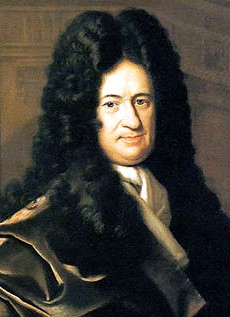
Gottfried Leibniz
Gottfried Wilhelm (von) Leibniz (1646 – 1716) was a German polymath and philosopher who occupies a prominent place in the history of mathematics and the history of philosophy, having developed differential and integral calculus independently of Isaac Newton.Leibniz's notation has been widely used ever since it was published. It was only in the 20th century that his Law of Continuity and Transcendental Law of Homogeneity found mathematical implementation (by means of non-standard analysis). He became one of the most prolific inventors in the field of mechanical calculators. While working on adding automatic multiplication and division to Pascal's calculator, he was the first to describe a pinwheel calculator in 1685 and invented the Leibniz wheel, used in the arithmometer, the first mass-produced mechanical calculator. He also refined the binary number system, which is the foundation of virtually all digital computers.
In philosophy, Leibniz is most noted for his optimism, i.e. his conclusion that our Universe is, in a restricted sense, the best possible one that God could have created, an idea that was often lampooned by others such as Voltaire. Leibniz, along with René Descartes and Baruch Spinoza, was one of the three great 17th-century advocates of rationalism. The work of Leibniz anticipated modern logic and analytic philosophy, but his philosophy also looks back to the scholastic tradition, in which conclusions are produced by applying reason to first principles or prior definitions rather than to empirical evidence.
Leibniz made major contributions to physics and technology, and anticipated notions that surfaced much later in philosophy, probability theory, biology, medicine, geology, psychology, linguistics, and computer science. He wrote works on philosophy, politics, law, ethics, theology, history, and philology. Leibniz also contributed to the field of library science. While serving as overseer of the Wolfenbüttel library in Germany, he devised a cataloging system that would serve as a guide for many of Europe's largest libraries. Leibniz's contributions to this vast array of subjects were scattered in various learned journals, in tens of thousands of letters, and in unpublished manuscripts. He wrote in several languages, but primarily in Latin, French, and German. There is no complete gathering of the writings of Leibniz translated into English.
(Wikipedia)
Monadology
Monads are the elements of all things; they are simple substance, created all at once out of nothing; they can neither be altered in quality nor changed internally by any other created thing.
No two monads are perfectly alike; for every individual monad there is some internal difference which accounts for its particular nature.
Perception and apperception are the two chief types of activities by which monads exhibit their natures.
Men are distinguished from the animals by their knowledge of necessary and eternal truths; man reasons according to the principles of contradiction and sufficient reason.
Only through God’s mediation is interaction or knowledge of any sort possible; although the monads are isolated, they function and perceive according to God’s pre-established harmony.
This is the best of all possible worlds, for God’s goodness made him choose it from the infinite number of possible universes.
(Page 601)
Theodicy
The truths of philosophy and theology cannot contradict each other.
If God is all-good, all-wise, and all-powerful, how did evil come into the world?
The answer is that some error is unavoidable in any creative less perfect than its creator; furthermore, all possible worlds contain some evil, and evil improves the good by contrast.
Since man has free will, he is responsible for his acts; God’s foreknowledge of the course of man’s inclination did not involve predestination.
The soul is coordinated with the body by a preestablished harmony.
(Page 454)
New Essay On The Human Understanding
Locke was mistaken in thinking that at birth the mind is like a black tablet.
Certain ideas are innate, but they rise to consciousness only when the mind is provoked by experience.
Sense perception is active, not passive.
Locke’s conception of simple ideas ignores such physical phenomena as the color spectrum and light waves; and his distinction between primary and secondary qualities is not necessary since it is possible to qualify perceptual generalizations carefully enough to allow for individual differences.
Locke’s suggestion that substance might be nothing but a collection of properties cannot be tolerated, for reason has difficulty in accepting the idea of properties which are not the properties of anything.
External spatial and temporal relations cannot guarantee identity; it is by the internal modifications of substance than an individual acquires its identity.
An exact analysis of the signification of words would show us the workings of the understanding.
(Page 518)
Space and Time
Leibniz claimed that the universe is made up of an infinitude of monads, which are simple, immaterial (spiritual) substances. Every monad is endowed with some degree of consciousness. He conceived of space as a set of relations which the monads have to one another; it is the order of coexistent things. He thought of time as the relations of the successive states of consciousness of a single monad. Physical bodies, on this theory, are groups of monads. Mathematically considered, every monad is a dimensionless point. Length, breadth, and position can be represented as relations of monads. Space, then, is a continuous, three-dimensional system of mathematical points corresponding to the order of a plenum of distinct monads. Time has but one dimension; succession and coexistence are the only temporal relations, corresponding, as they do, to the order of perceptions in the consciousness of a monad. For Leibniz, then, space and time were relations among things (monades) which would have no existence whatever if there were no monads.
The nature of space and time was what interested the young Kant most in these disputes between Leibniz and Newton. He studied the famous exchange of letters between Leibniz and Samuel Clarke, a defender of Newton’s philosophy.
Leibniz claimed that the universe is made up of an infinitude of monads, which are simple, immaterial (spiritual) substances. Every monad is endowed with some degree of consciousness. He conceived of space as a set of relations which the monads have to one another; it is the order of coexistent things. He thought of time as the relations of the successive states of consciousness of a single monad. Physical bodies, on this theory, are groups of monads. Mathematically considered, every monad is a dimensionless point. Length, breadth, and position can be represented as relations of monads. Space, then, is a continuous, three-dimensional system of mathematical points corresponding to the order of a plenum of distinct monads. Time has but one dimension; succession and coexistence are the only temporal relations, corresponding, as they do, to the order of perceptions in the consciousness of a monad. For Leibniz, then, space and time were relations among things (monades) which would have no existence whatever if there were no monads.
By contrast, Newton held that space and time are infinite and independent of the physical bodies that exist in space and time. For him space and time were things, and they would exist even if there were no bodies. He held that are absolute positions in space and time that are independent of the material entities occupying them and, furthermore, that empty space (void) and empty time are possible. Leibniz denied both tenets. Neither Leibniz nor Clarke was able fully to undermine the position of the other, and the result was an impasse.
Kant’s views on space and time, in his Dissertation entitled On the Form and Principles of the Sensible and Intelligible World (1770), had developed to a point that was very close to the views enunciated in the Critique of Pure Reason (1781). Space and time are the schemata and conditions of all human knowledge based on sensible intuition. Our concepts of space and time are acquired from the action of the mind in coordinating its sensa according to unchanging laws. The sensa are produced in the mind by the presence of some physical object or objects. Space and time are now based epistemologically on the nature of the mind rather than ontologically on the nature of things, either as a relation among monads (Leibniz) or as a thing (Newton’s absolute space). Kant had turned from modes of being to ways of knowing. This new epistemological view of space and time provided him with a way of reconciling the opposed views of Leibiz and Newton. Space and time are indeed the relational orders of contemporaneous objects and successive states, inasmuch as space and time are the conditions of intuitive representations of objects, rather than being mere relations of independent substances (monads). Space and time are indeed absolute wholes in which physical objects are located, inasmuch as they are forms of sensible intuition lying ready in the mind, rather than being independently existing containers for physical objects.
Kant’s in the Critique differ from those of the Dissertation in that space and time are held in the former to be passive forms of intuition by means of which a manifold of sensa are presented to the understanding, which has the active function of synthesizing this manifold. Space is the form of all appearances of the external senses, just as time is the form of all appearances of the internal sense. As such, space and time are nothing but properties of the human mind. Everything in our knowledge that belongs to spatial intuition (extension), change according to which change of location is determined. The representations of the external senses are set in time, which contains nothing but relations of succession, coexistence, and duration.
The monads
Leibniz's best known contribution to metaphysics is his theory of monads, as exposited in Monadologie. According to Leibniz, monads are elementary particles with blurred perceptions of one another. Monads can also be compared to the corpuscles of the Mechanical Philosophy of René Descartes and others. Monads are the ultimate elements of the universe. The monads are "substantial forms of being" with the following properties: they are eternal, indecomposable, individual, subject to their own laws, un-interacting, and each reflecting the entire universe in a pre-established harmony (a historically important example of panpsychism). Monads are centers of force; substance is force, while space, matter, and motion are merely phenomenal.
The ontological essence of a monad is its irreducible simplicity. Unlike atoms, monads possess no material or spatial character. They also differ from atoms by their complete mutual independence, so that interactions among monads are only apparent. Instead, by virtue of the principle of pre-established harmony, each monad follows a preprogrammed set of "instructions" peculiar to itself, so that a monad "knows" what to do at each moment. By virtue of these intrinsic instructions, each monad is like a little mirror of the universe. Monads need not be "small"; e.g., each human being constitutes a monad, in which case free will is problematic.
Monads are purported to have gotten rid of the problematic:
*interaction between mind and matter arising in the system of Descartes;
*lack of individuation inherent to the system of Spinoza, which represents individual creatures as merely accidental.
Theodicy and optimism
The Theodicy tries to justify the apparent imperfections of the world by claiming that it is optimal among all possible worlds. It must be the best possible and most balanced world, because it was created by an all powerful and all knowing God, who would not choose to create an imperfect world if a better world could be known to him or possible to exist. In effect, apparent flaws that can be identified in this world must exist in every possible world, because otherwise God would have chosen to create the world that excluded those flaws.
Leibniz asserted that the truths of theology (religion) and philosophy cannot contradict each other, since reason and faith are both "gifts of God" so that their conflict would imply God contending against himself. The Theodicy is Leibniz's attempt to reconcile his personal philosophical system with his interpretation of the tenets of Christianity. This project was motivated in part by Leibniz's belief, shared by many conservative philosophers and theologians during the Enlightenment, in the rational and enlightened nature of the Christian religion as compared to its purportedly less advanced non-Western counterparts. It was also shaped by Leibniz's belief in the perfectibility of human nature (if humanity relied on correct philosophy and religion as a guide), and by his belief that metaphysical necessity must have a rational or logical foundation, even if this metaphysical causality seemed inexplicable in terms of physical necessity (the natural laws identified by science).
Because reason and faith must be entirely reconciled, any tenet of faith which could not be defended by reason must be rejected. Leibniz then approached one of the central criticisms of Christian theism: if God is all good, all wise and all powerful, how did evil come into the world? The answer (according to Leibniz) is that, while God is indeed unlimited in wisdom and power, his human creations, as creations, are limited both in their wisdom and in their will (power to act). This predisposes humans to false beliefs, wrong decisions and ineffective actions in the exercise of their free will. God does not arbitrarily inflict pain and suffering on humans; rather he permits both moral evil (sin) and physical evil (pain and suffering) as the necessary consequences of metaphysical evil (imperfection), as a means by which humans can identify and correct their erroneous decisions, and as a contrast to true good.
Further, although human actions flow from prior causes that ultimately arise in God, and therefore are known as a metaphysical certainty to God, an individual's free will is exercised within natural laws, where choices are merely contingently necessary, to be decided in the event by a "wonderful spontaneity" that provides individuals an escape from rigorous predestination.
Discourse on Metaphysics
For Leibniz, "God is an absolutely perfect being." He describes this perfection later in section VI as the simplest form of something with the most substantial outcome (VI). Along these lines, he declares that every type of perfection "pertains to him (God) in the highest degree" (I). Even though his types of perfections are not specifically drawn out, Leibniz highlights the one thing that, to him, does certify imperfections and proves that God is perfect: "that one acts imperfectly if he acts with less perfection than he is capable of", and since God is a perfect being, he cannot act imperfectly (III). Because God cannot act imperfectly, the decisions he makes pertaining to the world must be perfect. Leibniz also comforts readers, stating that because he has done everything to the most perfect degree; those who love him cannot be injured. However, to love God is a subject of difficulty as Leibniz believes that we are "not disposed to wish for that which God desires" because we have the ability to alter our disposition (IV). In accordance with this, many act as rebels, but Leibniz says that the only way we can truly love God is by being content "with all that comes to us according to his will" (IV).
Because God is "an absolutely perfect being" (I), Leibniz argues that God would be acting imperfectly if he acted with any less perfection than what he is able of (III). His syllogism then ends with the statement that God has made the world perfectly in all ways. This also effects how we should view God and his will. Leibniz states that, in lieu of God’s will, we have to understand that God "is the best of all masters" and he will know when his good succeeds, so we, therefore, must act in conformity to his good will – or as much of it as we understand (IV). In our view of God, Leibniz declares that we cannot admire the work solely because of the maker, lest we mar the glory and love God in doing so. Instead, we must admire the maker for the work he has done (II). Effectively, Leibniz states that if we say the earth is good because of the will of God, and not good according to some standards of goodness, then how can we praise God for what he has done if contrary actions are also praiseworthy by this definition (II). Leibniz then asserts that different principles and geometry cannot simply be from the will of God, but must follow from his understanding.
Some Fundamental Principles of Leibniz's Philosophy
Leibniz asserts in the Monadology §§31–32, “Our reasonings are based on two great principles, that of contradiction … [and] that of sufficient reason.” (G II 612/AG 217) To these two great principles could be added four more: the Principle of the Best, the Predicate-in-Notion Principle, the Principle of the Identity of Indiscernibles, and the Principle of Continuity.
The relation among these principles is more complicated than one might expect. Leibniz sometimes suggests that the Principle of the Best and the Predicate-in-Notion Principle can be said to ground his “two great principles”; at other times, however, all four principles seem to work together in a system of circular implication.
And while the Principle of the Identity of Indiscernibles is often presented in contemporary discussions in analytic metaphysics as a stand-alone axiom, Leibniz tells us that it follows from the two great principles. Finally, the Principle or Law of Continuity is actually a principle that Leibniz takes from his work in mathematics and applies to the infinite hierarchy of monads in the world and to the quality of their perceptions; it appears to derive only tenuous support from the Principle of Sufficient Reason.
Key Principles
Several key principles form the core of Leibniz’s philosophy. Though Leibniz never lists these serially in the manner of, for instance, the axioms of Spinoza’s Ethics, the principles nonetheless shape Leibniz’s thinking and ground his major claims. He refers to them throughout his writings. ……
In the Monadology, Leibniz writes that we reason “based on two great principles” (M 30). The first of these is the principle of contradiction, which deems every contradiction to be false. Classically stated, the principle of contradiction holds that something cannot be both “x” and “not x” at the same time and in the same respect. ……
The second great principle of reason is the principle of sufficient reason, “by virtue of which we consider that we can find no true or existent fact, no true assertion, without there being a sufficient reason why it is thus and not otherwise, although most of these reasons cannot be known to us” (M 31). The classical statement of the principle of sufficient reason is nihil sine ratione: there is nothing without reason or cause. Leibniz holds that every state of affairs has an explanation, even if we must admit that we often do not have sufficient information to provide an explanation. The principle of sufficient reason assumes great prominence in Leibniz’s philosophy, most notably in his accounts of substance, causality, freedom, and optimism.
Closely related to the principle of sufficient reason is the principle of the best. This principle holds that rational beings always choose, and act for, the best. In this way, reason is teleologically ordered towards goodness. On Leibniz’s thinking, if reason did not opt for what is best, it would act arbitrarily; it would not have a sufficient reason for choosing one option over another, thus violating reason’s second great principle. Goodness provides the sufficient reason for rational choice. The principle of the best manifests itself differently in the cases of God and created minds. God, whom Leibniz considers “an absolutely perfect being” (DM 1), and who thus knows what is best, always acts in the best way. Created minds, who have a finite degree of perfection and thus limited knowledge of what is best, always act according to what seems the best from their limited perspectives.
The predicate-in-notion principle provides Leibniz’s notion of truth: praedicatum inest subjecto. In any true, affirmative proposition the predicate is contained in the subject. In order for the proposition, “Leibniz is a mathematician,” to be true, the idea “mathematician” must somehow be included in the idea “Leibniz.” Leibniz’s interpretation of the predicate-in-notion principle has far-reaching consequences for his metaphysics.
Somewhat relatedly, Leibniz affirms the principle of the identity of indiscernibles, which states that any two objects sharing all properties are in fact the same, identical object. Each individual object contains some individuating characteristic. Important for Leibniz, this individuating characteristic must be something intrinsic to the individual, and not simply a separation in space and time, which Leibniz considers purely extrinsic denominations.
The principle of the identity of indiscernibles is tied closely to the predicate-in-notion principle insofar as the latter makes intrinsic properties the basis of all truth and the former makes such properties the basis for identity and individuation.
A final key principle worth noting is the principle of continuity. “Nothing takes place suddenly, and it is one of my great principles that nature never makes leaps,” Leibniz writes in the New Essays. “I call this the Law of continuity” (NE 56). All change is continuous; there is never a leap, but rather a series of intervening stages. This principle is especially germane to Leibniz’s development of the infinitesimal calculus, but relevant too to his metaphysics and epistemology.
Posthumous reputation
Posthumous reputation
When Leibniz died, his reputation was in decline. He was remembered for only one book, the Théodicée, whose supposed central argument Voltaire lampooned in his popular book Candide, which concludes with the character Candide saying, "Non liquet" (it is not clear), a term that was applied during the Roman Republic to a legal verdict of "not proven". Voltaire's depiction of Leibniz's ideas was so influential that many believed it to be an accurate description. Thus Voltaire and his Candide bear some of the blame for the lingering failure to appreciate and understand Leibniz's ideas. Leibniz had an ardent disciple, Christian Wolff, whose dogmatic and facile outlook did Leibniz's reputation much harm. He also influenced David Hume who read his Théodicée and used some of his ideas. In any event, philosophical fashion was moving away from the rationalism and system building of the 17th century, of which Leibniz had been such an ardent proponent. His work on law, diplomacy, and history was seen as of ephemeral interest. The vastness and richness of his correspondence went unrecognized.
Much of Europe came to doubt that Leibniz had discovered calculus independently of Newton, and hence his whole work in mathematics and physics was neglected. Voltaire, an admirer of Newton, also wrote Candide at least in part to discredit Leibniz's claim to having discovered calculus and Leibniz's charge that Newton's theory of universal gravitation was incorrect.
Leibniz's long march to his present glory began with the 1765 publication of the Nouveaux Essais, which Kant read closely. In 1768, Louis Dutens edited the first multi-volume edition of Leibniz's writings, followed in the 19th century by a number of editions, including those edited by Erdmann, Foucher de Careil, Gerhardt, Gerland, Klopp, and Mollat. Publication of Leibniz's correspondence with notables such as Antoine Arnauld, Samuel Clarke, Sophia of Hanover, and her daughter Sophia Charlotte of Hanover, began.
In 1900, Bertrand Russell published a critical study of Leibniz's metaphysics. Shortly thereafter, Louis Couturat published an important study of Leibniz, and edited a volume of Leibniz's heretofore unpublished writings, mainly on logic. They made Leibniz somewhat respectable among 20th-century analytical and linguistic philosophers in the English-speaking world (Leibniz had already been of great influence to many Germans such as Bernhard Riemann). For example, Leibniz's phrase salva veritate, meaning interchangeability without loss of or compromising the truth, recurs in Willard Quine's writings. Nevertheless, the secondary literature on Leibniz did not really blossom until after World War II. This is especially true of English speaking countries; in Gregory Brown's bibliography fewer than 30 of the English language entries were published before 1946. American Leibniz studies owe much to Leroy Loemker (1904–1985) through his translations and his interpretive essays in LeClerc (1973).
Nicholas Jolley has surmised that Leibniz's reputation as a philosopher is now perhaps higher than at any time since he was alive. Analytic and contemporary philosophy continue to invoke his notions of identity, individuation, and possible worlds. Work in the history of 17th- and 18th-century ideas has revealed more clearly the 17th-century "Intellectual Revolution" that preceded the better-known Industrial and commercial revolutions of the 18th and 19th centuries.
In 1985, the German government created the Leibniz Prize, offering an annual award of 1.55 million euros for experimental results and 770,000 euros for theoretical ones. It was the worlds largest prize for scientific achievement prior to the Fundamental Physics Prize.
The collection of manuscript papers of Leibniz at the Gottfried Wilhelm Leibniz Bibliothek – Niedersächische Landesbibliothek were inscribed on UNESCO's Memory of the World Register in 2007.