Qur'an (Qur'an or Koran)
The Quran (English pronunciation: /kɔrˈɑːn/[n 1] kor-AHN; Arabic: القرآن al-qur'ān, IPA: [qurˈʔaːn], literally meaning "the recitation"; also romanised Qur'an or Koran) is the central religious text of Islam, which Muslims believe to be a revelation from God (Arabic: الله, Allah). Its scriptural status among a world-spanning religious community, and its major place within world literature generally, has led to a great deal of secondary literature on the Quran. Quranic chapters are called suras and verses are called ayahs.
Muslims believe the Quran was verbally revealed by God to Muhammad through the angel Gabriel (Jibril), gradually over a period of approximately 23 years, beginning on 22 December 609 CE, when Muhammad was 40, and concluding in 632 CE, the year of his death. Muslims regard the Quran as the most important miracle of Muhammad, a proof of his prophethood, and the culmination of a series of divine messages that started with the messages revealed to Adam and ended with Muhammad. They consider the Quran to be the only revealed book that has been protected by God from distortion or corruption.
According to the traditional narrative, several companions of Muhammad served as scribes and were responsible for writing down the revelations. Shortly after Muhammad's death, the Quran was compiled by his companions who wrote down and memorized parts of it. These codices had differences that motivated the Caliph Uthman to establish a standard version now known as Uthman's codex, which is generally considered the archetype of the Quran we have today. However, the existence of variant readings, with mostly minor and some significant variations, and the early unvocalized Arabic script mean the relationship between Uthman's codex to both the text of today's Quran and to the revelations of Muhammad's time is still unclear.
The Quran assumes familiarity with major narratives recounted in the Jewish and Christian scriptures. It summarizes some, dwells at length on others and, in some cases, presents alternative accounts and interpretations of events. The Quran describes itself as a book of guidance. It sometimes offers detailed accounts of specific historical events, and it often emphasizes the moral significance of an event over its narrative sequence. The Quran is used along with the hadith to interpret sharia law. During prayers, the Quran is recited only in Arabic. (Wikipedia)
The Quran also inspired Islamic arts and specifically the so-called Quranic arts of calligraphy and illumination. The Quran is never decorated with figurative images, but many Qurans have been highly decorated with decorative patterns in the margins of the page, or between the lines or at the start of suras. Islamic verses appear in many other media, on buildings and on objects of all sizes, such as mosque lamps, metal work, pottery and single pages of calligraphy for muraqqas or albums. (Wikipedia)
Cave of Hira, location of Muhammad's first revelation.
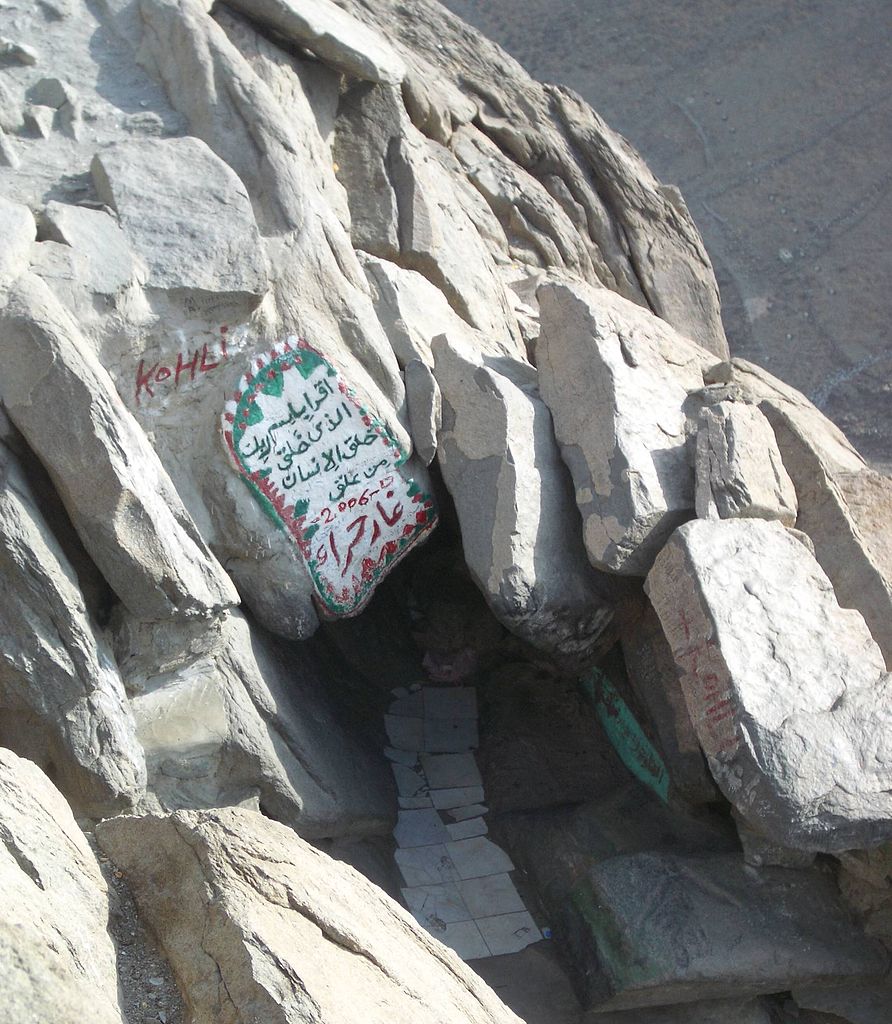
Cave of Hira, location of Muhammad's first revelation.
Image source: commons.wikimedia.org
Part of Al-Alaq - 96th sura of the Quran
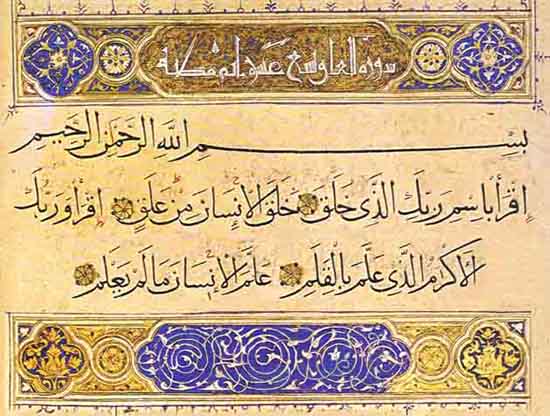
Part of Al-Alaq - 96th sura of the Quran - the first revelation received by Muhammad.
The first four verses (ayat) of Al-Alaq, the 96th chapter (surah) of the Qur'an. Egyptian Calligraphy of the first lines of Sura al-Alaq.
Image source: commons.wikimedia.org
Magnificent Koran written in gold
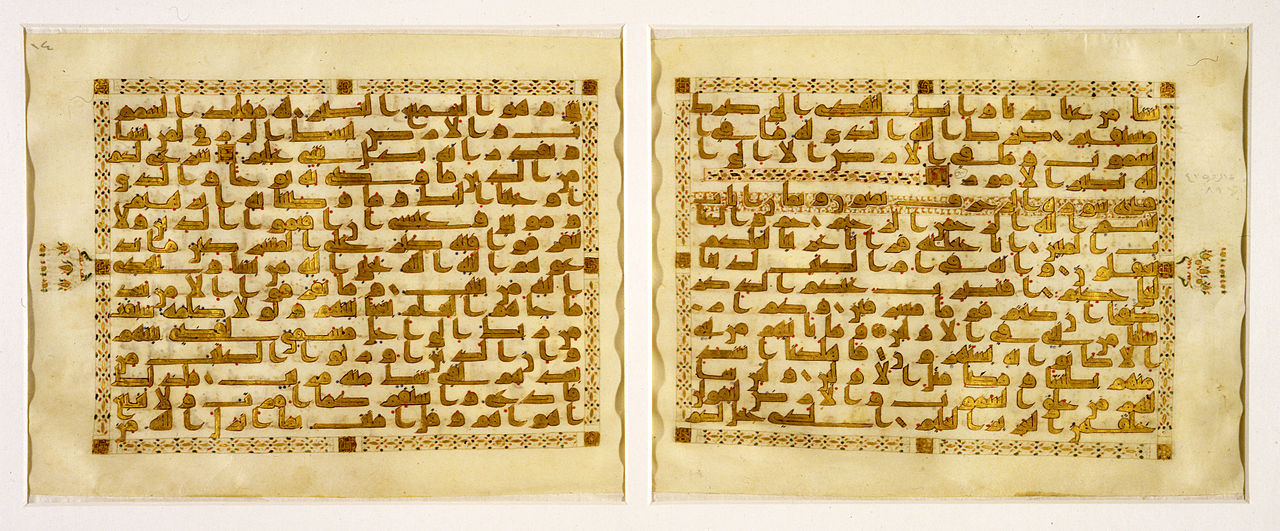
The leaves from this magnificent Koran written in gold and contoured with brown ink have a horizontal format.
This is admirably suited to classical Kufi calligraphy, which became common under the early Abbasid caliphs.
Image source: commons.wikimedia.org
11th Century North African Qur’an in the British Museum

11th Century North African Qur’an in the British Museum
Image source: commons.wikimedia.org
Surat al-Fatiha inscribed upon the shoulder blade of a camel
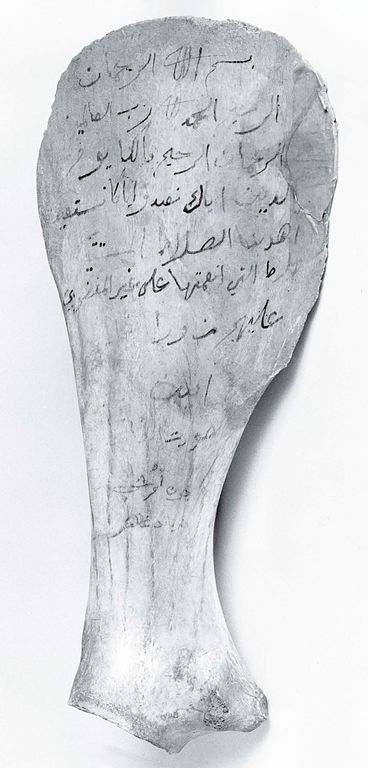
Surat al-Fatiha inscribed upon the shoulder blade of a camel
The writing in this image is incorrect, contain errors in the verses of Sura Sūrat al-Fātiḥa.
الكتابة في هذه الصورة غير صحيحة تحتوي على أخطاء في بعض أيات السورة
Image source: commons.wikimedia.org
Islamic Writing above the door outside the mosque in Tunisia
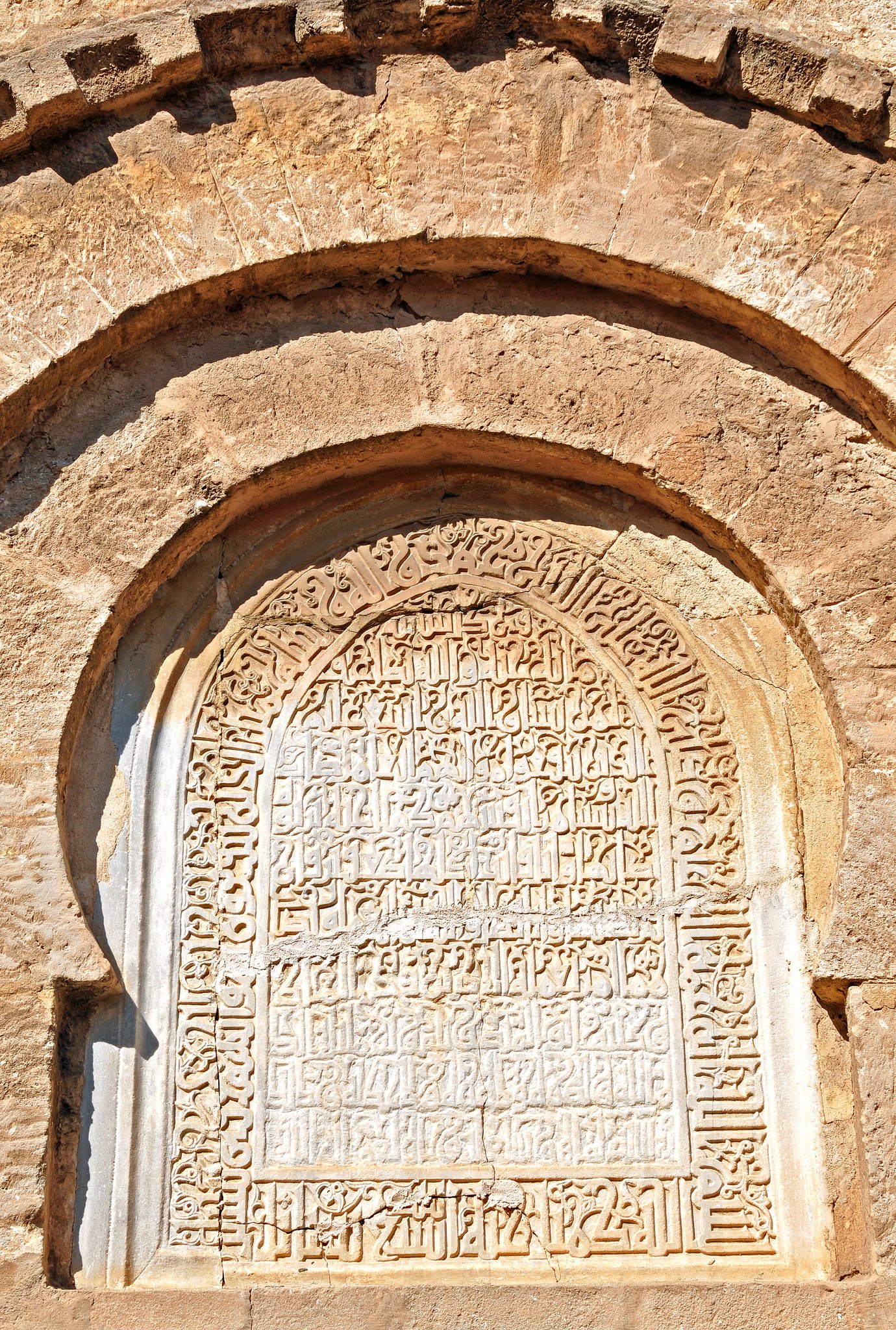
Islamic Writing above the door outside the mosque in Tunisia
Image source: www.flickr.com
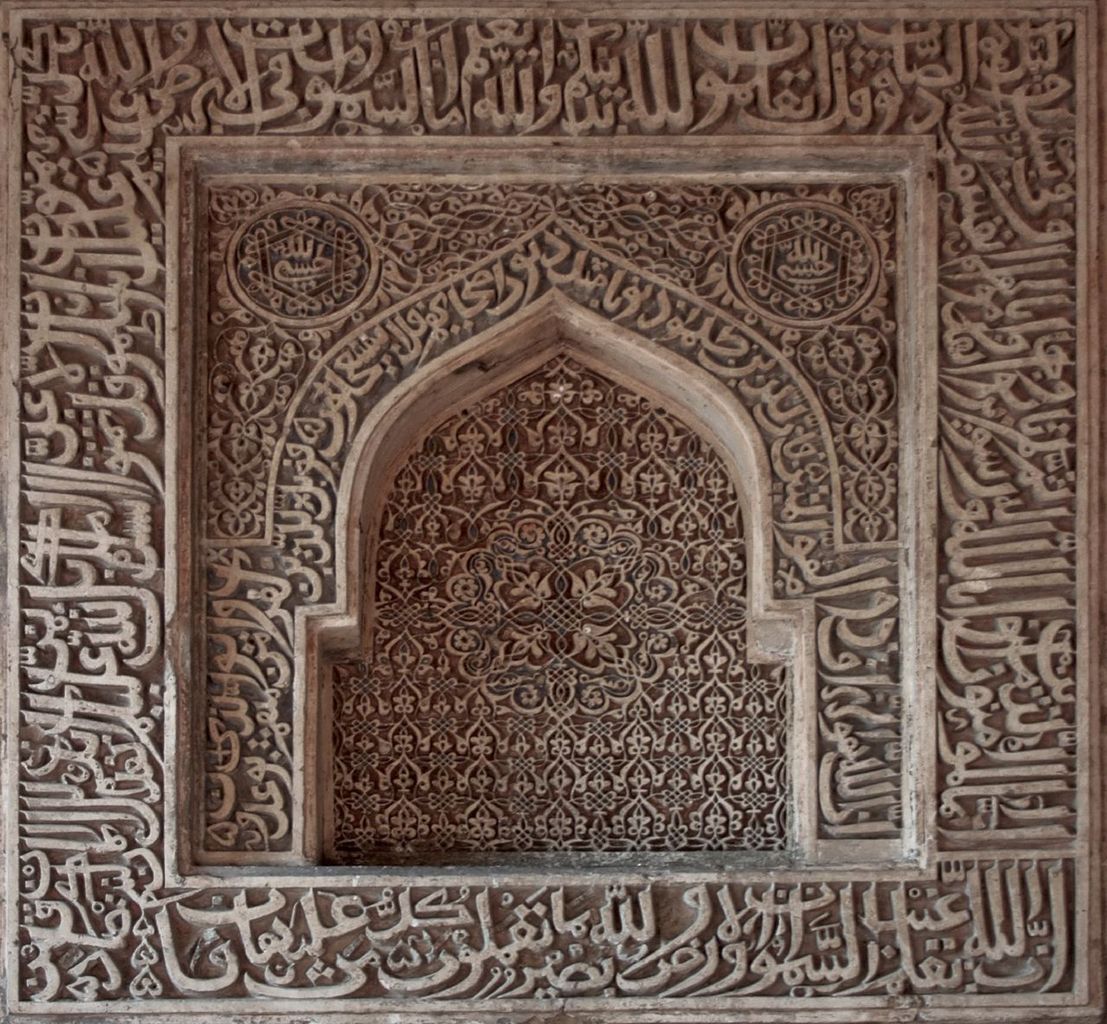
Quran inscriptions on wall, Lodhi Gardens, Delhi
Image source: commons.wikimedia.org
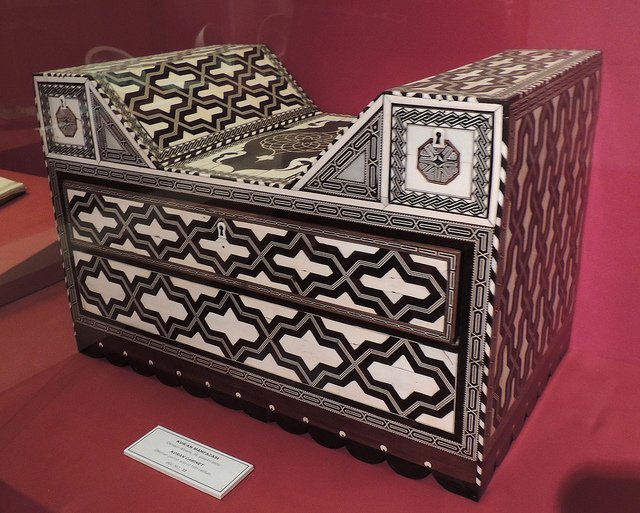



Koran case at Museum of Turkish and Islamic Arts

Koran case at Museum of Turkish and Islamic Arts
Image source: www.flickr.com
www.mygola.com Turkish and Islamic Arts Museum
Illuminated Manuscript Koran, Walters Art Museum in Baltimore, Maryland
An engrossed or illuminated manuscript is a manuscript in which the text is supplemented by the addition of decoration, such as decorated initials, borders (marginalia) and miniature illustrations. In the strictest definition of the term, an illuminated manuscript refers only to manuscripts decorated with gold or silver, but in both common usage and modern scholarship, the term is now used to refer to any decorated or illustrated manuscript from the Western traditions. Comparable Far Eastern works are always described as painted, as are Mesoamerican works. Islamic manuscripts may be referred to as illuminated, illustrated or painted, though using essentially the same techniques as Western works.


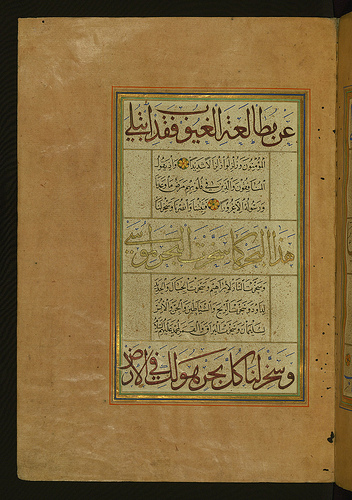
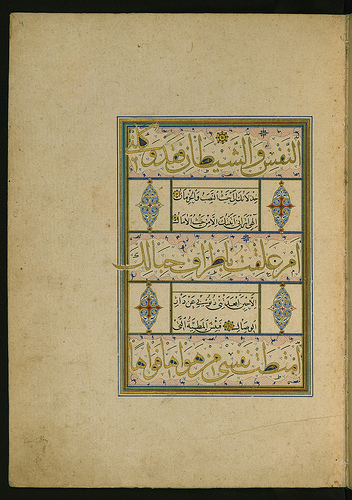
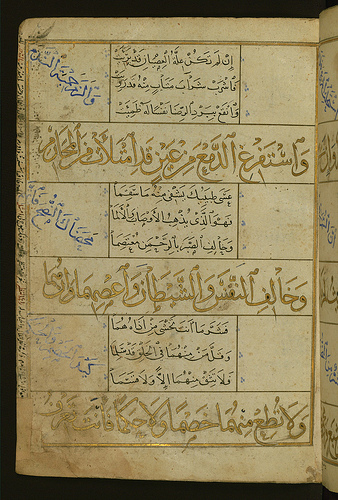
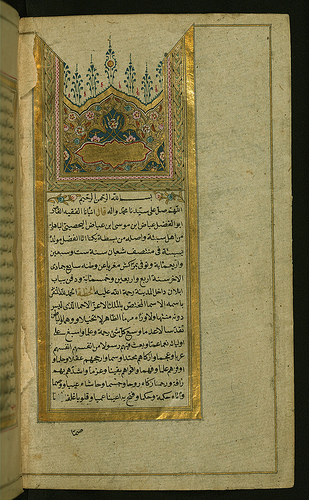
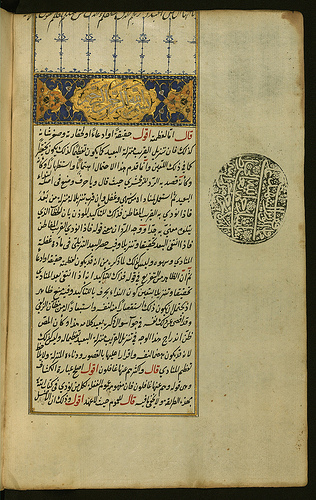
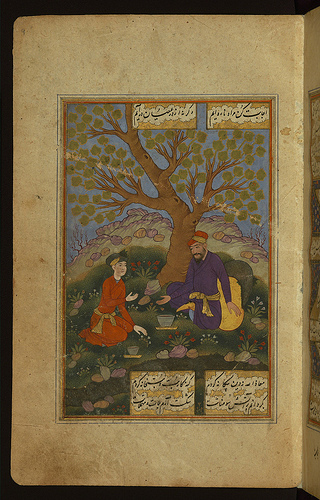
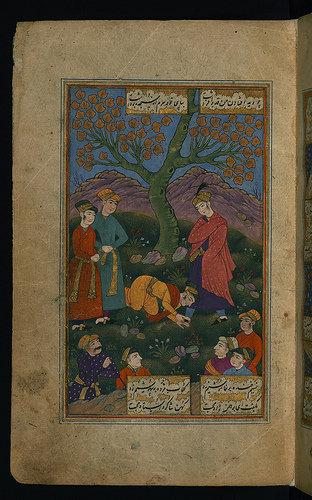
Image source: www.flickr.com→
www.flickr.com
Video source: Illuminated Manuscripts -- Digitizing at The Walters Art Museum www.neh.gov→
www.youtube.com